

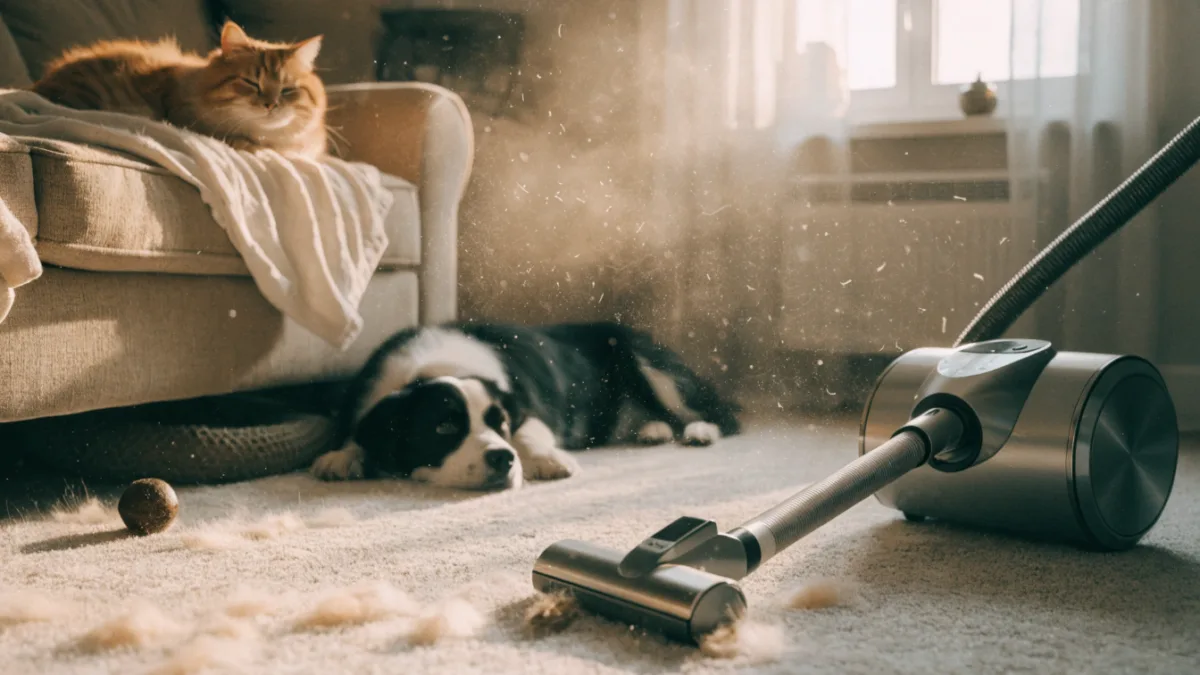
I used to think adopting a second cat would just mean twice the purring and maybe a few extra treats on the grocery list. What I actually got was a geometric explosion of fur that defies the laws of physics. My tuxedo cat, Barnaby, leaves distinct, highly visible white tufts on every piece of dark clothing I own. But it’s my orange tabby, Pickle, who contributes the invisible, microscopic flakes of skin that turn a casual vacuum session into a full-blown respiratory event.
If you share your home with multiple animals, you already know that managing the hair situation is practically a part-time job. But chasing visible fur is only half the battle. To truly conquer the chaos of a multi-pet household, you need to understand the invisible ecosystem you’re living in—and why your run-of-the-mill vacuum cleaner is hopelessly out of its depth.
It’s Not Just the Fur: The Science of Pet Dander
When we complain about pet hair, we’re usually talking about the macroscopic stuff: the tumbleweeds of dog undercoat rolling across the hardwood, the woven-in cat hair on your favorite armchair, the mysterious clumps clinging to your baseboards. But the real challenge of multi-pet living is what you can’t see.
Enter pet dander. Dander consists of microscopic, even microscopic flecks of skin shed by cats, dogs, and other furry animals. These tiny particles are incredibly lightweight, meaning they float in the air for hours before settling on your furniture, carpets, and lungs. Dander also carries saliva proteins—which is the actual culprit behind most pet allergies.
A standard vacuum might suck up the visible hair, but if it isn’t properly sealed, it acts like a leaf blower, taking all that microscopic dander and blasting it right back into your living room.
This is exactly why a True HEPA (High-Efficiency Particulate Air) filter is non-negotiable for multi-pet homes. To meet the HEPA standard, a filter must trap 99.97% of airborne particles as small as 0.3 microns. For context, a micron is one-millionth of a meter. Pet dander typically ranges from 2.5 to 10 microns, but it can break down into even smaller fragments. A true HEPA filter acts as an impenetrable wall for these allergens, ensuring that the air exhausted by your vacuum is actually cleaner than the air you breathe.
The Great Vacuum Debates (And My Unapologetic Opinions)
When you start shopping for a high-end pet vacuum, you’ll quickly run into a few fierce consumer debates. Having lived through more vacuum mishaps than I care to admit, I have strong feelings about all of them.
Bagged vs. Bagless
Bagless vacuums are wildly popular. They feel futuristic, they don’t require you to buy replacement bags, and let’s be honest, there is a deeply satisfying, slightly grotesque thrill in seeing exactly how much fur you just pulled from your rug. (If you’ve ever dumped a canister the size of a small guinea pig onto the grass, you know what I mean).
However, if anyone in your home has even a hint of a pet allergy, I strongly advocate for bagged vacuums. Emptying a bagless canister is a messy, dusty affair. No matter how careful you are, a plume of fine dander will escape back into the air. Bagged models completely enclose the debris. You just seal the bag, toss it, and you never have to make contact with the very things you just vacuumed up. Many allergy specialists favor models with completely sealed, hospital-grade bagging systems for exactly this reason.
Cordless Convenience vs. Corded Power
I love the idea of a cordless stick vacuum. The freedom! The lack of tripping over cables while navigating a cat tree! But the reality of a multi-pet home is that sheer volume of hair requires sustained, heavy-duty suction. Cordless vacuums are fantastic for quick daily sweeps of hard floors, but they tend to lose suction as the battery drains, and they frequently die mid-clean in homes with three or more shedding animals.
My stance? You likely need both. A corded vacuum for the deep, heavy-duty carpet extraction, and a cordless stick for the daily kitchen touch-ups. Just remember that a stick vacuum is a supplement, not a replacement for the heavy machinery.
The Robot Vacuum Illusion
Robot vacuums are marketed as the ultimate set-it-and-forget-it solution. They are brilliant for daily maintenance, especially if you have hard floors and a pet that sheds continuously. Running a robot daily keeps the fur bunnies from staging a hostile takeover. But they overpromise when it comes to deep cleaning. Most robot vacuums struggle to pull embedded cat hair out of plush carpets, and their small dustbins require constant emptying in a multi-pet home. If you get a robot, opt for one with a self-emptying base station—otherwise, you’ll be intervening every single day anyway.
Must-Have Features for the Fur-Apocalypse
Aside from that crucial HEPA filter, the modern appliance market has evolved to tackle the specific nightmare of multi-pet shedding. When you’re comparing models, look for these absolute game-changers:
- Anti-Tangle Brush Rolls: If you have long-haired pets, you know the horror of stopping mid-vacuum to get scissors and cut a solid cylinder of hair off the brush roll. This is why anti-tangle technology is a must. These brush rolls use specially engineered bristles and comb-like structures that slice or unwrap hair before it can bind to the mechanism. It will genuinely change your cleaning routine.
- Advanced Sealed Systems: A HEPA filter is completely useless if the vacuum’s casing has gaps in it. Unsealed vacuums leak dirty air before it ever reaches the filter. Look for vacuums specifically advertised as having a “100% Sealed System.” This means the entire body of the machine is engineered so that no dirty air can leak back into the house before passing through the filtration.
- Smart Particle Detection: Some of the newest, high-tech models use lasers to illuminate microscopic dust and pet hair on your floor. The vacuum’s sensors then detect higher concentrations of pet dander and automatically increase the suction power. It feels a little like magic, but it’s just brilliant engineering that ensures you don’t miss hidden spots.
- Specialized Attachments: You need a motorized upholstery tool. A standard lint roller is useless against fabric couches that have been napped on by three different dogs. Motorized upholstery tools have mini brush rolls that pull embedded hair out of fabrics and mattresses. A rigid crevice tool is also essential for excavating the dense fur-bunnies that gather along baseboards.
Matching the Machine to Your Home
There is no single perfect vacuum for every household. You have to look at your specific living space. (For some incredible, rigorous testing on different models, I highly recommend checking out the deep dives by [1] and [2]).
If your home is mostly wall-to-wall plush carpet, you need an upright or a heavy-duty canister vacuum. They provide the deep, aggressive agitation required to pull pet hair out of thick fibers. If you live in a multi-story home with mostly hard floors and stairs, a lightweight stick vacuum is going to be your best friend. And if you have a mix of both, a convertible model that allows you to lift the motorized canister off the base is incredibly versatile.
The Conscious Consumer Takeaway
Before you click “buy” on the most expensive model you can find, take a moment to think about sustainability. Electronic waste is a massive global problem, and cheap vacuum cleaners are a prime contributor to our overflowing landfills.
When you invest in a vacuum, look for models that prioritize longevity. Seek out brands that offer easily replaceable HEPA filters and, if you go cordless, replaceable batteries. There is a growing movement among appliance manufacturers to lean into sustainability—some even use recycled plastics in their construction or actively support animal welfare foundations with their proceeds.
Ultimately, buying the right vacuum isn’t just about making your house look presentable for unexpected guests. It’s about creating a genuinely healthy environment for both you and your animals. It’s about recognizing that our pets are family, and their dander doesn’t have to dictate our air quality. So do your research, invest in a machine that handles the invisible allergens, and maybe—just maybe—you’ll be able to wear a black shirt in your own home again.
Sources
- The Spruce — thespruce.com
- RTings — rtings.com