

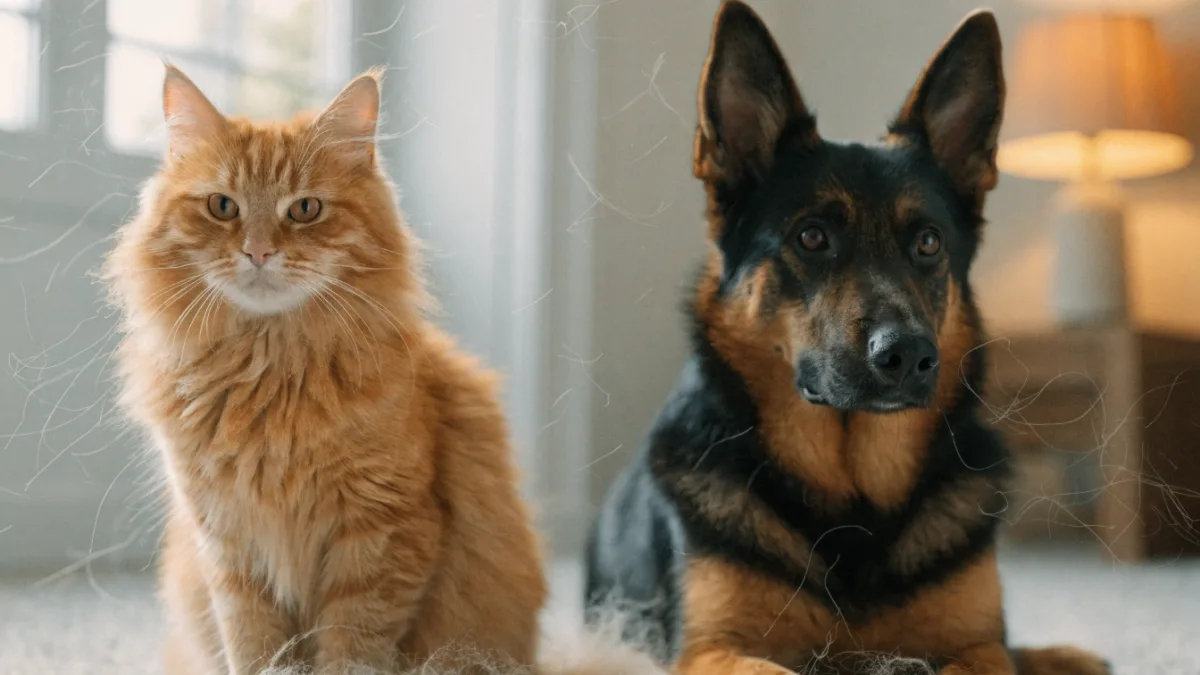
If you share your home with a dog or a cat, you also share your home with their discarded hair. It is on your clothes, woven into your couch cushions, and drifting across your hardwood floors like tiny, microscopic tumbleweeds. We spend billions of dollars a year on lint rollers, specialized vacuums, and air purifiers trying to combat it. But to understand how to manage the fur storm, you first have to understand the biology behind it. Dogs and cats approach coat replacement entirely differently, and recognizing the rhythm of their shedding is the key to keeping your house—and your sanity—intact.
The Sun Dictates the Shed
The biggest misconception about pet shedding is that it is triggered by a spike in outdoor temperature. People assume their dog drops its winter coat because the April weather suddenly feels like July. The actual trigger is photoperiodism—the amount of daylight hitting the animal’s retinas. As the days lengthen in the spring and shorten in the fall, the change in light stimulates the animal’s endocrine system, which signals the hair follicles to let go of old hair and start growing new hair.
This biological alarm clock worked flawlessly for thousands of years. Wolves and wildcats needed to adapt to harsh, shifting climates to survive. The problem is that modern pets live indoors with us. We keep our thermostats set to a comfortable 72 degrees year-round and turn on the LED lights the minute the sun goes down. This artificial environment completely scrambles their ancient biological software. Because indoor pets are exposed to consistent artificial daylight and climate control, their bodies forget what season it actually is. This disruption is exactly why so many modern pets seem to shed in a constant, low-grade drift rather than in distinct, predictable seasons.
The Big Dog Blow versus the Feline Slow-Drip
At a fundamental biological level, dogs and cats process hair replacement differently. Most dogs—specifically double-coated breeds—operate on a seasonal schedule. Cats operate on a continuous assembly line.
The Canine Coat Blow
Double-coated dogs, like Siberian Huskies, Golden Retrievers, and German Shepherds, possess a harsh, weather-resistant outer coat (guard hairs) and a dense, insulating undercoat. Twice a year, usually in spring and fall, these dogs “blow” their coats. When they blow the coat, the undercoat sheds out in massive, clumping tufts. I once groomed a friend’s Husky in late April, and the volume of pale gray undercoat that came out with an undercoat rake was dense enough to knit a sweater. In the spring, they drop the winter insulation. In the fall, they shed their lighter summer coat to make room for the thick winter undercoat growing in.
The Constant Feline Cycle
Cats, on the other hand, follow a continuous hair replacement cycle. Instead of massive, bi-annual purges, cats shed a steady stream of dead hair every single day of the year. They might have slight increases in shedding during the spring and fall, but the volume remains relatively consistent. This is why a short-haired cat can leave just as much fur on a black sofa over twelve months as a long-haired dog. Long-haired cats simply have longer fur strands, which makes the shedding far more visible and much harder to extract from carpet fibers, even if the actual volume of hair lost isn’t drastically higher than that of a short-haired cat.
Genetics Write the Rules
While photoperiodism dictates the schedule, genetics dictate the volume. A dog’s breed is the single greatest predictor of how much fur you will be cleaning up.
- Double-coated dogs: These are the heavyweights. Akitas, Bernese Mountain Dogs, Newfoundlands, and Pomeranians will flood your house with fur twice a year. You cannot prevent it; you can only intercept it.
- Single-coated dogs: Breeds like Poodles, Bichon Frises, and Portuguese Water Dogs have hair that continuously grows rather than falling out in a seasonal purge. They shed very little. I’ve changed my thinking on these breeds over the years—they aren’t maintenance-free, because that continuously growing hair requires rigorous, expensive professional grooming to prevent severe matting, but they absolutely solve the problem of airborne dog fur.
- Cats: Genetics still matter here, but in a different way. Short-haired cats have a faster hair growth cycle, meaning they turn over hair quickly. Long-haired cats, like Maine Coons or Persians, have a slower growth cycle, but the sheer length of the shed hair makes it incredibly invasive in a home environment.
Put the Clippers Down
Every summer, a dangerous myth circulates online: owners should shave their heavy-coated dogs or cats to keep them cool and stop the shedding. [1] That thick undercoat doesn’t just trap heat in the winter; it acts as thermal insulation against the scorching summer sun, protecting the dog’s skin from UV radiation and heat exhaustion.
Shaving a double coat does not stop the shedding cycle. The dog will still shed—it will just shed tiny, sharp, splinter-like hairs instead of soft clumps. Worse, shaving a double coat can permanently damage the hair follicles, leading to a condition called post-clipping alopecia, where the coat grows back patchy, brittle, and loses its natural weatherproofing ability.
While we are dismantling myths, let’s address the word “hypoallergenic.” There is no such thing as a truly hypoallergenic dog or cat. Pet allergies are triggered by proteins found in the animal’s dander (dead skin cells), saliva, and urine—not the hair itself. When a dog licks its paw and sheds hair around your house, they are depositing dried saliva and dander along with it. Low-shedding breeds simply distribute less dander into your environment, which makes them easier to tolerate for some allergy sufferers, but they are not a cure.
Winning the War on Fur
Managing pet hair feels like a losing battle because, biologically, it is. You are trying to out-clean a biological machine designed to reproduce hair endlessly. But you can manage it effectively if you attack the problem from three fronts: grooming, nutrition, and housekeeping.
Intercept the Hair
Regular brushing is your first and best line of defense. [2] For double-coated dogs, a high-quality undercoat rake is non-negotiable during the spring and fall blows. For cats, a deshedding tool will pull the loose hair from the undercoat without cutting the topcoat. The pet care industry has recently exploded with high-tech options, including specialized pet vacuums with grooming attachments that suck the loose hair straight off the animal. If your dog or cat tolerates the noise, these tools are absolute game-changers for volume control.
Feed the Coat
You can actually reduce excessive, unnatural shedding through diet. Hair is made almost entirely of protein, and a poor diet results in brittle, weak hair that breaks and falls out constantly. A high-quality, meat-rich diet supplemented with Omega-3 and Omega-6 fatty acids dramatically improves skin elasticity and follicle health. We are seeing a massive surge in vet-formulated dermatological supplements, including liquid salmon oils and biotin additives, because owners are realizing that coat health starts in the food bowl.
Upgrade Your Housekeeping
Accept that some fur will hit the floor. [3] with motorized brush rolls, and run a HEPA-certified air purifier in the rooms your pets frequent most. Air purifiers pull airborne dander and tiny hair particles out of the air, which protects your indoor air quality and keeps your tables noticeably less dusty. Wash your pet’s bedding weekly; letting them sleep on a blanket that is already saturated in old hair just accelerates the spread of fur around your house.
When Shedding Becomes a Warning Sign
Not all shedding is normal. If you are brushing your dog daily and they still look like they are balding, something is wrong. The presence of bald patches, red or inflamed skin, continuous scratching, or dull, brittle hair means the shedding is no longer a natural biological process. These symptoms point to medical issues that require a veterinarian’s attention.
Fleas, environmental allergies, and food intolerances cause severe itching, which leads to hair breaking off at the root. Mites and fungal infections like ringworm cause localized, rapid hair loss. Hormonal imbalances, such as an underactive thyroid (hypothyroidism) or an overproduction of cortisol (Cushing’s disease), can cause bilaterally symmetrical hair loss on a dog’s trunk. If the hair is falling out in sheets, or if the skin underneath looks angry and raw, stop buying deshedding tools and get the animal to a clinic.
Shedding is the price of admission for living with animals. Dogs and cats evolved complex, brilliant biological systems to survive the elements, and those systems don’t just switch off because we moved them into our climate-controlled living rooms. The fur storm is inevitable, but understanding the mechanics behind it—knowing when to brush, what to feed, and when to call the vet—transforms the process from a frustrating chore into a manageable part of the daily routine.
Sources
- Veterinarians and professional groomers strongly advise against shaving double-coated animals. — quora.com
- Consistent grooming pulls the dead hair out before it has a chance to fall onto your floor. — fourpawsusa.org
- Invest in a vacuum designed specifically for pet hair — facebook.com