

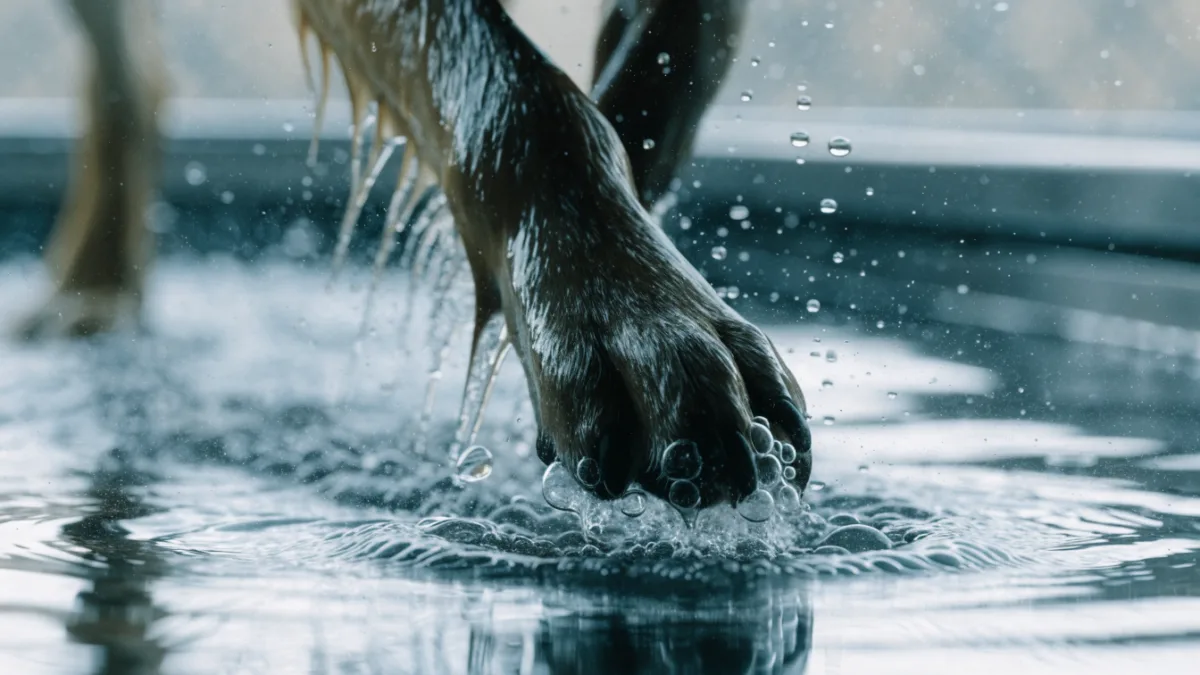
When Barnaby, an eight-year-old Labrador Retriever, tore his cranial cruciate ligament (the canine equivalent of a human ACL tear), his owner, Mark, was devastated. Surgery repaired the joint, but Barnaby was still holding up his back leg weeks later, hesitant to trust his own body. That is when we introduced them to dog hydrotherapy. Watching Barnaby paddle his legs in a warm-water treadmill, his eyes bright and his tail wagging, Mark turned to me and said, “I feel like I have my dog back.” Hydrotherapy is no longer just a trendy spa treatment for elite canine athletes. Today, it is a cornerstone of modern pet rehabilitation, changing the way we help our dogs and cats recover from orthopedic surgeries and manage chronic pain.
The Science of the Splash: Why Water Heals
Water provides a unique therapeutic environment that we simply cannot replicate on land. When a pet steps into an underwater treadmill or a specialized therapy pool, three distinct physical properties go to work on their body.
The first is buoyancy. When a pet is submerged in water, the upward thrust of the water counteracts the downward pull of gravity. This significantly reduces the weight-bearing load on their joints. If the water is at chest height, a dog is only bearing about 30 to 40 percent of its actual body weight. This allows them to move without experiencing the sharp pain of full impact.
The second is hydrostatic pressure. Water exerts a gentle, constant pressure from all directions. If you have ever worn a compression sock, you know how this feels. For a dog or cat recovering from surgery, this natural pressure acts like a full-body compression garment, helping to reduce swelling (edema) in the limbs and stimulate blood circulation. Better blood flow means more oxygen and nutrients are delivered to healing tissues.
Finally, there is resistance. Water is much denser than air. Every step a pet takes in the water requires more effort than a step on dry land, meaning they build muscle strength safely without having to run or jump. The warm water—usually kept between 82 and 90 degrees Fahrenheit (28 to 32 degrees Celsius)—also helps relax tight muscles and increases joint flexibility.
Dog Hydrotherapy: Getting Back on Their Paws
For dogs, underwater treadmills and pools have rapidly become a standard of care for post-operative recovery. We frequently use dog hydrotherapy for pets recovering from orthopedic surgeries, such as fracture repairs, spinal surgeries, or joint corrections.
Take my patient, Daisy, a six-year-old Golden Retriever dealing with severe hip dysplasia—a condition where the hip joint does not fit together perfectly, leading to arthritis. On land, Daisy was stiff and hesitant to go for walks. But in the underwater treadmill, she could stride comfortably. The water supported her hind end, allowing her to build the gluteal and hamstring muscles she needed to stabilize her hips on dry land. Beyond the physical healing, the psychological perk is immense. Owners frequently notice a positive, energetic difference in their dogs immediately following sessions. Moving without pain boosts a dog’s confidence and allows them to act like their younger selves.
Feline Physical Therapy: Debunking the “Cats Hate Water” Myth
I will be the first to admit it: early in my career, I was highly skeptical about putting cats in water. I changed my mind on this completely when the research and clinical data started showing undeniable benefits. The primary debate surrounding this topic is whether it is humane or practical to put cats in water. While dogs often take to it naturally, cats require an entirely different, highly specialized approach.
Feline physical therapy involving water is highly effective for aiding in healthy weight loss, providing significant pain relief, and improving overall mobility. However, it should never be forced. Cats are not small dogs, and throwing a feline into a hydrotherapy pool is a recipe for stress and injury.
Success with cats relies entirely on what animal behaviorists call “behavioral habituation.” This is a patient, gradual process designed to minimize stress and help the cat acclimate to the water comfortably. A certified rehabilitation therapist will start simply by letting the cat explore the empty treadmill, offering high-value treats. Over several sessions, a tiny amount of water is introduced. We use platforms so the cat can choose to walk in the water or rest above it. When done correctly, cats like Luna, an eleven-year-old domestic shorthair I treated for severe osteoarthritis, actually learn to enjoy the warm water. Luna’s owner was shocked to see her voluntarily step into the treadmill for her therapy, finding relief from the chronic joint stiffness that was slowing her down.
Bringing the Benefits Home
While professional pet rehabilitation centers are incredible, you can absolutely continue the benefits of hydrotherapy at home under veterinary guidance. If your pet is recovering from surgery or managing a chronic condition, here are a few ways to support them:
- Warm towel wraps: You can mimic the vasodilation (widening of blood vessels) caused by warm water by soaking a towel in warm water, wringing it out completely, and draping it gently over your pet’s affected joint for 10 minutes. Always test the temperature on your own wrist first.
- Gentle home swimming: If you have a calm, dog-friendly pool or access to a quiet, still body of water (and your dog is a confident swimmer), short, 5-minute swims can be a great way to maintain muscle tone. Always use a canine life jacket, even for strong swimmers, and never force a dog into the water.
- Assisted range of motion: While not water-based, performing slow, gentle stretching of your pet’s limbs while they are relaxed on a soft bed mimics the joint mobilization they receive in the clinic. Always have your vet or rehab specialist demonstrate the proper technique first to avoid injuring surgical sites.
Knowing When to Seek a Professional
If your pet is dealing with orthopedic post-op recovery, osteoarthritis, obesity, or general chronic joint pain, ask your primary vet for a referral to a certified canine or feline rehabilitation practitioner. They will assess your pet’s gait, muscle mass, and pain levels to design a specific protocol—whether that means utilizing specialized pools or underwater treadmills.
Ultimately, veterinary medicine is shifting toward a more holistic, integrative approach. We do not just want our pets to survive their surgeries or age gracefully; we want them to thrive. Incorporating therapies like hydrotherapy allows owners to take an active role in their pet’s long-term mobility and pain management. Every pet deserves to move through their world with comfort and joy, and sometimes, all it takes is a little water to help them make that splash.