

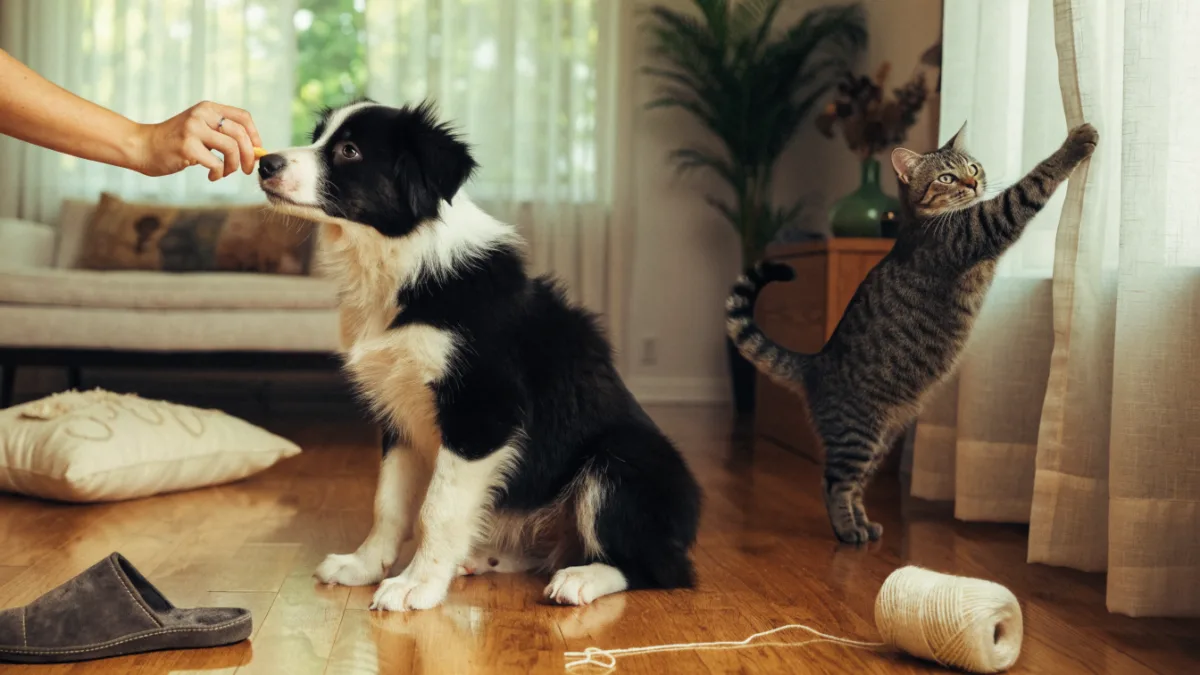
Your sweet, responsive puppy who used to come flying back to you at the dog park suddenly looks at you, considers the recall cue, and takes off after a squirrel instead. Or maybe your cuddly kitten who slept in your lap for hours is now scaling your curtains at 3 AM and treating your ankles like prey. Congratulations — you’ve hit the teenage phase. It’s the stretch of adolescence that catches almost every pet owner off guard, and it’s the number one reason animals get surrendered to shelters. But here’s the truth: your pet isn’t broken, and you aren’t failing. Their brain is literally under construction.
What’s Actually Happening in That Teenage Brain
Adolescence in pets isn’t a behavioral choice — it’s biology. During this phase, which typically hits dogs between six and eighteen months and cats between six months and two years, your pet’s brain is actively rewiring itself. Hormones like testosterone and estrogen are flooding their system at levels they’ve never experienced before. According to,[1] these hormonal shifts have a direct impact on attention span, impulse control, and emotional regulation.
Recent studies in canine cognition have actually mapped the teenage dog brain, and the findings are validating for anyone who’s been pulling their hair out. Dogs going through puberty temporarily become less responsive to their owners’ cues and more drawn to environmental rewards. That squirrel? It’s biologically more interesting to your adolescent dog than you are right now. It’s not personal. It’s neuroscience.
The “Stubborn” Myth Needs to Die
I used to think adolescent dogs were being stubborn. I’d label them as defiant or dominant when they ignored a cue they’d known for months. I was wrong, and honestly, that mindset made me a worse trainer. When we frame teenage behavior as stubbornness, we start responding with frustration instead of strategy. We assume the dog is making a conscious choice to blow us off when really, their brain is so flooded with hormones and novel stimuli that the cue we gave them barely registers.
The same goes for cats. Your eight-month-old kitten isn’t scratching your sofa to assert control over the household. They’re driven by developmental impulses — territorial marking, predatory play, and an urgent need to burn energy. Labeling either species as “rebellious” misses the point entirely and sets up an adversarial dynamic that helps no one.
Dogs vs. Cats: Two Different Flavors of Chaos
While the underlying biology is similar, how adolescence actually looks day-to-day is pretty different between dogs and cats. Understanding those differences matters because the management strategies that work for one won’t necessarily work for the other.
What Teenage Dogs Look Like
The classic canine teenager is a regression machine. A puppy who had a rock-solid sit at four months might act like they’ve never heard the word at seven months. Recall falls apart. Leash manners evaporate. I had a client with a Golden Retriever mix named Bess who went from acing her basic obedience class at five months to blowing off every single cue by eight months. Her owner was ready to throw in the towel, convinced Bess had forgotten everything. She hadn’t forgotten — her brain just temporarily deprioritized human feedback in favor of exploring the world. We adjusted the training plan, added more reinforcement, and three months later Bess was checking in voluntarily at the park again.
,[2] that this regression is documented and normal. Progress during adolescence is rarely linear. You’ll have great weeks followed by terrible ones, and that zigzag pattern is exactly what you should expect.
What Teenage Cats Look Like
Adolescent cats express their developmental chaos differently. According to [3] cats between six months and two years often show increased predatory play, more frequent “zoomies,” heightened territorial scratching, and sometimes aggression during play that wasn’t there before. A kitten who used to play gently might start grabbing your hand hard enough to draw blood — not because they’ve turned mean, but because their predatory motor patterns are maturing and they need appropriate outlets.
The key difference is that dogs tend to test social boundaries with humans, while cats tend to express teenage energy through activity and environmental interaction. Your job as the human is the same either way: provide appropriate outlets and don’t take it personally.
Survival Strategies That Actually Work
Management Over Willpower
Here’s the single most useful concept I can give you for surviving this phase: management beats training every time. Management means controlling the environment so your pet can’t practice the behavior you don’t want. If your teenage dog destroys shoes, the answer isn’t to lecture them about shoes — it’s to put the shoes away. If your adolescent cat counter-surfs, the answer is a motion-activated deterrent or keeping them out of the kitchen until the phase passes. You aren’t avoiding the problem. You’re preventing bad habits from rehearsing themselves into permanence while your pet’s brain matures.
Pet-proofing isn’t just for puppies and kittens. Re-evaluate your setup during adolescence. Check your fencing. Secure your trash. Provide appropriate scratching surfaces before your cat finds the couch. The fewer opportunities your pet has to rehearse unwanted behavior, the faster you’ll get through this phase.
Channel the Energy Somewhere Useful
Tired teenagers are well-behaved teenagers — but I’m not just talking about physical exhaustion. Mental enrichment is the secret weapon most people completely overlook. For dogs, scent puzzles, snuffle mats, and structured search games tire the brain in ways that a simple walk around the block can’t. I started incorporating nosework games with my adolescent clients a few years back, and the difference in their dogs’ behavior was striking. Ten minutes of hiding treats around a room would settle a frantic teenage Shepherd more than a thirty-minute jog.
For cats, think about predatory outlets. Food puzzles, wand-toy sessions that mimic prey sequences, and vertical spaces for climbing all give that teenage energy somewhere productive to go. A cat who’s spent twenty minutes “hunting” a feather wand is a cat who’s going to sleep instead of scale your curtains.
Don’t make the mistake of reducing enrichment just because your pet is being difficult. That’s when they need it most.
Routines and Proofing Are Your Best Friends
Adolescent pets thrive on predictability. Keep meal times consistent. Keep training sessions short — three to five minutes is plenty for a dog whose attention span has temporarily collapsed. Keep enforcing the same household rules you’ve always had, because if the rules get blurry during adolescence, you’re going to pay for it later. Consistency doesn’t mean rigidity or harshness. It means the boundaries stay clear even when your patience is thin.
What to Avoid When You’re Frustrated
This is where I need to be direct. Punishing normal adolescent behavior is one of the worst things you can do, and I say that as someone who used to train more traditionally before I knew better. When you punish a teenage dog for not coming when called, you aren’t teaching them that recall is important. You’re teaching them that coming to you predicts something unpleasant, which makes the next recall even harder.
The dominance theory stuff — the idea that your pet is trying to assert alpha status over you — has been thoroughly debunked by modern behavioral science. Your adolescent animal isn’t plotting a household coup. They’re a teenager with a developing brain, and they need guidance, not a power struggle.
Avoid the quick-fix tools, too. Shock collars and prong collars are marketed as solutions for “stubborn” dogs, but the growing consensus in veterinary behavior is that these tools can cause lasting psychological harm, especially during the sensitive adolescent developmental window. There’s a reason the force-free movement is gaining so much traction — it works, and it doesn’t damage the relationship you’re trying to build.
The Light at the End of the Tunnel
Adolescence ends. I know it doesn’t feel like it when you’re in the middle of it, but it does. Most dogs start settling into more consistent adult behavior between eighteen months and two years, depending on breed and individual. Cats typically begin mellowing around two years old. The regression you’re seeing now is temporary, and the training you did early on isn’t gone — it’s just buried under hormones and brain rewiring. It’ll come back.
What stays forever is the relationship you build during this phase. If you approach adolescence with empathy, consistent boundaries, and appropriate outlets, you’ll come out the other side with a pet who trusts you completely. That trust is worth every frustrating moment. Your teenage pet isn’t giving you a hard time — they’re having a hard time. Help them through it, and you’ll have a companion for life.
Sources
- researchers at Cornell University's Riney Canine Health Center — vet.cornell.edu
- The RSPCA emphasizes — rspca.org.uk
- veterinary guidance from Clyde Veterinary Hospital — clydevet.com.au