

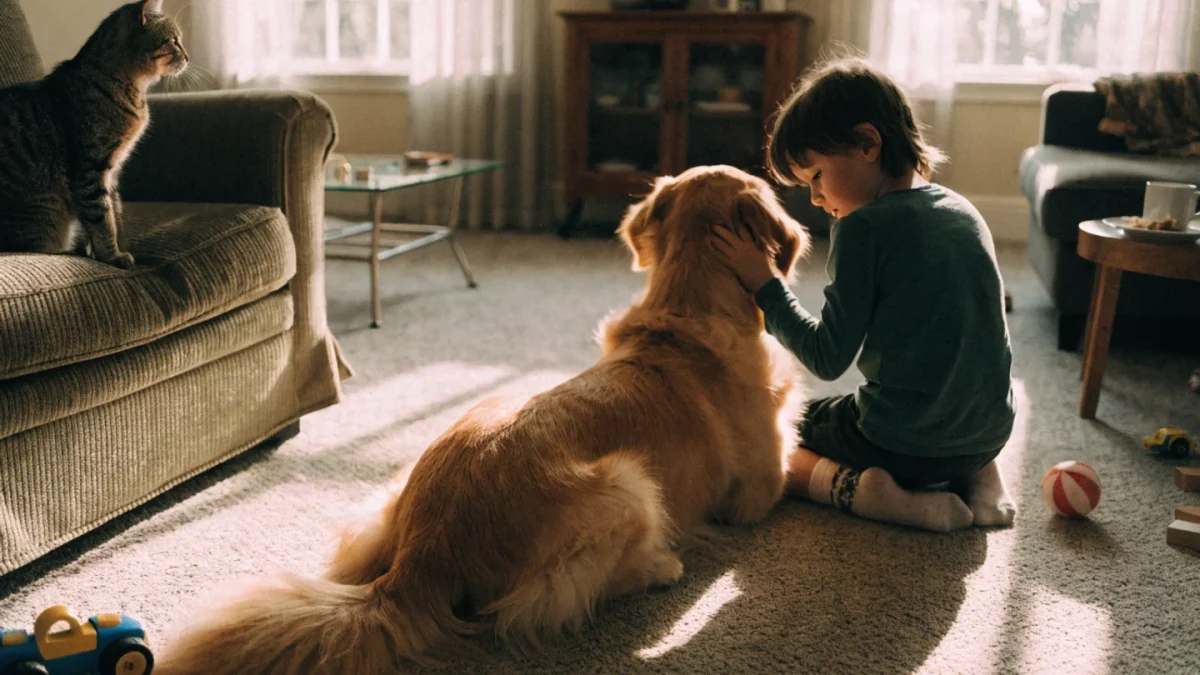
My friend's daughter was three when she figured out that the family cat didn't enjoy being carried like a baby doll. The cat had been tolerating it — barely — for about a month, which is honestly impressive restraint for a cat. The learning moment came when the cat finally set a boundary (gently — one swipe, no claws extended, more of a firm "no" than anything aggressive), and the kid cried, and my friend had to navigate both a disappointed toddler and an offended cat simultaneously.
That moment, she told me later, was one of the most unexpectedly useful parenting experiences she'd had. Her daughter learned about consent, reading body language, and respecting boundaries — all from a cat who'd simply had enough.
That's the thing about raising kids alongside animals. The benefits are real, but they're not automatic. They emerge from the messy, day-to-day work of teaching children how to interact with a creature that thinks differently, communicates differently, and has needs that don't always align with what a kid wants.
The Genuine Benefits
I don't have kids myself, but I've watched enough friends navigate this to know: the good parts are really good.
Empathy and Emotional Intelligence
Children who grow up with pets have regular practice in reading nonverbal cues — noticing when the dog is anxious, recognizing when the cat wants to be left alone, understanding that another living being has feelings and preferences that matter even when they're inconvenient.
This isn't just anecdotal. A systematic review published in the International Journal of Environmental Research and Public Health found that childhood pet ownership encourages healthy social development, including empathy and prosocial behavior — though the strongest effects show up when families actively engage children in the pet's care, not just when a pet happens to live in the house. The daily practice of considering another creature's needs builds emotional muscle that carries into human relationships.
Responsibility (When Taught, Not Assumed)
The "get them a pet so they learn responsibility" approach only works if parents actively teach the responsibility part. Handing a 7-year-old a hamster and expecting them to independently manage feeding, cleaning, and wellness doesn't teach responsibility — it teaches the hamster to be neglected.
What does work: age-appropriate pet chores with parental oversight, gradually increasing independence as the child proves reliable, and parents modeling the care they want to see. A 5-year-old can help fill a water bowl. A 10-year-old can manage daily feeding. A teenager can take the dog for walks. But the parent remains the backup — and the pet's primary advocate — throughout.
Comfort and Companionship
Pets don't judge. They don't care about grades or social drama or the complicated hierarchies of middle school. For kids going through difficult transitions — a move, a divorce, starting a new school, the general upheaval of adolescence — a pet provides a constant, uncomplicated source of affection.
I've heard from multiple friends that their kids talk to the family pet about things they won't talk to their parents about. That's not a failure of parenting — it's a feature of having a patient, nonjudgmental listener available around the clock.
Health and Activity
Dog-owning families with children tend to be more physically active — the dog needs walks regardless of the weather, and kids who participate in those walks get more outdoor time and exercise than they might otherwise. It's not a dramatic health intervention, but the consistent movement adds up.
The Realistic Challenges
The Instagram version of kids-with-pets is all cuddles and matching pajamas. The real version involves a lot more supervision, a lot more cleanup, and a few moments that are genuinely scary if you're not prepared for them.
Safety Is Never Passive
Young children and pets should never be left unsupervised together. Not because your pet is dangerous and not because your kid is reckless — but because both are unpredictable, and neither fully understands the other's boundaries.
A toddler who pulls a dog's tail doesn't know it hurts. A dog who snaps at a grabbing hand is reacting instinctively, not maliciously. The problem is the interaction, not either participant — and preventing problematic interactions is the parent's job.
This is exhausting. I've seen it. Managing a toddler and a dog requires the kind of constant vigilance that makes parents understand why coffee exists. But it's non-negotiable during the early years.
The Adjustment Period
Existing pets didn't sign up for a new baby. Their routine is about to be disrupted — less attention, more noise, a strange small human who moves unpredictably and smells like milk. Some pets handle this gracefully. Others… don't.
Preparing your pet before a baby arrives makes an enormous difference. Gradual changes — to routine, to access, to attention — help the pet adjust before the chaos of a newborn takes over the household.
Allergies
Pet allergies in children are real and more common than most people expect. If your child develops allergy symptoms after bringing a pet home, you're facing a genuinely difficult situation with no easy answer. Talk to your pediatrician before the situation escalates — there are management strategies that can work, but they depend on the severity and the specific allergen.
The Grief
Pets don't live as long as children need them to. A child who grows up with a dog will likely experience that dog's death, and for many kids, it's their first encounter with loss. This is painful and important and worth thinking about in advance — not to avoid it, but to prepare for how you'll support your child through it.
Making It Work: The Practical Framework
Match the Pet to the Family, Not the Fantasy
The "perfect family dog" that lives in your imagination might not match your actual family's lifestyle. Consider:
- Energy level. A high-energy breed and a sedentary family is a recipe for frustration on both sides.
- Size and temperament. Large, boisterous dogs can accidentally knock over small children. Timid or anxious pets may not thrive in a loud, busy household.
- Age. Adult pets with known temperaments are often a safer choice for families with young children than puppies, which require training and have less predictable behavior.
- The pet's history. Shelter and rescue pets come with temperament assessments. Use that information.
For more on this, which pets work best for families with young kids goes into detail.
Teach the Kids Before the Pet Arrives
If possible, start teaching kids to be gentle and responsible with animals before the pet comes home. Practice gentle touching with stuffed animals. Explain what pulling ears and tails does. Talk about what it means when a cat hisses or a dog growls — these are warnings, not invitations.
Children who arrive at the pet interaction with some framework for respectful behavior are safer and more successful than children who have to learn everything in real time with a live animal.
Create Safe Zones
Every pet in a family home needs a space that's off-limits to children — a crate, a cat tree, a room with a baby gate. And every child needs to learn that when the pet goes to their safe zone, it means "I need space right now" and that boundary is absolute.
This teaches the child about consent and respecting limits. It also protects the pet from being overwhelmed, which reduces the risk of a fear-based reaction.
Supervise Actively, Not Passively
"I was in the next room" isn't supervision. Active supervision means being physically present when young children and pets interact, watching body language (on both sides), and intervening before a situation escalates rather than after.
This doesn't last forever. As children get older and demonstrate consistent respectful behavior with animals, the level of supervision can decrease. But in the early years — particularly ages 1 through 5 — it's constant.
Normalize Imperfection
Things will go wrong. The dog will steal food from the kid's hand. The cat will scratch someone. The kid will accidentally step on the pet's tail. These moments are not catastrophes — they're learning opportunities, handled calmly and without blame.
The families I've seen do this best treat these incidents as teaching moments rather than crises. "The cat scratched you because you were holding her too tight. Let's practice gentle hands." "The dog took your snack because you put it at his level. Let's keep food up higher."
Age-by-Age Expectations
Babies (0-1): No interaction without direct adult intervention. The pet adjusts to the baby's presence. The baby does nothing except exist and be fascinating to the pet.
Toddlers (1-3): Close supervision, every time. Teach gentle touch, demonstrate often. Expect the child to forget the rules regularly. Expect the pet to be patient — but not infinitely so.
Preschoolers (3-5): Can begin to understand rules about pet interaction consistently. Can participate in supervised feeding. Still need active supervision but are starting to internalize boundaries.
School-age (6-10): Can take on age-appropriate pet chores. Understand body language better. Can interact with pets more independently, though check-ins and guidance remain important.
Preteens and teens (11+): Can manage significant pet care responsibilities. Often develop deep bonds with family pets. May benefit most from the emotional support a pet provides during the challenging adolescent years.
The Long View
Raising kids with pets isn't a parenting hack. It's a commitment that requires effort, supervision, and patience — from the parents. The kids learn empathy by watching you demonstrate it. They learn responsibility because you teach it. They learn to respect animals because you insist on it.
But when it works — and it usually does, with effort — the result is a child who understands that other creatures have feelings, that care requires consistency, and that love sometimes looks like cleaning a litter box at 6 AM because somebody depends on you. Those aren't small lessons.
FAQ
What age is best to introduce a pet to the family?
There's no single perfect age, but many families find that getting a pet when the youngest child is around 5 or 6 works well — old enough to understand gentle handling and participate in care, young enough to grow up with the pet. That said, plenty of families successfully have pets with babies and toddlers. It just requires more supervision and realistic expectations about how much the child can participate in care.
Should we get a puppy or an adult dog for our family?
For families with young children, adult dogs with known temperaments are often the safer choice. Puppies are unpredictable, mouthy, and require intensive training during a period when parents are already stretched thin. An adult dog from a shelter or rescue has been temperament-assessed, and what you see is much closer to what you get.
Can cats and young children coexist safely?
Absolutely. Cats are often excellent family pets because they naturally remove themselves from situations they don't like — they'll jump to a high shelf or retreat to another room. The key is ensuring the cat always has an escape route and that children are taught not to follow, corner, or pick up a cat that has moved away.
What if my child is allergic to pets?
Talk to your pediatrician before making any decisions. Mild allergies can sometimes be managed with environmental controls (air purifiers, keeping pets out of bedrooms, regular cleaning) and allergy medication. Severe allergies may make pet ownership impractical. Some families choose hypoallergenic breeds, though no breed is truly allergen-free — they just produce fewer allergens.
How do I handle my child's grief when a pet dies?
Honestly and age-appropriately. Don't minimize the loss or rush the grieving process. Acknowledge that it's painful, share your own sadness, and give the child space to process. For younger children, concrete explanations work better than euphemisms — "died" is clearer and less confusing than "went away" or "went to sleep." Many children benefit from a ritual — writing a letter, making a drawing, planting something in the pet's memory.