

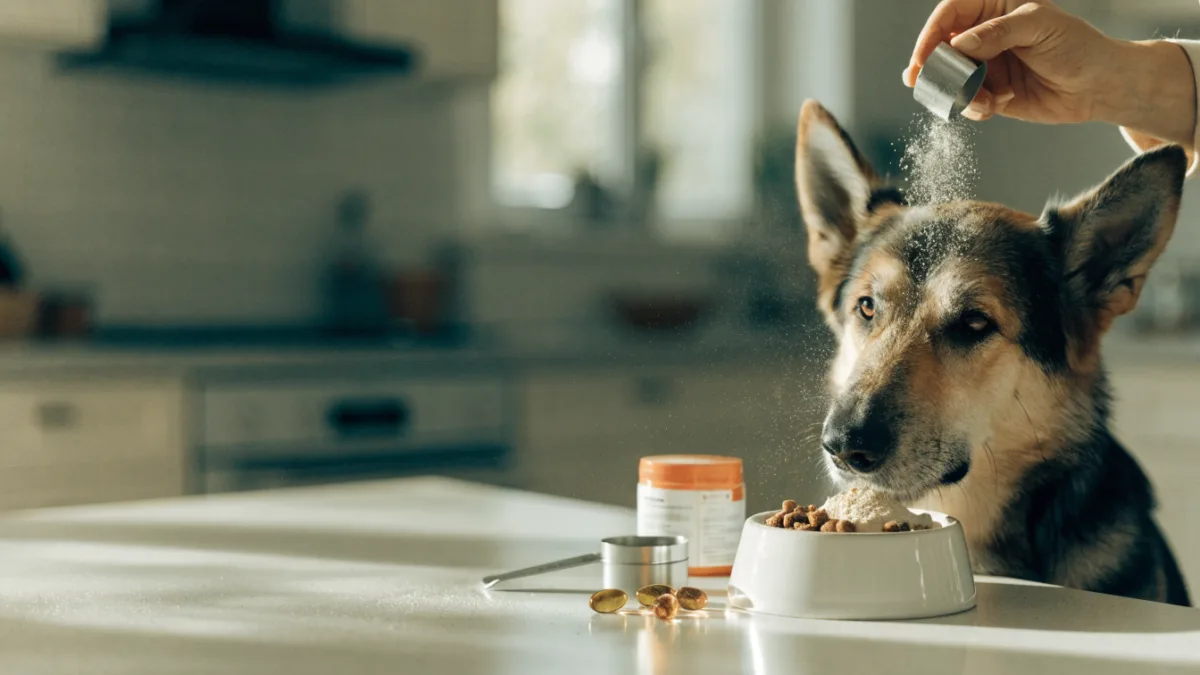
Just last week, I had a wonderfully chatty appointment with a client named Mark and his nine-year-old Golden Retriever, Cooper. Cooper has always been a boundless, happy-go-lucky guy, but lately, he’s been stiff in the mornings, hesitating before jumping into the back of the car. Mark sat on the floor of my exam room, petting Cooper’s head, and pulled out a grocery bag filled with half-empty plastic tubs.
“Sarah,” Mark sighed, “I’ve been giving him a glucosamine powder, a hip-and-joint chew, and a salmon oil pump. He’s getting a whole cocktail every morning, but I honestly can’t tell if any of this is working. The pet store employee swore by this stack, but I’m just throwing money down the drain, aren’t I?”
I completely understood his frustration. We all want to do whatever we can to keep our older pets comfortable, and the supplement aisle can feel incredibly overwhelming. The truth is, the pet supplement industry has shifted dramatically in recent years. I’ll admit, I used to dismiss a lot of these trendy powders and potions as expensive placebos. But the science has evolved, and I’ve changed my mind. We now have solid clinical evidence showing that certain supplements genuinely work—it just comes down to finding the right biological “stack” and ensuring the ingredients actually make it into your pet’s bloodstream. Let’s pull back the curtain on the world of canine and feline joint supplements.
How Joint Powders Actually Work: Putting Out the Fire
To understand why a supplement stack works (or doesn’t), it helps to understand what is actually happening inside an aging joint. The simplest way to picture it: imagine your pet’s joint is a well-oiled hinge. The cartilage is the smooth, Teflon-like cushion covering the ends of the bones, and the joint fluid is the lubricant keeping everything gliding seamlessly.
As pets age, that Teflon cushion starts to wear down. The body tries to repair it, which triggers low-grade, chronic inflammation. Inflammation is essentially a biological fire. It brings swelling and pain to the area, which is why Cooper was stiff in the morning.
The primary goal of any effective joint supplement isn’t just to “lubricate” the joint, but to put out that inflammatory fire and provide the building blocks to support the remaining cartilage. According to,[1] targeting this inflammation is critical for managing orthopedic conditions. While older pets often develop osteoarthritis, this inflammatory cycle can happen at any age, especially in highly active or large-breed dogs.
The “Big Three”: Building an Effective Stack
The pet health industry is moving away from single-ingredient miracles—like relying entirely on plain glucosamine—and moving toward combined “stacks.” This means using multiple ingredients that target joint degradation from completely different biological pathways. Based on,[2] the most researched and effective stack comes down to three heavy hitters:
1. Omega-3 Fatty Acids (EPA and DHA)
Omega-3s are the ultimate natural anti-inflammatories. Specifically, two types of Omega-3s—Eicosapentaenoic acid (EPA) and Docosahexaenoic acid (DHA)—work at the cellular level to block the inflammatory pathways that cause joint pain. But the benefits don’t stop at the joints. High-quality fish oil provides a holistic “stack” of benefits for the whole body. When Linda, a client with a thirteen-year-old Persian cat named Whiskers, started her on a therapeutic dose of Omega-3s for her arthritis, Linda was thrilled to report a few months later that Whiskers’ coat was incredibly soft and her dandruff had completely cleared up.
2. Green-Lipped Mussel (GLM)
Sourced exclusively from the coastal waters of New Zealand, Green-Lipped Mussel is a powerhouse. It contains a highly potent, naturally occurring blend of Omega-3s, but it also contains unique joint-protecting compounds like glycosaminoglycans (GAGs). These compounds help maintain the health of the joint fluid and cartilage matrix in ways isolated synthetic ingredients simply can’t replicate.
3. Collagen
We hear a lot about collagen for human skin and joint health, but it’s incredibly vital for our pets, too. Collagen is the main structural protein in cartilage. It acts as the scaffolding that holds the joint together. Adding a high-quality collagen source to a joint stack gives the body the exact raw materials it needs to rebuild and maintain the cushioning that protects the bones.
The Size Discrepancy: Does Your Big Dog Need More?
One of the most fascinating developments in joint supplement research came out recently, in a.[3] The researchers measured how Omega-3 supplementation affected the “Omega-3 Index”—a clinical measurement of how much Omega-3 is actually present in a pet’s red blood cells.
The results were incredibly validating: Omega-3 supplementation significantly improved the Omega-3 Index in all dogs tested. But here is the catch that had me leaning forward in my chair while reading the study. The researchers found that Omega-3s significantly improved pain scores and boosted overall quality of life specifically in small and medium-sized dogs.
For large and giant breed dogs, the pain relief wasn’t as pronounced. Why? It all comes down to volume and distribution. A 90-pound Labrador has a vastly larger volume of blood and body mass than a 20-pound Beagle. It is highly likely that large and giant breed dogs require significantly higher therapeutic doses of Omega-3s to achieve the same localized anti-inflammatory effect in their joints. If you have a big dog and you’re giving them a standard, one-size-fits-all fish oil dose, you simply might not be giving them enough to move the needle on their pain.
The Hidden Truth: Bioavailability and the Regulation Gap
So, why did Mark’s expensive stash of supplements fail to help Cooper? The answer brings us to the biggest hidden truth in the pet supplement industry: bioavailability. Bioavailability is just a fancy medical term for how well a nutrient is absorbed and actually utilized by the body’s cells.
Here is a harsh reality worth stating plainly: joint supplements are not regulated like prescription medications. The market is heavily saturated with products of varying purity, dosage accuracy, and effectiveness. You can buy a cheap fish oil off a grocery store shelf, but many commercial Omega-3s are processed in a way that makes them incredibly difficult for a dog or cat’s digestive tract to absorb. The oil quite literally passes right through them. If your pet’s stool is suddenly greasy or dark, you’re looking at expensive fish oil going straight into the grass.
This has sparked an ongoing debate in the veterinary community. Many standard fish oils are in a form called triglycerides, which can be harder to absorb. This has led to a surge in specialized formulations. If you are looking for a supplement, check the label for phospholipid-based oils—these are usually derived from krill and mimic the natural cell structure of the gut, allowing for vastly superior absorption. Also, look for third-party testing stamps (like NASC, the National Animal Supplement Council) on the label, which ensures that what the bottle says is in the powder is actually in there.
Wanting to use natural remedies is a great instinct, and worth saying so plainly. The goal isn’t to ditch supplements; it’s to ditch the cheap ones that aren’t formulated for biological absorption.
The Ripple Effect: Choosing Supplements that Protect the Ocean
Before you rush out to buy the right stack for your pet, we need to talk about where these ingredients come from. Omega-3s and Green-Lipped Mussels are derived from marine life, and overfishing for fish oil is a massive global conservation concern. We can’t treat our pets at the expense of the ocean’s fragile ecosystems.
When you are reading labels for bioavailability and purity, also look for sustainability certifications. Seek out products certified by the Marine Stewardship Council (MSC) or those that source their oils from highly abundant, smaller species lower on the food chain, like sardines, anchovies, or krill. Not only do these smaller fish accumulate fewer heavy metals and toxins, but they also reproduce quickly, making them a much more eco-friendly choice.
Farmed Green-Lipped Mussels from New Zealand are another excellent choice. They are generally considered a highly sustainable, low-impact aquaculture practice, as they are grown on ropes suspended in the ocean and actually filter the water around them.
At the end of Cooper’s appointment, Mark and I came up with a new game plan. We streamlined his giant tubs of mismatched powders into a single, highly bioavailable, sustainably sourced stack with appropriate doses of EPA, DHA, and Collagen, keeping his larger size in mind. A joint supplement will never cure arthritis, and you should always consult with your own veterinarian before starting a new regimen to ensure it won’t interact with your pet’s current medications. But by choosing the right, scientifically backed ingredients, you can absolutely help your pet move comfortably and happily for years to come.
Sources
- orthopedic experts at Cornell University's Riney Canine Health Center — vet.cornell.edu
- current veterinary nutritional guidelines — vcvets.com
- 2024 study published by Carlisle et al. in the PubMed Central (PMC) database — pmc.ncbi.nlm.nih.gov