

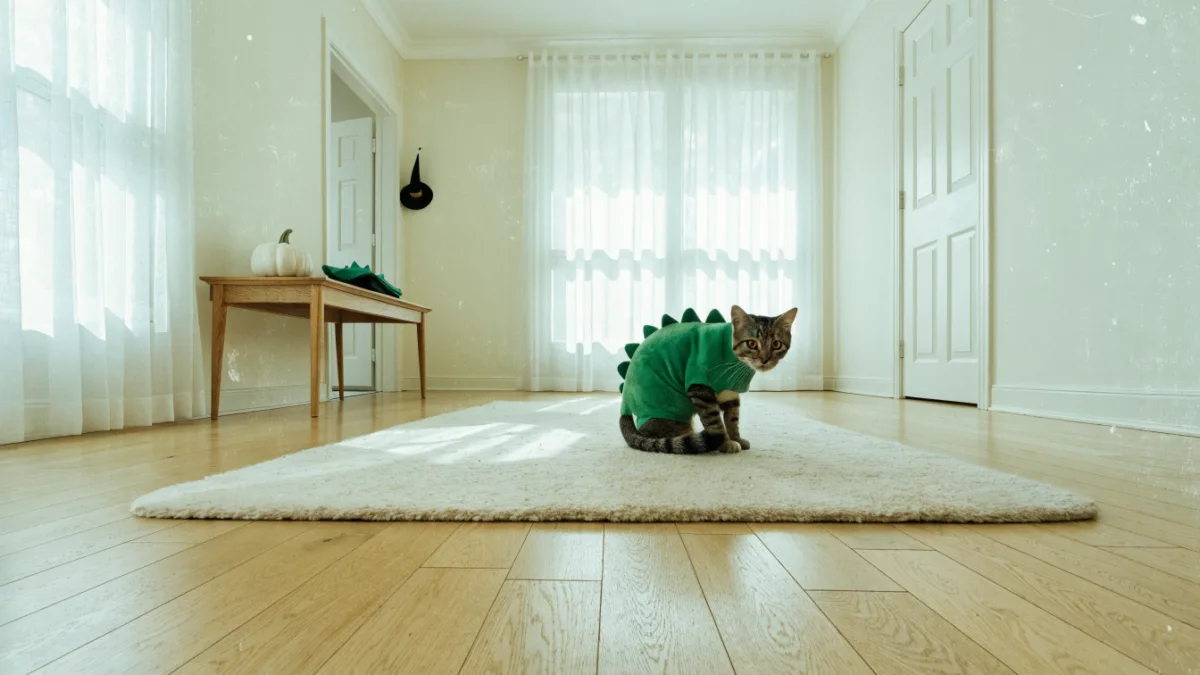
Halloween 2019 was the year I learned my lesson. I had spent an embarrassing amount of money on a tiny dinosaur costume — complete with a spike-lined hood and little stuffed arms — for my cat Mabel. She’s a confident, slightly chaotic tortoiseshell who normally fears nothing, so I figured she’d tolerate it for at least long enough to get a decent photo. I was wrong. The moment I eased the hood over her ears, she flattened herself against the floor like a furry pancake, her eyes went wide and glassy, and she refused to move a single muscle. She stayed frozen for a full thirty seconds before I came to my senses and pulled it off. That dinosaur costume now lives at the bottom of a closet, and Mabel has forgiven me — mostly.
Every October, millions of pet owners pull out the seasonal bin and try to convince their animals that being a hot dog or a tiny vampire is fun. And look, I get it. The photos are adorable. But here’s the thing: most pets don’t actually want to wear clothes, and many of them are telling us that clearly — we just aren’t always fluent in the language they’re using.
The Universal Truth: Animals Hate Being Restrained
Before we get into the specific warning signs, it helps to understand why costumes are so unpleasant for most animals. Dogs and cats aren’t tiny humans. They don’t have a concept of “dressing up” or “looking silly.” When you put a piece of fabric over their body, all they experience is restriction.
Both species rely on their bodies to communicate. A dog’s tail tells other dogs (and us) how they’re feeling. A cat’s whiskers help them navigate tight spaces and detect changes in air currents. When a costume covers the base of the tail, pins the ears flat under a hood, or squeezes the torso, it doesn’t just feel physically uncomfortable — it cuts the animal off from their primary sensory tools. That’s disorienting at best and genuinely frightening at worst. Costumes can also make it harder for pets to walk naturally, sit comfortably, or position themselves to use the bathroom, which adds a whole new layer of stress.
Reading Pet Stress Signals Before It Escalates
Animals rarely go from “fine” to “panicked” instantly. They almost always give us smaller signals first — we just have to know what to look for. Here are the most common indicators that your pet is unhappy in their Halloween finery:
The Obvious (But Often Ignored) Signs
- Freezing in place. This is the one I missed with Mabel. When an animal stops moving entirely and seems to “shut down,” they are not being patient or cooperative. They are overwhelmed. This freeze response is a stress reaction, not a sign of calm.
- Scratching or biting at the outfit. If your pet immediately tries to remove what you just put on them, listen to them. They’re not being dramatic — they’re communicating clearly.
- Flattened ears or a tucked tail. Classic anxiety body language in both dogs and cats. If the ears pin back against the skull or the tail tucks tightly between the legs or against the body, your pet is scared or uncomfortable.
The Subtle Signs That Are Easy to Miss
- Whale eye. This is when you can see the whites of your pet’s eyes — usually because they’re holding their head still while tracking something that makes them nervous. It’s a sign of escalating anxiety.
- Excessive panting when it’s not hot. Dogs pant to cool down, but they also pant when stressed. If your dog is panting heavily indoors in October while wearing a costume, the outfit is the problem.
- Lip licking and yawning. These are self-soothing behaviors. Frequent lip licking or yawning outside of normal tiredness or hunger contexts often signals discomfort.
Here’s my personal rule, and I encourage you to steal it: if I have to bribe my pet with treats just to get them to take a few steps in a costume, the costume comes off. Full stop. No photo is worth making an animal I love feel trapped.
Cat Clothes Safety: Why Felines Are a Different Story
Let’s talk about cats specifically, because they deserve their own conversation. Cats are, as a general rule, more sensitive to clothing than dogs. This isn’t because cats are “difficult” — it’s because their entire sensory system is distributed across their bodies in ways we don’t always appreciate.
A cat’s whiskers aren’t just decorative. They’re highly sensitive tactile organs that help them judge spatial relationships, detect movement, and navigate in low light. Their fur itself is loaded with touch receptors that feed them constant information about their environment. When you put a costume on a cat, you’re essentially blindfolding and muffling them at the same time.
Most cats will have one of two reactions to being dressed up, and neither is great. The first is the freeze response — they’ll drop low to the ground and refuse to move, like Mabel did in her dinosaur outfit. The second is panic — frantic scrambling, trying to bolt out of the costume, which can lead to injury if they get tangled or catch a claw in the fabric. Some cats may also salivate excessively, vocalize in distress, or breathe rapidly when constrained.
If you have a cat who genuinely seems unbothered by a simple, loose-fitting sweater (some do exist — my friend’s ragdoll basically lives in knitwear from November to March because he runs cold), that’s between you and your cat. But proceed with extreme caution, and never put anything over a cat’s face, ears, or the base of their tail.
Evaluating Dog Halloween Costumes: A Realistic Checklist
Dogs, on the whole, tend to be slightly more tolerant of costumes than cats — but “slightly more tolerant” is a low bar. Some individual dogs genuinely don’t seem to mind lightweight, well-fitting outfits. My sister’s golden retriever, Biscuit, appears completely indifferent to the pumpkin bandana she wears every October. But indifference isn’t enjoyment, and it’s our job to make sure a costume isn’t causing harm even if the dog isn’t actively protesting.
If you’re going to try a costume on your dog, here’s what to look for:
- Breathability. The fabric should be lightweight and allow air to circulate. Avoid thick, stiff materials that trap heat.
- Full range of motion. Your dog should be able to walk, sit, lie down, and move all four legs freely. If the costume pulls at the shoulders or restricts the hindquarters, it’s too tight or poorly designed.
- Nothing near the face. No hoods, hats, or attachments that could slip over the eyes or ears. Your dog needs to see and hear clearly.
- No small, chewable parts. Buttons, bells, pom-poms, and dangling zippers are choking hazards. Dogs investigate with their mouths, and a loose piece that gets swallowed can cause a gastrointestinal emergency.
- Fire resistance. Halloween often involves candles and jack-o’-lanterns. Check that any costume material is labeled as fire-resistant.
- A proper fit. Too loose and it can snag on furniture or outdoor debris; too tight and it restricts breathing and movement. You should be able to comfortably fit two fingers between the costume and your dog’s body.
And please — introduce the costume gradually. Don’t wait until Halloween night to put it on for the first time. Let your dog sniff it, drape it loosely over their back for a few seconds, give them a treat, and remove it. Build up slowly over days. If at any point they show stress signals, back off.
The Case for Skipping the Costume Entirely
Here’s where I’ll be honest about my own opinion: I think we put too much pressure on pets to participate in human holidays the “fun” way. The debate over whether dressing up pets is harmless fun or borderline cruel comes down to individual animals, but behaviorists generally agree on one thing — animals don’t have an innate desire to wear clothes, and forcing the issue when an animal is clearly uncomfortable isn’t fair to them.
The good news is that there are plenty of ways to include your pet in the Halloween spirit without putting them in a full-body outfit. Some alternatives I genuinely love:
- Festive bandanas. A well-fitting bandana with a seasonal print is about as low-stress as it gets. It doesn’t restrict movement, doesn’t cover the face, and most dogs and many cats tolerate one without issue.
- Decorative collars or collar covers. A simple orange-and-black collar or a removable collar charm gives Halloween energy without the commitment of a full costume.
- Seasonal harnesses. If your dog already wears a harness on walks, swapping it for one in a fall color or pattern is functional and festive.
- Anxiety-friendly apparel. Some companies now make pressure wraps — similar to anxiety vests — in holiday patterns. If your pet already finds gentle pressure soothing, this can be a rare win-win. But check with your vet first if your pet has any underlying anxiety issues.
What Matters More Than the Photo
At the end of the day, Halloween is supposed to be fun — for everyone in the household, including the four-legged members. If your dog happily trots around in a taco costume and shows zero signs of distress, I’m genuinely happy for you. Take the photos. Post them. Enjoy it. But if your cat freezes, your dog won’t stop pawing at their hood, or you find yourself holding treats hostage just to keep the outfit on for thirty more seconds, please let it go.
Our animals trust us to advocate for them. They can’t tell us with words when something feels wrong, so they use their bodies instead — and it’s our responsibility to pay attention. The costume conundrum isn’t really about costumes at all. It’s about learning to read the beings we live with, respecting their boundaries, and understanding that love sometimes looks like putting the dinosaur outfit back in the closet and letting your cat be a cat.
That’s not a compromise. That’s the whole point of sharing your life with an animal.