

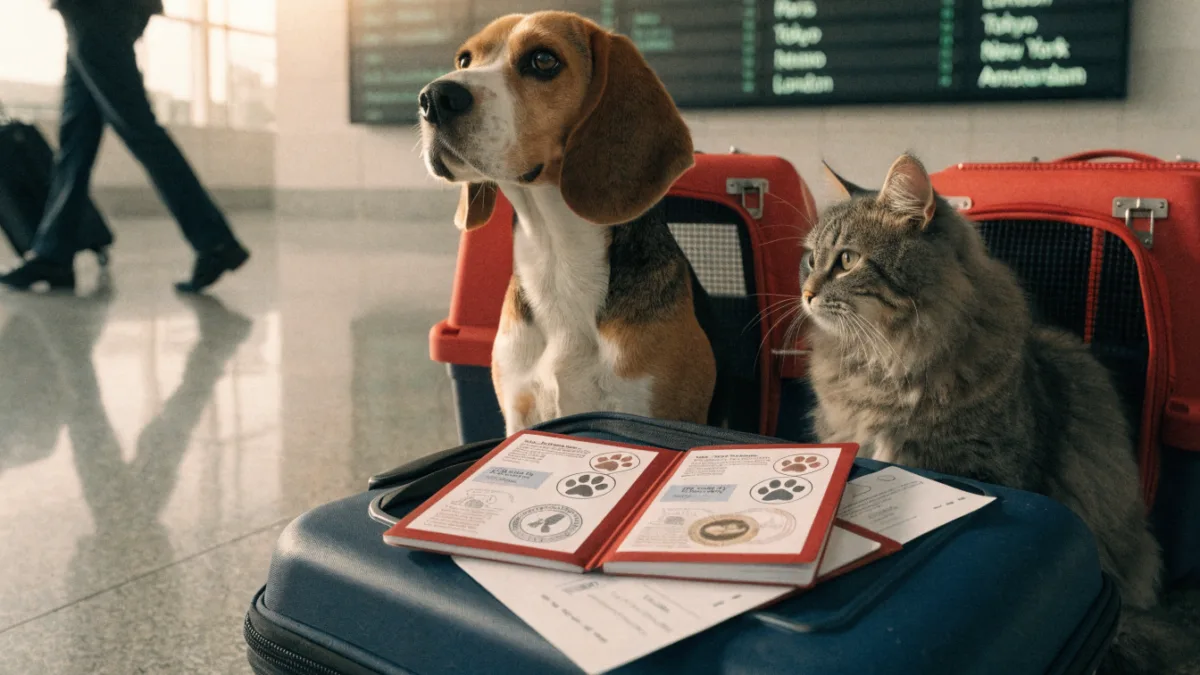
If you’ve ever tried to take a pet across an international border, you know the feeling: staring at a government webpage at 2 a.m., three tabs deep into a rabbit hole of veterinary requirements, wondering if your cat needs more paperwork than you do. I once nearly missed a flight because the airline counter agent wasn’t sure if Mochi’s health certificate was “the right kind” — it was, for the record, but not before I had a small meltdown at check-in. The truth is, “pet passport” sounds like a cute Instagram prop. In reality, it’s a bureaucratic obstacle course where one missing signature can mean your animal gets denied entry at the border. No do-overs. No “let me call my vet.” Just turned away.
First Things First: There’s No Such Thing as a Universal Pet Passport
Here’s where most people get tripped up. The phrase “pet passport” gets thrown around like it’s a single, globally recognized document. It’s not. It’s really two completely different things depending on where you live and where you’re going.
In the European Union, a pet passport is a literal, official booklet — blue, stamped, government-issued — that tracks your animal’s microchip number, vaccinations, and treatments. It’s standardized across all EU member states, and it’s genuinely as handy as it sounds. Get one, keep it current, and your dog or cat can move between France, Germany, Spain, and the rest of the bloc with relatively little friction. (Though as we’ll get to, Brexit threw a wrench in this for British pet owners.)
Everywhere else? “Pet passport” is just a nickname people use for the stack of documents required. In the United States, there’s no passport system. American pet parents traveling internationally work with a Certificate of Veterinary Inspection — essentially a health certificate issued by a USDA-accredited veterinarian within a specific window before travel, usually 10 days. You carry that, plus proof of rabies vaccination and microchip records, and that’s your “passport.” A folder of paper, not a sleek little booklet.
And by the way — passports are exclusively for dogs, cats, and ferrets. If you’re traveling with a bird, reptile, or fish, you’re in entirely different territory with country-specific regulations. Don’t assume the rules overlap.
The Non-Negotiables: What Every Country Wants to See
Despite the chaos of varying requirements, there’s a baseline almost every country expects. Think of these as your bare minimum — some destinations will want more, but nobody wants less.
- An ISO-compliant microchip. This is the 15-digit international standard. If your pet has a 9- or 10-digit chip (common in older US implants), some countries won’t recognize it. I learned this the hard way when Mochi’s original chip turned out to be the wrong frequency for EU scanners. We had to get a second one implanted. She was not thrilled.
- A current rabies vaccination. And I cannot stress this enough — “current” means administered before the window your destination requires, not just “not expired.” For the EU, that’s at least 21 days before arrival. For rabies-free countries, you may need proof going back much further.
- A clean health certificate. Issued within that narrow 10-day window before travel, signed by an accredited vet, and sometimes endorsed by a government agency. Miss the window? Start over.
That 21-day rabies rule catches people constantly. You can’t decide to move to Portugal on a Tuesday and bring your dog on Friday. The vaccine needs time to be considered “effective” by EU standards, and there’s no flexibility. I’ve talked to people who had to leave their pets with family for three extra weeks because they didn’t plan ahead.
Where You’re Going Matters More Than Where You’re From
This is the golden rule of international pet travel, and I repeat it like a mantra: the destination dictates the documentation. A road trip from the US to Canada requires vastly less paperwork than relocating to Australia. The difference isn’t bureaucratic red tape for the sake of it — it’s about biosecurity.
The Relaxed Lane: Mainland EU and Neighbors
If your pet meets the core requirements — microchip, rabies vaccine at least 21 days prior, and a health certificate — entering mainland Europe from a rabies-controlled country is relatively smooth. No quarantine. You walk through customs, show the passport or health certificate, and go. It’s the closest thing to easy that international pet travel gets.
The Strict Lane: Rabies-Free Countries
Countries classified as rabies-free — the UK, Japan, Australia, New Zealand, and Hawaii (yes, Hawaii counts as its own zone for US travelers) — have built fortress-like entry systems. And honestly? It makes sense. These places have spent decades and millions eradicating diseases that are endemic elsewhere. They’re not about to let one sloppy health certificate undo all of that.
But the requirements are intense. Australia, for instance, requires a rabies neutralizing antibody titer test (RNAT) — a blood draw sent to a government-approved lab — months in advance. Then there are waiting periods, additional parasite treatments, and an actual quarantine period upon arrival that can stretch 10 days or more. Japan’s process is similar. Hawaii’s 5-Day-Or-Less quarantine program requires meticulous advance planning, though if you jump through every hoop correctly, you can sometimes avoid the facility stay.
The UK requires specific treatment against the tapeworm Echinococcus multilocularis — a parasite that doesn’t exist on the island and that British authorities are determined to keep out. That treatment must be administered by a vet no less than 24 hours and no more than 120 hours before you cross the border. Miss that window? Denied entry. No exceptions.
When Perfect Pets Hit Invisible Walls
Here’s where international pet travel stops being just inconvenient and starts feeling genuinely unfair. Animal welfare advocates have long criticized border policies that penalize pets for paperwork errors rather than actual health risks. A vet checks the wrong box. A microchip scan fails because of frequency mismatch. A vaccination date is one day outside the window. The result? An animal gets denied entry or shuffled into a quarantine facility — stressful, confusing, and sometimes traumatic for a pet who doesn’t understand what they did wrong.
Then there’s breed-specific legislation, or BSL, which is arguably the most controversial aspect of international pet travel. Even with a flawless passport, certain dog breeds face outright bans in specific countries. Pit Bulls, Staffordshire Terriers, and Rottweilers are routinely denied entry — or worse, face seizure and euthanasia risks — regardless of their individual temperament or health status. It doesn’t matter if your dog is a certified therapy animal. It doesn’t matter if they’ve never shown a hint of aggression. BSL judges the breed, not the individual, and no amount of paperwork overrides it.
I have strong feelings about this. The science on BSL is, to put it gently, not supportive of its effectiveness. Study after study has shown that breed-specific bans don’t meaningfully reduce dog bite incidents — responsible ownership and behavior-based assessments do. But that’s a rant for another day. The practical takeaway: if you share your life with a breed that’s restricted, research your destination’s BSL laws before you book anything.
Recent Earthquakes in the Pet Travel Landscape
If you traveled internationally with a pet before 2021 and are planning a trip now, forget what you remember. The rules have shifted dramatically in ways that have caught even experienced travelers off guard.
Brexit Broke British Pet Passports
Since the UK left the European Union, Great Britain (England, Scotland, and Wales) no longer issues EU pet passports — and any EU passports previously issued by British vets are no longer valid for EU travel. British pet owners now need an Animal Health Certificate for each trip into the EU, which must be obtained within 10 days of travel and is significantly more expensive than maintaining a passport. For people who used to pop across the Channel with their dogs regularly, this has been a costly and frustrating change. Northern Ireland, in a quirk of post-Brexit arrangements, still follows EU rules.
The CDC Cracked Down on Dog Imports
As of August 1, 2024, the US Centers for Disease Control and Prevention implemented sweeping new rules for dogs entering the United States — and this affects Americans traveling abroad just as much as foreign pets coming in. Dogs must now be microchipped, at least 6 months old, and have specific rabies documentation that varies based on where they’ve been. The rules are complex enough that the CDC created an online quiz to help owners figure out which category they fall into. If you’re bringing a dog back to the US after an international trip, do not assume the old rules still apply. They don’t.
Pet Travel Services Are Booming
Unsurprisingly, the bureaucratic burden has spawned an entire industry. Specialized pet travel agents and veterinarians who focus exclusively on international health paperwork are increasingly common. These professionals know the exact requirements, deadlines, and gotchas for specific countries. They’re not cheap, but when the alternative is your pet being turned away at customs, the math starts looking different. If you’re doing anything more complex than a US-to-Canada trip, seriously consider professional help — at minimum for a consultation.
Why All This Red Tape Actually Exists
It’s easy to resent the paperwork mountain. Trust me, I’ve cursed more government forms than I can count. But stepping back, the reason behind the bureaucracy matters — and it’s bigger than bureaucratic control.
Strict quarantine and passport laws exist primarily to protect ecosystems and public health. Rabies kills approximately 59,000 people globally each year, mostly in regions where the virus remains endemic in dog populations. Countries that have eliminated it have done so through aggressive vaccination campaigns and equally aggressive border controls. Let one infected animal slip through, and the consequences ripple outward — not just for human health, but for native wildlife that has no natural immunity.
The tapeworm requirement for the UK? Echinococcus multilocularis can cause fatal disease in humans and infects wild canid populations. Australia’s intense scrutiny of imported pets? The continent’s unique fauna has been devastated by introduced species and diseases before. These rules aren’t arbitrary punishment for pet owners. They’re conservation measures — imperfect, sometimes maddening, but rooted in genuine ecological stewardship.
So when you’re standing in that government office at 4 p.m. on a Friday trying to get a health certificate endorsed, remember: the inconvenience you’re feeling is the cost of keeping places like Australia’s wildlife safe, Japan’s streets rabies-free, and the UK’s ecosystem intact. Your cat’s stress is temporary. The ecological damage from a lax border? That’s permanent.
Plan early. Read the actual government pages — not just blogs, the,[1] and the [2] are good starting points for Americans. [3] pets without proper documentation will be denied entry — full stop. And talk to your vet, because they’re your front line in this process. The earlier you start, the smoother it goes. Mochi and I have made it through customs in five countries now, and I promise: the preparation is exhausting, but watching your cat confidently claim a windowsill in a new time zone makes every form worth it.
Sources
- USDA's pet travel portal — aphis.usda.gov
- State Department's guidance — travel.state.gov
- As Travel + Leisure reported — travelandleisure.com