
I have approximately 4,732 photos of my cat Miso on my phone. I’d estimate maybe 40 of them are actually in focus. The rest look like they were taken during a minor earthquake — blurry blobs of calico fur hurtling through space, or dark smudges in what I swear was a well-lit room until I pressed the shutter button. Meanwhile, my friend’s Border Collie mix recently did a victory lap around the dog park, and I managed to capture exactly zero usable shots. Just a streak of black and white motion blur and what might be an ear in the corner of one frame.
Pet photography is humbling. But after a lot of trial and error — and some genuinely terrible photos I’ll never delete because they’re accidentally hilarious — I’ve learned that the secret isn’t some artistic gift. It’s understanding that dogs and cats present completely different technical challenges, and your camera settings need to match the chaos in front of you.
The Exposure Triangle, But Make It Furry
Before we get into specific numbers, let’s talk about why pet photography breaks cameras in ways that landscape photography doesn’t. It comes down to three settings that constantly fight each other: shutter speed, aperture, and ISO. Photographers call this the “exposure triangle,” which sounds intimidating but is really just a fancy way of saying everything is a trade-off.
Shutter speed determines how long your camera’s sensor is exposed to light. Fast shutter speeds freeze motion but let in less light. Aperture controls how wide the lens opens — a wide aperture (lower f-number) lets in more light and blurs the background, which is gorgeous for pet portraits. ISO is your camera’s sensitivity to light; raise it when you’re desperate, but the photo gets grainier.
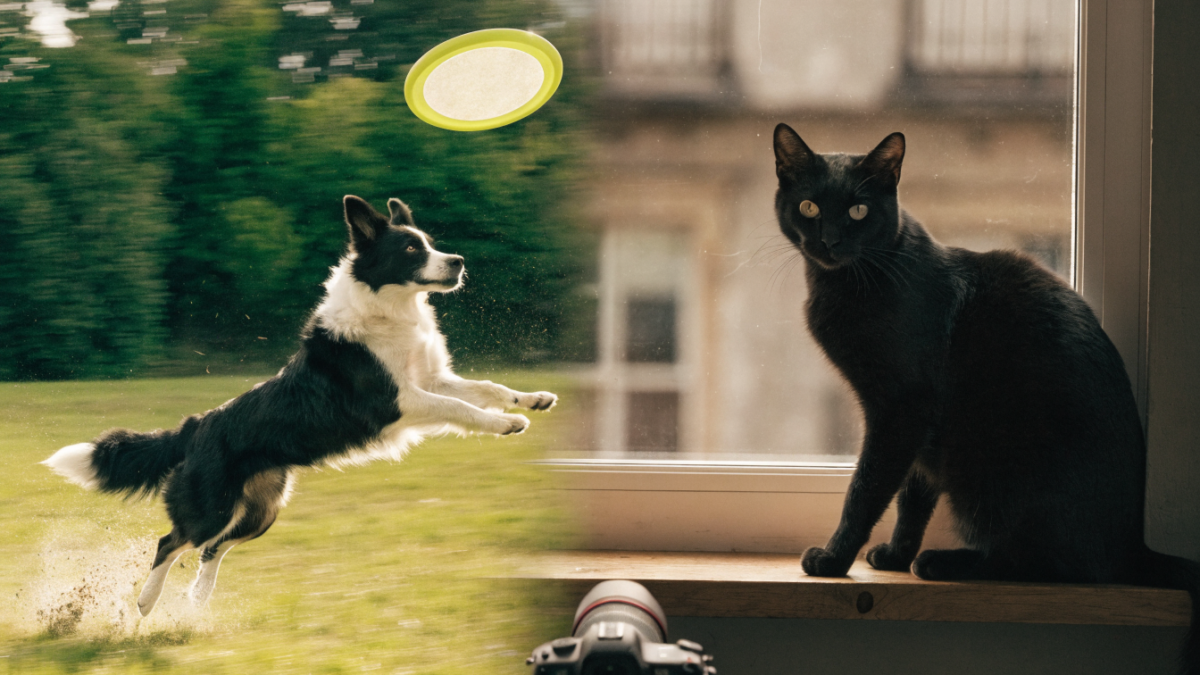
The reason pet photography is hard is that pets move unpredictably and they’re often in terrible lighting. Dogs are frequently outdoors in bright but variable light, sprinting at full speed. Cats are frequently indoors, lurking in the dim corner of a room they’ve specifically chosen because it’s cozy and shadowed. You can’t use the same approach for both.
Fast-Moving Dogs: Freezing the Chaos
Let’s start with the easier scenario — not because dogs are easy, but because the settings are more straightforward. When you’re photographing a running dog, your single most important setting is shutter speed. Everything else is secondary.
The Magic Number: 1/1000th of a Second
If you remember nothing else from this article, remember this: 1/1000th of a second or faster. That’s the minimum shutter speed for freezing a dog in full sprint. At 1/500th, you’ll get motion blur in the legs. At 1/250th, you’ll get what photographers generously call an “artscape” and what I call a mistake.
To achieve that blazing-fast shutter speed, you need to compensate with the other two sides of the triangle. Open your aperture wide — something between f/1.8 and f/2.8 is ideal. This lets in maximum light and creates that dreamy blurred background that makes your dog pop. Then keep your ISO as low as the light allows, ideally between 200 and 800 for outdoor settings.
The Speed Over Perfection Rule
Here’s where I’ll get opinionated: a slightly grainy, perfectly sharp photo of your dog mid-jump is infinitely better than a noise-free, beautifully colored blur. The noise versus blur debate in the pet photography community comes down heavily in favor of accepting noise. Grain can be reduced in editing. Motion blur cannot be fixed. If you have to choose between cranking your ISO to 3200 or dropping your shutter speed below 1/500th, crank the ISO every time.
This is also where continuous shooting mode becomes your best friend. Dogs don’t pose. They do weird, wonderful things for approximately half a second before returning to their normal schedule of sniffing everything. Shoot in burst mode, hold the shutter down, and sort through the results later. You’ll throw away 90% of the shots, but the 10% will be gold.
Low-Light Cats: The Shadow Dwellers
Cats present the opposite problem. Miso’s favorite napping spot is under my bed, behind a storage bin, in what I can only describe as a cave. She’s barely moving, but the lighting situation is a disaster. This is where aperture and ISO become your priorities, and shutter speed can relax a bit.
Slower Is Fine — Within Reason
For a cat that’s sleeping, grooming, or doing that slow-motion stretch they do seventeen times a day, a shutter speed between 1/250th and 1/500th of a second is generally sufficient. They’re not sprinting. The movement is minimal. This buys you precious light-gathering room.
The real challenge with cats is that they choose the worst-lit spots in your home and then look at you like you’re the problem. Your strategy here is to maximize natural light. Position yourself so a window is behind or beside you, illuminating the cat. North-facing windows give soft, even light. South-facing windows (if you’re in the Northern Hemisphere — flip it if you’re south of the equator) give warmer, more directional light.
Wide Open and ISO High
Open that aperture as wide as your lens allows. If you’re using a prime lens that goes to f/1.8 or even f/1.4, now’s the time to use it. The shallow depth of field actually works in your favor here — it isolates the cat from the messy background of your living room that you definitely didn’t clean before the photo session.
Don’t be afraid to push your ISO. Modern cameras handle high ISO remarkably well, and the grain that results has a certain charm — almost film-like. ISO 1600, 3200, even 6400 if necessary. Better a grainy photo of your cat looking majestic in her cardboard box than no photo at all.
The Flash Question: Just Don’t (Usually)
Here’s something I feel strongly about: turn off your on-camera flash. Always. Not sometimes. Not “just this once.” The flash that’s built into your camera or phone is the enemy of good pet photography for two reasons.
First, it produces harsh, flat lighting that washes out fur texture and creates demonic glowing eyes. You know the look — that green or blue eyeshine that turns your sweet pet into something from a horror movie. Second, and more importantly, it startles animals. A sudden burst of bright light is stressful, especially for cats who are often photographed in their safe, quiet spaces.
Now, I’ll acknowledge that professional pet photographers sometimes use off-camera flashes with softboxes and diffusers, and the results can be stunning. But that’s studio lighting — controlled, diffused, and positioned purposefully. The flash on your phone or camera is neither of those things.
Natural light is almost always the right choice. Golden hour — that hour after sunrise or before sunset — turns any dog into a supermodel. A sunny window turns any cat into a Renaissance painting. Chase the light, don’t manufacture it.
New Technology That’s Actually Helpful
If you’ve bought a mirrorless camera in the last few years, you have a secret weapon: AI-powered animal eye autofocus. Major camera manufacturers now include focus modes specifically trained to recognize and track the eyes of dogs and cats. This is genuinely revolutionary. Instead of fighting with autofocus points as your dog rockets across a field, the camera locks onto their eyes and tracks them automatically.
And if you’re shooting on a smartphone — which, let’s be honest, most of us are most of the time — things have gotten remarkably good. Modern phones use computational photography, essentially taking multiple exposures in rapid succession and combining them to handle challenging situations. The AI optimizes shutter speed and exposure automatically. You still need good light, and you still need to be patient, but the technical barrier is lower than ever.
Final Thoughts: Patience, Not Perfection
The best pet photographers aren’t the ones with the most expensive gear or the perfect settings memorized. They’re the ones who understand animal behavior, wait for the right moment, and aren’t afraid to take 200 photos to get one good one. Know your pet’s patterns — when they’re most active, when they’re most relaxed, where the good light falls in your home at different times of day.
And while we’re talking about outdoor photography: if you’re photographing your cat outdoors, please do it safely. Cats on harnesses or in enclosed outdoor spaces (“catios”) keep both your pet and local wildlife safe. Free-roaming outdoor cats are wonderful subjects, but they’re also one of the leading causes of decline in songbird and small mammal populations worldwide. A great photo isn’t worth a nest of fledglings.
So go adjust those settings, find your light, and maybe — just maybe — you’ll get that one perfect shot. I finally got Miso in focus last week. It only took 4,731 tries.