

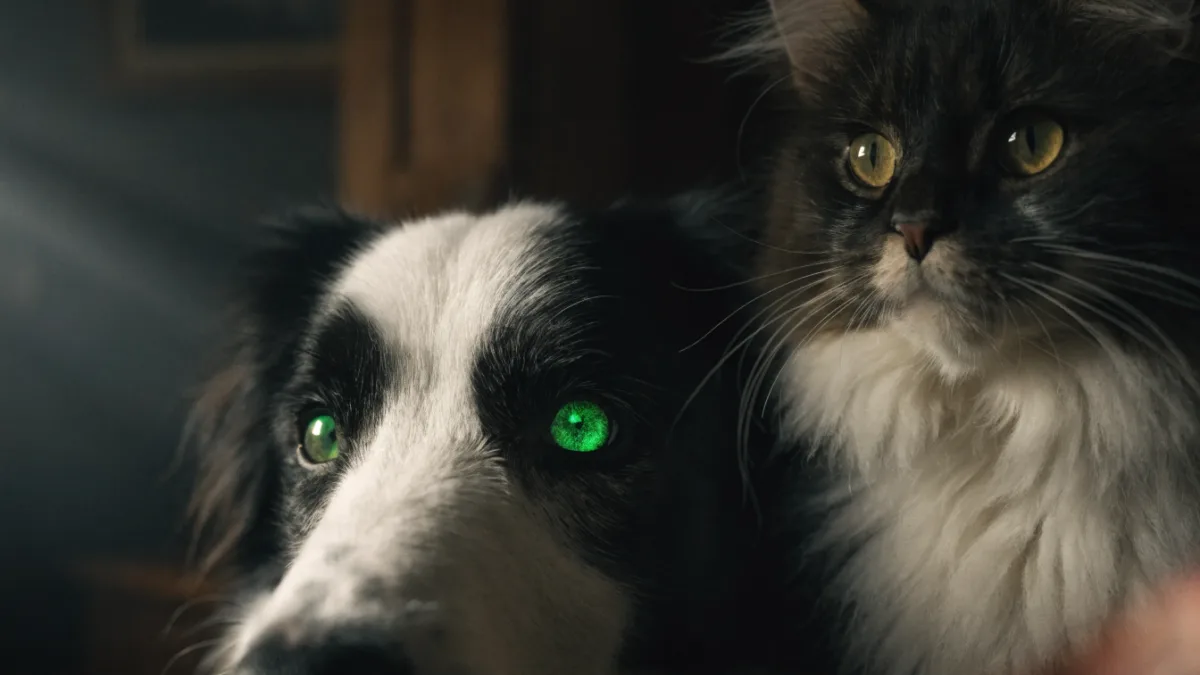
If you’ve ever stumbled to the kitchen for a glass of water at 2 a.m. and been greeted by two glowing green orbs staring at you from the hallway, you already know the unsettling magic of pet eyes at night. There’s a memorable version of this call: an owner named Maria, who had recently adopted a black Maine Coon cat named Sirius, convinced something was wrong with him. “His eyes are glowing,” she whispered into the phone, as though she were reporting a paranormal event. “Like, actually glowing. Is he okay?” The reassuring answer, given to countless pet owners over the years, is that what she was seeing wasn’t supernatural — it was one of the most elegant little engineering feats in mammalian anatomy.
The Shining Layer: Meet the Tapetum Lucidum
That ghostly glow coming from your dog’s or cat’s eyes has a name, and it’s a beautiful one: the tapetum lucidum. It’s Latin for “shining layer,” which is exactly what it does. The structure itself is a thin, reflective layer of tissue sitting right behind the retina — the light-sensitive lining at the back of the eye. Think of it as a tiny biological mirror.
Here’s what surprises most people when I explain it in the exam room: the eyes aren’t actually producing any light of their own. Despite the phrase “glowing in the dark,” there’s no bioluminescence happening. Your Labrador isn’t a firefly. What you’re seeing is reflected light — light that entered the eye, passed through the retina, bounced off the tapetum lucidum, and reflected back outward. That’s why you only see the glow when there’s at least a tiny light source around: a porch light, headlights, a camera flash, or even a bright full moon.
I sometimes demonstrate this for clients using my ophthalmoscope in a dim exam room. When I shine the instrument’s light toward a dog’s retina, that greenish-yellow reflection bounces right back at me. It’s a normal, healthy sign — and honestly, it never stops being a little magical, even after years of practice.
How It Works: The “Second Chance” for Light
To really appreciate what the tapetum lucidum does, it helps to understand what the eye is trying to accomplish. Vision happens when light hits photoreceptors — specialized cells called rods and cones — in the retina. Rods handle low-light vision and motion detection, while cones manage color and detail. Dogs and cats have far more rods than humans do, which already gives them a built-in advantage in dim conditions.
But evolution went one step further. In low light, not every photon (particle of light) gets absorbed by those rods on the first pass. Some of it sails right past the photoreceptors and would ordinarily be lost forever. The tapetum lucidum catches that escaping light and reflects it back through the retina, giving the photoreceptors what I like to call a “second chance” to absorb it.
It’s not that dogs and cats can see in total darkness — no animal can. But they can make extraordinarily efficient use of whatever tiny bits of light happen to be available.
Imagine reading a book by candlelight. Now imagine someone hands you a second candle. The page isn’t suddenly blazing with light, but you can make out the words much more clearly. That’s essentially what the tapetum does for your pet — it doubles the usefulness of ambient light.
Why Cats Outshine Dogs (and Both Outshine Us)
Cats are the undisputed champions of low-light vision among our companion animals. Their tapetum lucidum is particularly well-developed, and they also have an unusually high concentration of rods — roughly six to eight times more than humans. Combined, these features allow cats to see in light conditions that would leave us essentially blind. A dog’s night vision is impressive too, significantly better than ours, but cats are the true specialists.
Both species also have another trick: large pupils that can dilate far wider than ours. When your cat’s pupils blow open into those enormous black saucers at dusk, they’re physically pulling in as much available light as possible. It’s the same principle behind a camera’s aperture opening wider in a dark room.
The Evolutionary Backstory
The tapetum lucidum isn’t unique to dogs and cats — not by a long shot. This reflective layer appears across a remarkably wide range of species: deer, cows, horses, ferrets, seals, and even some sharks. It’s a powerful example of convergent evolution, where unrelated species independently develop the same useful trait because it solves a shared problem.
For the wild ancestors of our pets, good night vision wasn’t a luxury. It was survival. The early cats that prowled the forests and grasslands were crepuscular hunters — most active during the murky hours of dawn and dusk, when prey animals were also moving but light was scarce. The ancient wolves that eventually became our dogs were similarly adapted for low-light pursuits, chasing down meals long after the sun had dipped below the horizon.
Humans, by contrast, evolved as primarily diurnal creatures. We traded exceptional night vision for sharper daytime color perception and visual acuity. Our cones dominate, and our rods are comparatively modest. That’s why your cat can navigate the living room at midnight with total confidence while you’re stubbing your toe on the coffee table.
Why the Glow Isn’t Always the Same Color
Pet owners sometimes notice that the eyeshine color varies — not just between species, but between individual animals, and even between a single animal’s two eyes. This is completely normal and comes down to differences in the tapetum lucidum’s structure and pigmentation.
- Green and yellow-green are the most common colors in both dogs and cats.
- Blue or white can appear in some animals, particularly those with lighter eye colors or blue irises.
- Red or orange glow often shows up in animals with tapeta that are less pigmented or in eyes where the tapetum is absent in certain areas.
- Dogs without a tapetum — about 10% of them, particularly some Beagles and other breeds — may show a reddish reflection because you’re seeing the blood-rich tissue at the back of the eye directly.
I once saw a Husky named Loki whose left eye reflected brilliant green while the right one glowed a softer amber. His owner, a photographer, was photographing him in the backyard and thought the asymmetry indicated disease. After a thorough exam, I confirmed what I suspected: Loki simply had subtle differences in the pigmentation of each tapetum. It was a quirk, not a problem — though it did make for an oddly striking portrait.
When to Pay Attention to Eyeshine Changes
While we’re on the subject, the tapetum lucidum can occasionally tip us off that something’s wrong. If you’re used to seeing a bright, even glow from your pet’s eyes and suddenly notice that one eye looks duller, dimmer, or a significantly different color than the other, it’s worth having your veterinarian take a look. Conditions like cataracts, retinal disease, or internal eye inflammation can all alter how light reflects inside the eye.
The key word is change. A pet who’s always had faintly asymmetric eyeshine probably has nothing to worry about. A pet whose eyeshine has noticeably shifted — especially if accompanied by squinting, redness, discharge, or bumping into things — should be examined promptly.
Appreciating the Wild in Our Living Room
The next time you catch those luminous eyes staring back at you from across a dark room, take a moment to appreciate what you’re really seeing. That glow is a direct link to your pet’s wild ancestry — a piece of evolutionary engineering that helped their ancestors hunt, survive, and eventually find their way to our hearths. It’s a reminder that the soft, purring creature on your lap or the wagging tail at your feet is still, in many ways, a creature built for the night.
And the broader takeaway? The natural world is full of adaptations like this — elegant solutions to environmental challenges that took millions of years to perfect. Whether it’s a cat’s tapetum, an owl’s silent flight, or a deep-sea fish’s bioluminescent lure, these biological innovations deserve our wonder and our protection. Supporting wildlife conservation — through donations, advocacy, or simply teaching the next generation to value biodiversity — ensures that the same evolutionary creativity that gave your dog those shining eyes continues to thrive in ecosystems around the world.
So no, Maria’s cat Sirius wasn’t haunted or sick. He was simply doing what cats have done for millennia: seeing clearly in a world that, to the rest of us, looks impossibly dark.