

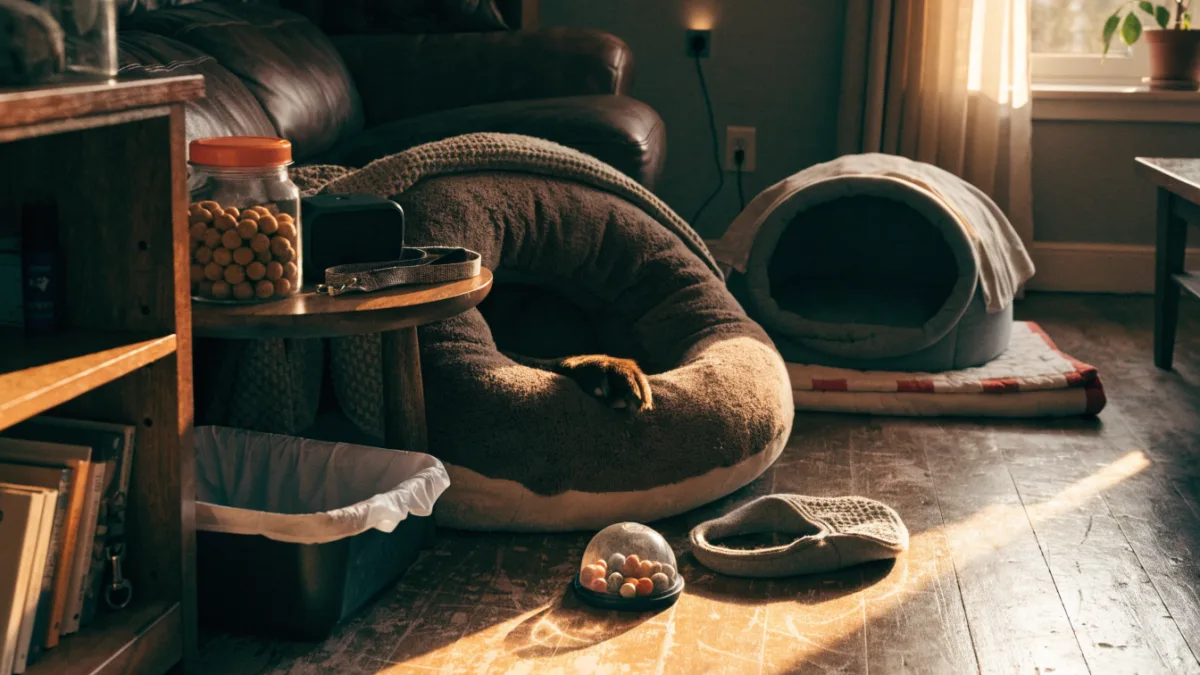
Mochi knows a storm is coming before my weather app does. The barometric pressure dips, and somewhere between my second coffee and the first far-off rumble, she’s relocated from her windowsill to the two-inch gap behind the guest room dresser, where she will remain until the sky formally apologizes. My childhood dog, Waffles, had the opposite strategy — a border collie mix who glued himself to the nearest human legs and shook like the floor was electrified. Two very different animals, one shared problem: boom season was coming for both of them.
Up to half of dogs show fear responses to fireworks and thunder — and July 5th is one of the busiest intake days of the year at U.S. animal shelters, because panicked pets run.
That stat isn’t meant to scare you, and neither is the rest of this article. It’s meant to light a small fire under you (sorry), because noise phobia is genuinely one of the most treatable anxieties our pets have — and the earlier you start, the easier it gets. Whether your local boom calendar is the Fourth of July, New Year’s Eve, festival season, or a summer storm that rolls in on a random Tuesday, your dog or cat deserves a plan, not a hope.
Two Species, Two Very Different Meltdowns
Dogs panic loudly. They pace, drool, vocalize, claw at doors, and — in the case of Waffles, circa year three of his thunder career — go straight through a screen door that had never wronged him. Cats panic quietly. They hide, freeze, skip meals, avoid the litter box, and occasionally bolt outdoors. Same fear, opposite volume settings, which is exactly why feline noise anxiety gets missed so often: the cat isn’t making a scene, so nobody checks whether she’s okay.
Why does the phobia develop in the first place? Cornell’s canine health team:[1] genetics (herding breeds like Waffles are notably overrepresented — I checked, it’s not personal), a missed socialization window in puppyhood (roughly 3 to 14 weeks), one bad traumatic association, or even living with another anxious animal. And here’s the part that matters most: untreated noise fear tends to intensify with each exposure. Mild trembling one season can become wall-crashing escape attempts within a few years. That progression from “shaky dog” to “destroyed doorframe” is not your dog being dramatic. It’s a phobia doing what phobias do.
One wrinkle specific to thunderstorms: dogs and cats often react before any sound is audible. Falling barometric pressure, static electricity in their coat, even the smell of an approaching storm can trigger the fear response. This is why Mochi vanishes while the sky is still blue, and it’s why sound training alone doesn’t fully fix storm fear — the forecast itself is part of the trigger.
The Countdown Plan
Two to Three Months Out: Teach the Sound Before the Sound
This is desensitization and counterconditioning — pairing scary sounds with wonderful things at a volume so low it barely registers. The sequence matters: first teach a relaxed settle on a mat (my colleague Jake is your person for the mechanics of that), then play storm or fireworks recordings at whisper-level while handing out high-value treats. Raise the volume only when your pet stays relaxed. The one rule that cannot be broken: never crank the volume to “get them used to it.” That’s called flooding, it backfires, and it can make the phobia significantly worse.
Four to Six Weeks Out: Book the Vet
Industry surveys consistently find that fewer than half of owners who notice fear signs ever bring them up with their veterinarian. Don’t be in that group. This appointment is where you discuss prescription options — there’s now an FDA-approved medication (dexmedetomidine, a gel applied to the gums) specifically for canine noise aversion, alongside commonly prescribed meds like trazodone and gabapentin. And whatever you land on, do a trial dose before the real event. You want to know how your individual pet responds on a quiet Tuesday, not discover at 9 p.m. on fireworks night.
One to Two Weeks Out: Build the Safe Room, Check the ID
Pick an interior room — no windows, den-like, away from the noise. A crate with the door left open, a pile of blankets, whatever your pet already trusts. If you’re using pheromone diffusers (dog-appeasing pheromone for dogs, feline facial pheromone for cats), plug them in now; they need days to build up in the room. Then do the unglamorous errand: verify your pet’s microchip registration actually has your current phone number, not the one from three moves ago. Microchipped dogs make it home at roughly twice the rate of unchipped ones — but only if the chip leads somewhere. Update the tags and take a fresh photo while you’re at it.
Event Day: The Checklist
Medicate on your vet’s schedule — timing is everything. Exercise early in the day; a long morning walk doesn’t cure anxiety, but it lowers the baseline. Close windows and curtains against the flash of fireworks. Run fans or white noise, plus calming music designed specifically for pets. Frozen food-stuffed toys give a panicking brain something else to do. Stay home if you possibly can, and [2] — panicked escapes on fireworks night are exactly how pets end up in shelters. A frightened dog will clear a fence they’ve respected for eight years.
The Cat Part Nobody Talks About
Feline noise fear is badly understudied — the research lags years behind the canine side — but the surveys we have say fireworks and thunder are common triggers for cats too. The signs are just subtle: hiding, freezing, appetite changes, litter box avoidance, or what looks like a cat who simply “disappeared for the evening.” That’s not chill. That’s fear.
The cardinal rule: never drag a hiding cat out. Hiding is her coping strategy, not a problem to be solved. Give her a better refuge instead — an interior closet or under-bed cave with water, and if she’s holed up for hours, litter box access nearby. For genuinely anxious cats, it’s worth asking your vet about medication options; in Europe, a pregabalin solution was recently approved specifically for feline anxiety, a genuine milestone for a species that’s been medicated off-label for decades. Availability varies by country, so it’s a conversation, not a shopping list.
Mochi’s setup, for the record: a cardboard box inside the guest room closet, lined with a fleece she already loves, positioned so she can see the door. She still hates thunder. But she hates it from a place that feels like hers, and she comes out on her own schedule instead of spending the night compressed behind a dresser where I can’t reach her if the house ever needed evacuating.
Myths, Debates, and Honest Uncertainty
“You’ll reinforce the fear if you comfort them.” Debunked, and good riddance. Fear is an emotional state, not a behavior you can reward — veterinary behaviorists have been clear on this for years. Soothe your pet freely. The only line: don’t force interaction on an animal that wants distance. Offer, don’t insist.
Sedation without anxiety relief. Some clinics still reach for acepromazine, but veterinary behaviorists widely criticize it for noise phobia: it sedates without reducing fear and may actually sharpen noise sensitivity, leaving you with an animal who is immobilized and terrified. If it comes up, ask questions. That’s not distrust of your vet — it’s being an informed client.
Compression vests. Hugely popular, and the controlled studies are genuinely mixed. My take: low-risk to try, fine to layer in, but not a standalone fix for a real phobia.
CBD. Heavily marketed, thinly evidenced, and with no regulatory oversight of dosing or purity. If you want to try it, run it past your vet first so it doesn’t interact with anything prescription.
And to the training purists who insist medication is a shortcut: most veterinarians now advocate combining approaches — behavior work and, when needed, medication — for moderate-to-severe cases. A dog too panicked to eat treats cannot learn. Medication can lower the fear enough for the training to actually reach them.
Here’s my honest takeaway after enough boom seasons to lose count: this problem gets worse when ignored and better when treated, so start earlier than feels necessary — the desensitization timeline especially rewards a head start. And with storm seasons stretching longer in many regions, “boom season” is less of a holiday weekend and more of a quarterly event, which makes the preparation worth doing properly. Your goal isn’t a pet who loves fireworks; that animal doesn’t exist. Your goal is a pet who gets through the night safely, in a den you built, wearing ID that works. Waffles never made peace with thunder, but with a plan, he got from “destroyed screen door” back to “trembling but home.” Mochi never will either — but she’s got her box, and honestly, I think she respects the effort.
Sources
- lays out the usual suspects — vet.cornell.edu
- make all yard trips leashed — news.vt.edu