

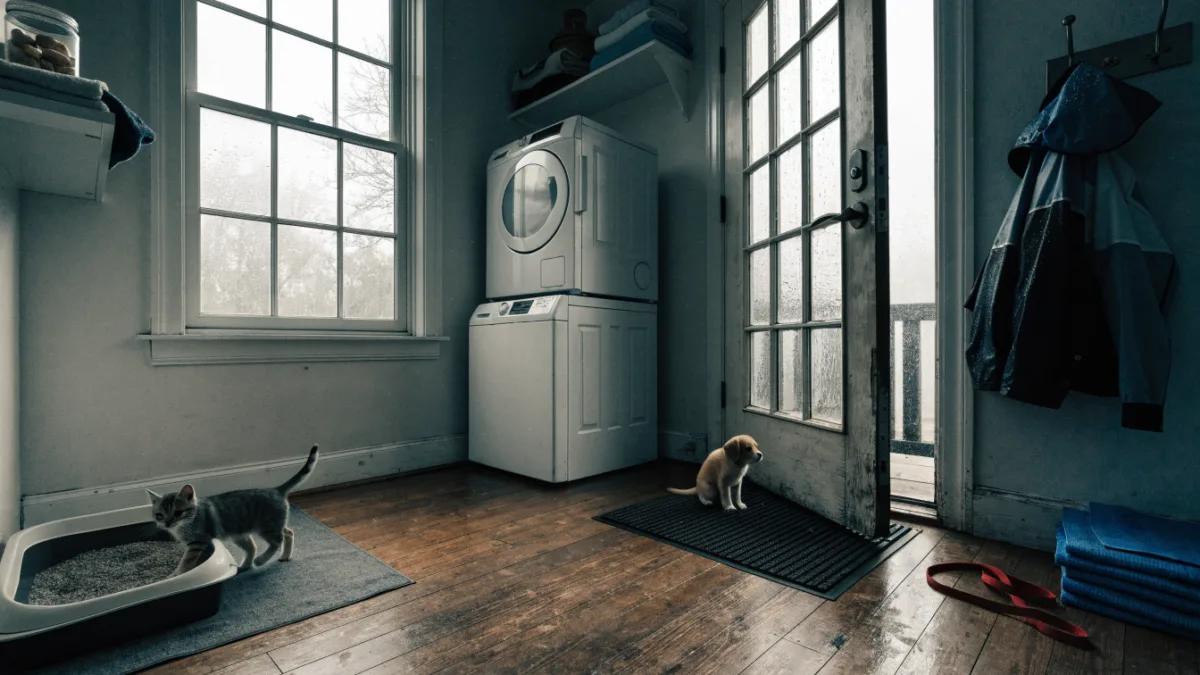
Last spring, a couple I work with brought home an eight-week-old Labrador puppy and a ten-week-old shelter kitten the same weekend. By Wednesday, the kitten was using her litter box like she’d written the manual. The Lab? He was still peeing behind the couch at week six. Neither of those outcomes was about good or bad training — it’s biology. Kittens arrive with the software pre-installed. Puppies show up with a blank hard drive and expect you to do the installation, one 2 a.m. trip outside at a time. Here’s how the two journeys actually compare, stage by stage, and what to do when either one goes sideways.
Instinct vs. Curriculum
The core difference between these two projects comes down to this: nobody teaches a kitten to use a litter box. Digging, squatting, and burying waste is hardwired feline behavior — cats evolved to hide their scent from predators and rivals, so a kitten will dig in litter (or garden dirt, or your houseplant, given the chance) with zero instruction. Most kittens start using a box at three to four weeks old, usually just by shadowing their mother. If you adopt at eight to twelve weeks, there’s a good chance your “training” consists of pointing at the box once.
Puppies have a natural instinct too, but it’s much narrower: they don’t like soiling their sleeping area. Your job is to teach them that the entire house is effectively the den — and, harder still, to teach them how to tell you when they need out. That’s why:[1] is the puppy, every time — up front, anyway. Kittens are the easier launch. But cat behaviorists will tell you the plot twist: when litter problems do happen, they’re often stubborner than puppy setbacks. More on that later.
The Side-by-Side Timeline
Here’s the honest calendar for both species, so you know what “on track” actually looks like:
| Age | Puppy | Kitten |
|---|---|---|
| Week 8 | Minimal bladder control — roughly one hour of holding per month of age. Expect 6–10+ potty trips a day, including overnight. | Likely already box-trained. Show her the box, keep it close, done. |
| Weeks 8–12 | Peak accident season. Crate training, constant supervision, trips after every wake-up, meal, drink, and play session. | Reliability builds fast. Just don’t move the box or switch litters on her. |
| Weeks 12–16 | Control improves; intervals stretch. Starts figuring out how to signal — pacing, whining, hovering at the door. | Fully dependable in most cases. Graduate to a standard box if you started with a low-sided one. |
| Months 4–6 | Full bladder control develops (16–20 weeks), but adolescence can trigger regressions. Don’t hand over unsupervised freedom yet. | Cruising. Preferences are forming — consistency in litter type matters now. |
| Months 6–12 | Most dogs are reliable by 4–6 months of training; small breeds can take up to a year. | Set it and forget it. Problems now are almost always environmental or medical. |
The Puppy Program
Since this is my home turf, let me walk you through what actually works. The whole system rests on four things:
- A ruthless schedule. Out after waking, after eating, after drinking, after play — every time, no exceptions. Puppies eliminate on a predictable clock, and you’re just being there when it rings.
- A properly sized crate. Just big enough to stand, turn around, and lie down. Too much space and they’ll designate a corner bathroom. The crate is a bedroom, never a punishment — a dog who associates it with fear is fighting you for no reason.
- Umbilical-cord supervision. When the pup’s loose in the house, clip the leash to your belt. If she’s within three feet of you, she can’t sneak off to the hallway. This one technique cuts accidents more than anything else I teach.
- Reward inside the moment. Treat and praise within a second or two of finishing outside — not after you’re back inside. Puppies connect consequences that are immediate, not delayed.
And when accidents happen — they will — clean with an enzyme-based cleaner, not an ammonia product. Ammonia mimics the chemical signature of urine, so you’re essentially leaving a sign that says “bathroom here.” I learned that one the hard way with a client’s Beagle who kept hitting the same floor tile for a month before we figured out the cleaner was re-inviting him.
What about puppy pads? Genuinely debated. Some trainers argue pads teach “go inside on soft stuff” and delay outdoor training; others see them as a lifeline for apartment dwellers. I’ve used both approaches depending on the household — just know that if you start with pads, transitioning off them is a second training project.
The Kitten Setup
Your job with a kitten isn’t training — it’s real estate. A few rules cover ninety percent of it, and they’re echoed in nearly every [2]
- Start with a low-sided box in a single room while she learns the layout of your home.
- Use unscented, non-clumping litter for kittens under about four months — young kittens may taste litter, and clumping clay can cause problems if swallowed. Switch to unscented clumping later.
- Keep the box far from food, water, and noisy appliances. A box next to a washing machine that kicks into spin cycle mid-squat will lose that cat’s trust.
- Follow the n+1 rule: one box per cat, plus one extra.
- Never relocate the box abruptly, and skip covered boxes and perfumed litters — they’re the two most common triggers for box refusal in cats.
One thing worth knowing: cats with painful paws — including declawed cats, where that practice still happens — frequently develop litter avoidance because granules hurt to dig in. If a rescued cat refuses the box, pain is a real suspect, not spite.
When Things Go Sideways
Rule one: rule out medicine first
A house-trained animal who suddenly starts having accidents gets a vet visit before a behavior plan. Full stop. Straining, frequent small urinations, blood in the urine, diarrhea — those are symptoms, not statements. I had a client with a Miniature Schnauzer who was rock-solid at five months, then started squatting in the hallway over a single weekend. She was braced for “he’s regressing.” It was a urinary tract infection. Two weeks of medication, back to normal. Cats get the same deal — UTIs, crystals, and parasites all show up as “litter box problems” first.
The usual regression triggers
Once health is cleared, look at what changed. For puppies: a move, a new baby or pet, adolescence (that four-to-six-month stretch is notorious), and weather — some dogs treat rain as a personal insult and would rather hold it than get their feet wet. For kittens: a moved box, a new litter formula, a new cat in the home, or a box that’s become too dirty for her standards — and cat standards are high.
Here’s the part I’ll cop to being wrong about earlier in my career: I used to shrug that cats were “just easier.” Then I watched a friend’s cat start urinating in the bathtub after they moved the litter box next to the new laundry machines. That cat held a grudge for months. Puppy accidents are a volume problem; cat avoidance is a mystery-novel problem. House soiling affects roughly one in ten cats at some point, and it’s a leading behavioral reason cats lose their homes — which tells you how badly these standoffs can go when people guess instead of investigating.
What never works: punishment
Rubbing a nose in it, yelling after the fact, swatting — all debunked, all counterproductive, for both species. A puppy punished for accidents doesn’t learn “don’t pee inside.” He learns “don’t pee where the human can see.” You get a dog who sneaks behind the couch, and a relationship built on fear. Same with cats: scolding near the box teaches her the box is dangerous. If you catch an accident in progress, interrupt calmly, carry the puppy outside or set the kitten in the box, and reward the finish. Clean it up and move on.
And yes, some people litter-train puppies — it’s a real niche practice, mostly for small breeds and brutal climates, and you’ll find heated debate in groups like [3] trying it in multi-cat households. It can work with patience, but treat it as an add-on, not a shortcut around the outdoor schedule.
So that’s the scorecard. The kitten’s race is a sprint — days, not weeks, if the setup is right. The puppy’s is a marathon measured in months, with a schedule, a crate, a leash on your belt loop, and enzyme cleaner in the cabinet. Different races, same rule: accidents are communication, not betrayal. Your puppy isn’t plotting against you and your kitten isn’t punishing you — they’re either too young to hold it, confused about the setup, or trying to tell you something hurts. Decode the message before you change the plan. Because the pets who end up surrendered over “house soiling” were almost always sending a signal nobody translated — and translating it is the cheapest, kindest fix there is.
Sources
- the honest answer to "which is harder?" — reddit.com
- credible guide to potty training dogs and cats — weenect.com
- this thread of Australian Shepherd owners — facebook.com