

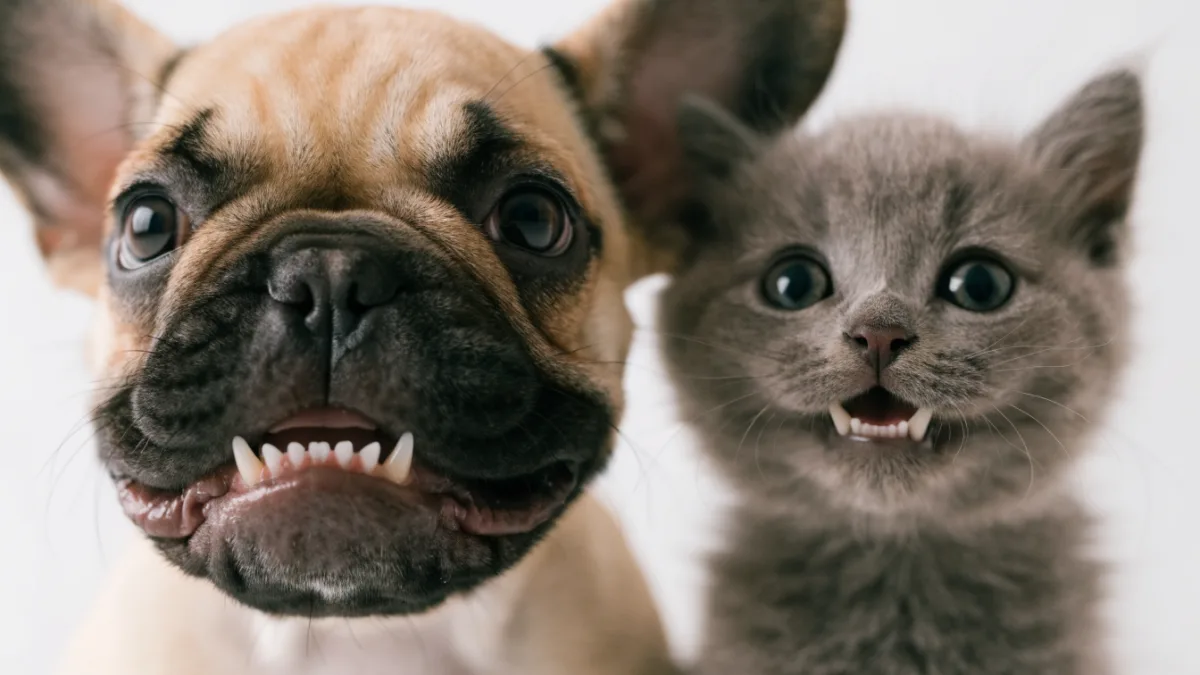
Just last week, I found myself smiling at an eight-month-old Shih Tzu named Barnaby. He had just been carried into my exam room, and true to his breed, he had a face only a mother—and a veterinarian—could love. His lower jaw jutted out proudly, and his tiny lower canine teeth pushed straight up into his upper lip. His owner, laughing, pointed out Barnaby’s “adorable little snaggletooth.”
It is easy to look at a crooked smile in a puppy or kitten and see nothing but charm. We even breed specifically for those flat faces and shortened snouts. But what many pet owners perceive as an endearing quirk is actually a dental malocclusion, which is simply a fancy medical term for a misalignment of teeth or a mismatch in how the jaws fit together.
When we talk about dog jaw alignment versus feline dental malocclusion, we are looking at two completely different sets of rules. Dogs and cats have evolved with different natural skull shapes, and human breeding practices have drastically altered those shapes—especially in dogs. Let us look at why your growing pet’s bite matters, when a crooked tooth is harmless, and when that cute smile is actually causing them pain.
Skeletal vs. Dental Malocclusions: What is Happening in the Mouth?
Before we dive into the differences between puppies and kittens, it helps to understand what we are looking at when we peer into a wiggling pet’s mouth. Malocclusions generally fall into two broad categories.
The first is a skeletal malocclusion. This happens when the actual jawbones are mismatched in length or width. An overbite (where the upper jaw is too long) or a puppy underbite (where the lower jaw is too long) are classic examples. The teeth themselves might be perfectly normal, but the foundation they sit on is the wrong size.
The second is a dental malocclusion. In this case, the jaws are the correct length, but individual teeth are simply in the wrong spot. They might be rotated, crowded, or erupting at a completely bizarre angle.
The “Puppy Underbite” Phenomenon
If you have ever owned a flat-faced (brachycephalic) breed like a Pug, French Bulldog, or Shih Tzu, you are intimately familiar with the puppy underbite. But long-snouted (dolichocephalic) breeds like Greyhounds and Collies have their own unique alignment challenges, too. Why are dogs so prone to crooked teeth?
It comes down to genetics and selective breeding. Humans spent centuries carefully altering the shape of canine skulls. We took a standard wolf-like jaw and artificially shortened it to create those flat, expressive faces. However, while we successfully shrank the jawbones, we did not shrink the teeth. Evolution just has not caught up to the dog show standard.
You are essentially asking the same number of adult teeth to fit into a drastically smaller space. The result? Teeth overlap, rotate, and push outward. This is why dog jaw alignment issues are so incredibly common.
Not every rotated tooth is a problem. If a tiny front incisor in a Pug is slightly turned sideways but does not touch any other teeth or rub against the gums, it is perfectly harmless. We call this a “functional malocclusion.” It looks a bit odd, but it does not cause the dog any discomfort.
How Kittens Differ: Feline Dental Malocclusion
Now, let us talk about cats. Kittens generally have much more natural jaw alignments compared to modern dog breeds. Because we have historically interfered much less with the basic structure of the feline skull, their teeth tend to erupt exactly where they are supposed to.
When we do see a feline dental malocclusion, it is usually an individual tooth issue rather than a massive skeletal mismatch—though there are exceptions. Flat-faced cats like Persians and Himalayans suffer from the same jaw-to-tooth ratio problems as flat-faced dogs, frequently dealing with crowding and overlapping teeth.
For the average domestic shorthair, though, malocclusions are typically caused by trauma to the jaw or, more commonly, retained baby teeth. If a kitten’s adult tooth comes in right next to a stubborn baby tooth that refuses to fall out, the adult tooth will be deflected and grow in at an angle.
When a Quirky Smile Becomes a Medical Crisis
This is the most critical part of our conversation. When does a malocclusion cross the line from a cosmetic quirk to a medical necessity?
The rule of thumb is simple: if a misaligned tooth is hitting another tooth, puncturing the gums, or digging into the roof of the mouth (the palate), it is a medical emergency.
Animals are notoriously good at hiding oral pain. A dog or cat will rarely stop eating just because their mouth hurts; their survival instincts are simply too strong. Instead, they quietly adapt. One of the most painful scenarios I see is called a base narrow mandibular canine. This happens when a dog’s lower canine teeth point inward instead of straight up.
A few years ago, a six-month-old Labrador Retriever named Cooper came in. His owner brought him in because he had started acting “aloof” and was refusing to play fetch, which was incredibly out of character. On examination, the cause was immediately clear. Cooper’s lower canine teeth were digging directly into the roof of his mouth, burrowing two deep, bleeding holes into his palate right behind his upper teeth. Imagine having two needles stabbing the roof of your mouth every time you closed your jaw.
His owner was horrified—she thought he was just losing interest in his toys. We brought Cooper in for a procedure called crown reduction. A veterinary dentist carefully shaved down the problematic teeth, smoothed the edges, and applied a protective sealant. Within a week, Cooper was back to happily retrieving tennis balls.
The American Veterinary Dental College (AVDC) is very strict about this: orthodontic intervention in pets must never be used purely to make an animal look a certain way for a dog or cat show. Braces, extractions, and filings must be used solely to alleviate pain and restore function.
The Hidden Culprit: Retained Baby Teeth
One of the most common causes of sudden, painful misalignments in young pets is retained deciduous (baby) teeth.
In both puppies and kittens, the roots of the baby teeth are supposed to dissolve as the adult teeth push through the gums, allowing the baby teeth to fall out naturally. Usually, by the time a pet is six to seven months old, all their adult teeth should be in place.
But sometimes, the roots do not dissolve properly. The baby tooth stays firmly anchored, and the adult tooth is forced to erupt right next to it. Because the baby tooth is blocking the proper path, the adult tooth gets pushed out of alignment.
I always tell new puppy and kitten owners to do a quick “tooth check” around the five-month mark. If you see a double row of teeth—especially the long canine teeth (the fangs)—it is time to call your vet. Extracting that retained baby tooth quickly can often save the adult tooth from growing in crooked, preventing a lifetime of orthodontic issues.
Fixing the Bite: Extractions, Reductions, and Pet Braces
If your pet is diagnosed with a painful malocclusion, do not panic. Veterinary dentistry has advanced incredibly over the last decade, moving far beyond the old mindset that pets simply have bad breath and there is nothing to be done about it.
Depending on the specific alignment issue, we have several tools at our disposal:
- Extractions: If a tooth is severely crowded or causing trauma to the palate, the safest and fastest solution is often to simply remove the offending tooth. Once the sharp tip is gone, the trauma to the surrounding tissue stops immediately.
- Crown Reduction: As with Cooper the Labrador, we can carefully file down the tip of a tooth, smooth the pulp chamber, and seal it so it no longer hits the roof of the mouth.
- Pet Orthodontics (Braces): Yes, dogs and cats can get braces. Just like human braces, these are acrylic or wire appliances glued to the teeth to slowly shift them into a functional position. And yes, I have changed my mind on this over the years. Early in my career, I thought pet braces were an unnecessary luxury. But after seeing how dramatically they can relieve chronic pain without resorting to pulling healthy teeth, I now view them as a vital tool when used for the right medical reasons.
Final Thoughts
It is easy to be mesmerized by the cute, crooked smile of a growing puppy or kitten. But our pets rely on us to look past the aesthetics and ensure their bodies are functioning comfortably.
Whether you are dealing with a classic puppy underbite, monitoring your flat-faced Persian’s crowded teeth, or just checking to make sure those stubborn baby teeth fall out on time, proactive dental care is a vital part of pet ownership. Always ask your veterinarian to perform a thorough oral exam during your pet’s annual visits. Because a healthy, pain-free mouth is the foundation for a long, happy life—no matter how perfectly, or imperfectly, their teeth happen to line up.