

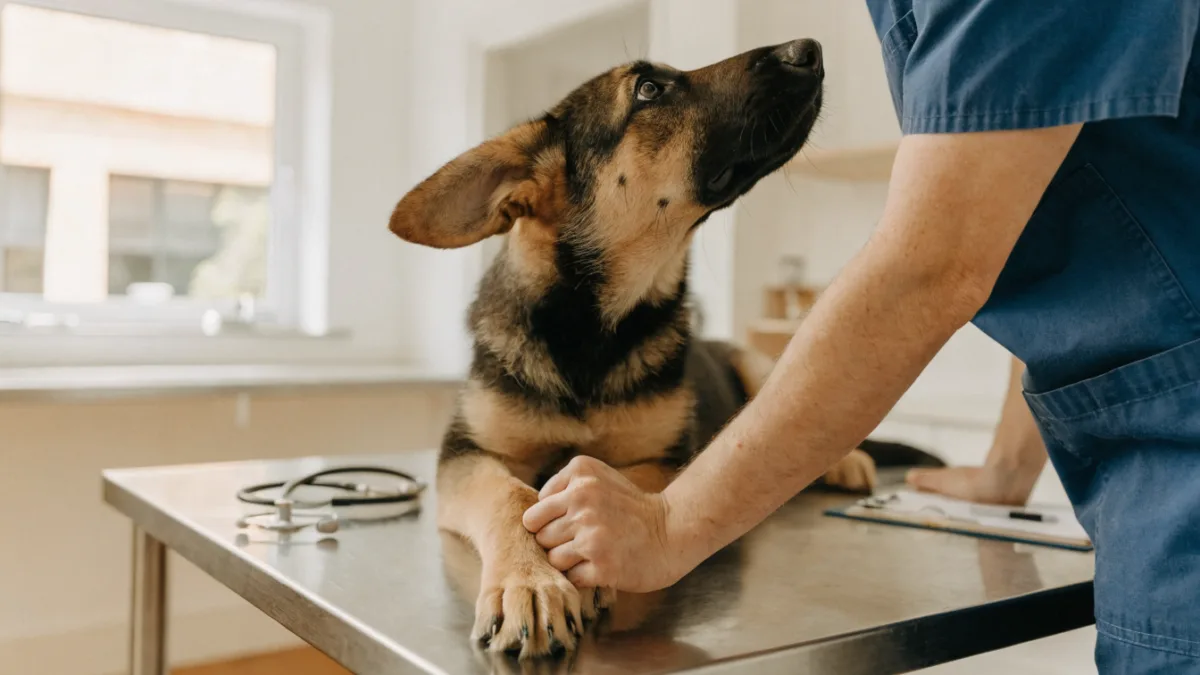
Picture the Andersons bringing their six-month-old German Shepherd puppy, Bruno, into the clinic on a Tuesday morning, convinced he’d broken his leg. He’d been bounding around the backyard the evening before, and by bedtime, he was holding up his right front paw and whining softly. Mrs. Anderson looked terrified. But watching Bruno trot down the hallway revealed something interesting: he was barely favoring that leg anymore. By the time he reached the exam room, he was weight-bearing on all fours, tail wagging, as if nothing had happened. What his owners didn’t yet know was that Bruno was experiencing a classic case of panosteitis — the mysterious “growing pains” that send countless large-breed puppy owners into a panic every year.
When “Growing Pains” Aren’t Just an Expression
Panosteitis, sometimes called “eosinophilic panosteitis” or simply “pano,” is a condition that primarily affects the long bones — think the femur, humerus, and tibia — of large and giant breed dogs. It typically shows up between five and eighteen months of age, right in the thick of adolescence when these puppies are growing at what seems like an impossible rate.
Here’s what’s actually happening inside the bone: the marrow — that spongy tissue in the center of long bones — becomes inflamed. We’re not entirely sure why. There’s evidence that genetics play a role, and German Shepherds like Bruno are overrepresented, along with Golden Retrievers, Labrador Retrievers, Basset Hounds, and Dobermans. But the exact trigger remains one of veterinary medicine’s more stubborn mysteries.
What I tell owners is this: pano is the quintessential “shifting leg lameness.” One week it’s the front left. Two weeks later, it’s the back right. The pain is very real — these dogs are genuinely uncomfortable — but it’s also self-limiting. By the time most dogs reach eighteen to twenty-four months of age and their growth plates close, panosteitis typically disappears on its own.
The hardest part of diagnosing pano isn’t the medicine. It’s helping anxious owners understand that a limping puppy doesn’t always mean something catastrophic. Sometimes it just means their dog is growing up.
The Nutrition Question
There’s ongoing discussion in veterinary circles about whether diet plays a role in triggering or worsening panosteitis. The theory goes something like this: over-nutrition — feeding puppies more calories, protein, or calcium than they need — may accelerate bone growth in ways that predispose large breeds to developmental orthopedic problems. I’ll be honest: I’ve changed my thinking on this over the years. Earlier in my career, I was fairly dismissive of the calcium-protein connection. But the evidence has become harder to ignore. We now know that large-breed puppy diets — specifically formulated with controlled calcium-to-phosphorus ratios — genuinely seem to reduce the severity and frequency of developmental bone issues. Not eliminate them entirely, but reduce them.
What I recommend to owners of large-breed puppies is straightforward: choose a diet specifically labeled for large-breed growth, and resist the urge to “bulk up” a growing puppy with extra supplements. More is not better here. It’s just more.
Cats Don’t Get Growing Pains — They Get Landing Wrong
Now let’s talk about the other side of the limping equation. A few weeks after Bruno’s visit, a twelve-pound orange tabby named Miso came in. His owner, Mr. Reyes, had noticed Miso skipping his usual morning zoomies and sleeping in the closet — a spot he’d never favored before. When Miso finally emerged for breakfast, he was holding his left hind leg up and moving gingerly.
Miso hadn’t broken anything. He’d sprained his stifle — that’s the veterinary term for the knee joint — almost certainly during one of his acrobatic leaps from the kitchen counter the night before. Cats are extraordinary athletes, but their confidence occasionally outpaces their physics. Soft tissue injuries like sprains (which involve ligaments) and strains (which involve muscles or tendons) are the leading cause of limping in pets, and cats are particularly prone to them because of how they move: explosive jumps, awkward landings, and that signature mid-air twist that looks impressive until something pulls the wrong way.
The key difference between dogs and cats here isn’t just anatomy — it’s how the injury presents. A dog with pano might yelp and hold up a leg dramatically, then appear fine an hour later. A cat with a sprain will often do what Miso did: quietly change his behavior, find a hiding spot, and hope you don’t notice anything is wrong.
Reading the Signs Beyond the Limp
This brings me to one of the most important things I want owners to understand: limping is a classic sign of pain, but it’s not the most common one. In fact, by the time a pet is visibly limping, they’ve often been uncomfortable for days or even weeks.
Cats are especially skilled at masking discomfort — an evolutionary survival instinct that serves them poorly in a home environment where early intervention matters. The Feline Grimace Scale, a relatively recent tool developed by veterinary researchers, has been a game-changer for helping owners and clinicians recognize subtle pain in cats. It evaluates ear position, orbital tightening, muzzle tension, whisker changes, and head position. If you know what to look for, a cat’s face tells you a great deal.
But you don’t need a clinical tool to start paying closer attention. Here are the signs I ask every owner to watch for:
- Changes in sleep patterns — sleeping more than usual, or sleeping in new, unusual locations (like Miso in the closet)
- Appetite changes — eating less, eating more slowly, or showing less enthusiasm for food
- Reduced activity — fewer zoomies, shorter walks, reluctance to jump onto furniture
- Grooming changes — cats may stop grooming themselves, or may over-groom a painful area
- Social withdrawal — a typically affectionate pet becomes withdrawn or irritable when touched
- Nausea or digestive changes — pain can trigger gastrointestinal upset in both dogs and cats
Mr. Reyes nearly missed Miso’s sprain because Miso didn’t yelp or cry. He just quietly retreated. The limp was almost an afterthought — a clue his owner noticed only because he was already paying attention to the behavioral shifts.
Assessing the Limp at Home
When you notice your pet limping, take a breath before panicking. There’s a structured way to assess what you’re seeing that can help you decide whether you’re dealing with a minor issue or something that needs immediate attention.
Start With Observation
Watch your pet walk on a flat, non-slippery surface. Which leg is affected? Is the limp constant, or does it come and go? Does your pet touch the leg to the ground at all, or hold it up entirely? A pet who is non-weight-bearing — meaning they won’t put any pressure on the limb — needs to be seen sooner rather than later.
Gentle Physical Assessment
With calm, slow movements, run your hands along the affected leg. You’re checking for three things: visible swelling, heat compared to the opposite leg, and areas where your pet flinches or pulls away. Compare the suspicious leg to the healthy one — your hands will often detect a temperature difference or subtle swelling before your eyes do. If you find an obvious deformity, an open wound, or your pet reacts with sharp pain when you barely touch the area, stop and call your vet.
The Rest Test
For minor limps with no swelling, heat, or deformity, strict rest for twenty-four to forty-eight hours is reasonable. And I mean strict: no walks, no stairs, no jumping, no play. Crate rest or confinement to a small room. If the limp improves significantly with rest, you’re likely dealing with a mild soft tissue injury. If it doesn’t improve — or worsens — it’s time for professional help.
When to Skip the Waiting and Call Your Vet
There’s a real debate among pet owners about whether every limp warrants a veterinary visit, or whether careful home rest is sufficient. I understand the hesitation — veterinary care is an investment, and nobody wants to feel like they overreacted. But I’ve seen enough cases where “just a sprain” turned out to be a torn cranial cruciate ligament (the canine equivalent of an ACL tear), a fracture, or even bone cancer to know that waiting has real costs.
Here’s my threshold for when home rest is no longer appropriate:
- The limp persists beyond 24-48 hours of strict rest
- Your pet is non-weight-bearing — refusing to put any pressure on the limb
- There’s visible swelling, heat, or deformity in the leg or joint
- Your pet is showing other pain signs — not eating, lethargic, hiding, panting excessively in dogs
- The limp keeps “shifting” between legs — a hallmark of panosteitis that still warrants diagnosis and pain management
- Your pet has a fever or the leg feels unusually warm to the touch
For conditions like panosteitis, while the condition itself is self-limiting, the pain during flare-ups can be significant. We have more options now than ever for managing that discomfort. Modern veterinary medicine has shifted toward what we call multimodal pain management — combining anti-inflammatory medications, joint support supplements, physical therapy, and in some cases newer pain medications that target nerve pathways differently than traditional NSAIDs. The goal isn’t just to mask pain; it’s to keep young dogs comfortable and moving normally while their bodies finish growing.
And for cats like Miso, who are hiding a soft tissue injury behind closed eyes and a quiet demeanor, early intervention means faster healing and less compensation injury risk. When a cat favors one leg, they shift their weight to others — and that uneven loading can create secondary problems in the back, hips, and opposite limbs if left unaddressed.
Bruno outgrew his panosteitis by fourteen months. Miso’s sprain healed with two weeks of restricted activity and a short course of anti-inflammatory medication. Both of their owners learned the same lesson I’ll leave you with: our pets can’t tell us when something hurts, but they’re always communicating. The limp is just one sentence in a much longer conversation. Learning to listen to the rest of it — the sleeping patterns, the appetite shifts, the subtle changes in where and how they move — is one of the most meaningful things we can do for the animals who share our lives. They depend on us to notice. So notice.