

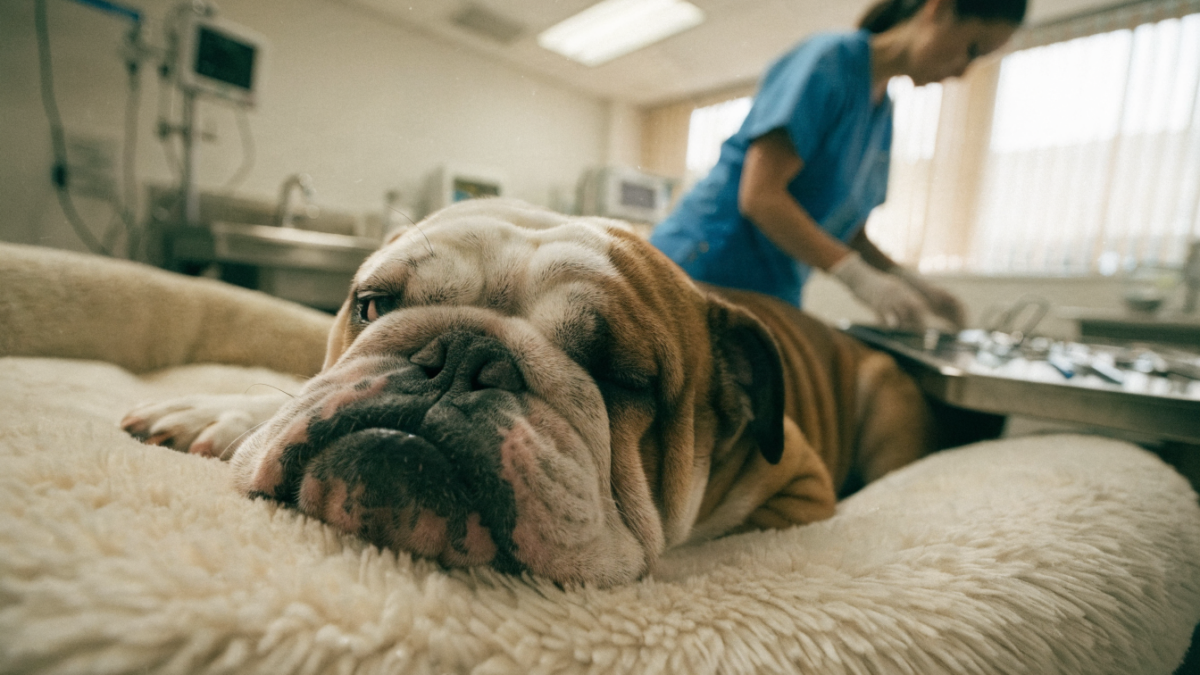
The phone rang at 2:00 AM last spring, and I immediately recognized the panicked voice on the other end. It was Marcus, a regular client, and his three-year-old French Bulldog, Beans, was in trouble. Beans had been straining for over an hour, producing nothing but a greenish-brown discharge. I told Marcus to grab her and head straight to the clinic. When he arrived, Beans was exhausted, her gums pale, her breathing shallow and raspy. We rushed her into the back for an X-ray, which confirmed exactly what I suspected: a puppy with a massive skull was wedged tightly in the birth canal, completely stuck. We immediately prepped her for emergency surgery.
This scenario is so common in my line of work that it practically constitutes a routine Tuesday night. But for Beans, and for thousands of flat-faced pets like her, this medical crisis is entirely manufactured. We have bred these animals to be so anatomically extreme that they can no longer give birth naturally. For many flat-faced, or brachycephalic, breeds, a surgical birth isn’t an unexpected emergency—it is a biologically required standard.
The Anatomy of a Crisis: When Heads Don’t Fit
In veterinary medicine, we use the term dystocia to describe a difficult or abnormal birth. When a human experiences dystocia, it’s usually due to the baby’s positioning. But when a French Bulldog or an English Bulldog experiences dystocia, it’s usually because of a fundamental, structural mismatch between the mother and her offspring.
Over the last century, selective breeding for aesthetic preferences has drastically altered the skeletal structure of these dogs. Breed standards began favoring massive, oversized heads, broad shoulders, and narrow pelvises. While this combination creates a specific “cute” or stocky silhouette that appeals to many pet owners, it creates a mechanical nightmare for delivery. The puppies’ heads and shoulders are simply too wide to pass through the mother’s pelvic canal.
I always explain it to clients like this: imagine trying to push a watermelon through a keyhole. No matter how hard the mother pushes, the physics just aren’t going to work. When we talk about,[1] we are looking at a situation where natural birth is now biologically near-impossible without human medical intervention.
The Surgery Shuffle: What a Pet C-Section Really Looks Like
When Beans arrived at the clinic that night, we didn’t waste any time attempting medical interventions like oxytocin to stimulate contractions. Doing so in a brachycephalic dog with a physically blocked puppy can cause the uterus to rupture. The only option was a Caesarean section.
For breeds like the English and French Bulldog, surgical birth is now considered a standard part of reproduction rather than an emergency exception. Ethical breeders of these dogs don’t even wait for labor to begin; they schedule the C-section in advance. But these surgeries are incredibly delicate.
The Hidden Anesthetic Risks
Brachycephalic animals face a condition called Brachycephalic Obstructive Airway Syndrome (BOAS). Because humans have bred their skulls to be unnaturally short, the soft tissues inside their mouths and throats—like the soft palate and tonsils—haven’t shrunk to match. These tissues get packed into a smaller space, partially blocking the airway.
When we put a flat-faced dog under anesthesia for a C-section, managing their airway is a massive challenge. I remember speaking with a colleague years ago who casually mentioned how “routine” bulldog C-sections were, but I’ve always approached them with my heart in my throat. Over the years, I’ve changed my mind on the casual nature of these procedures. The risks of,[2] going under anesthesia are incredibly high. Every time we intubate them, there’s a risk that their inflamed, narrowed airways will spasm or completely obstruct.
For a flat-faced breed, reproduction is a complex, high-stakes medical procedure, not the natural, instinctual process it is for other mammals.
Thankfully, Beans came through her surgery beautifully. We safely delivered three robust, wriggling puppies. But when I handed those puppies to Marcus, I couldn’t help but feel a pang of concern for their future.
It’s Not Just Dogs: The Feline Flat-Face Dilemma
While we spend a lot of time discussing the birth crises in flat-faced dogs, we rarely talk about their feline counterparts. Brachycephalic cats, particularly Persians and Exotic Shorthairs, suffer from the exact same selective breeding consequences. Their skull deformities cause profound structural issues that go far beyond how they give birth.
Because their faces are so flattened, their tear ducts often cannot drain properly. Consider a stunning Persian cat named Cleopatra, seen a few months ago. Her owner brought her in because her face was constantly wet, and the fur around her eyes was stained dark brown. The owner thought this was just “normal” for the breed. I had to explain that Cleopatra’s tears weren’t draining into her nose as they should; they were simply spilling over her face. This constant moisture leads to chronic skin infections and painful eye ulcers.
According to research on [3] these animals are routinely affected by severe ophthalmic (eye) and facial issues directly tied to their skull shape. While BOAS is highly studied and standardized in dogs, cats are frequently sidelined in these welfare conversations, leaving them to suffer in silence with dental crowding, severe breathing issues, and birthing difficulties of their own.
The Tide is Turning: Ethics, Standards, and a Global Shift
There is an ongoing, heated debate within the veterinary and breeding communities regarding the morality of continuing to breed animals whose natural reproductive capabilities have been essentially bred out of them. Can we truly call a breed healthy if it cannot reproduce or breathe properly without medical intervention?
Kennel clubs and breed registries are frequently criticized for maintaining aesthetic standards that perpetuate these health crises. Breed clubs often argue for gradually improving the breeds from within, but animal welfare advocates argue that the timeline is too slow. The physical extremes are simply too severe to correct with a few generations of careful pairing. This has led to a push for stricter regulations, and in some regions, outright bans on breeding the most extreme flat-faced phenotypes.
A Global Pushback
What gives me hope is that public perception is actively shifting. I am seeing a notable decline in the popularity of flat-faced breeds as pet owners become more educated about these severe health concerns. This pushback is highly visible on an international scale. In the United Kingdom, Australia, New Zealand, and across continental Europe, advertising platforms and even governments are taking steps to curb the promotion of these breeds.
Perhaps the most telling sign of this global shift is happening in France. The movement against the extreme breeding of the French Bulldog has gained significant traction in its very namesake country. When the global community—including the birthplace of the breed—begins to reject the aesthetic, you know a real cultural shift is underway.
Domestic pets like French Bulldogs and Persians are not endangered. In fact, they are historically among the most over-populated and highly sought-after animals in the world. But while we don’t need to conserve their population numbers, animal welfare advocates argue fiercely for the “conservation” of their biological health. We have to prioritize the dog over the aesthetic.
When Marcus brought Beans and her puppies back for their two-week checkup, he looked at me and asked, “Do you think they’ll be okay?” I looked at the three little flat-faced puppies, already starting to snore, and gave him my honest clinical answer: “We will love them, and we will give them the best medical care possible, but we have to stop pretending their bodies are okay.” If you are considering bringing a flat-faced pet into your life, I urge you to look past the cute, wrinkled face. Recognize the veterinary reality behind the aesthetic, and consider supporting breeders who are actively working to lengthen muzzles, narrow heads, and return these animals to a state where natural, healthy birth is possible once again.
Sources
- birthing difficulties in brachycephalic dogs — royalkennelclub.com
- brachycephalic dogs — orchardhousevets.com
- flat-faced cats — mdpi.com