

A few weeks ago, a couple sat across from me in the exam room with their five-month-old Labrador mix sprawled across both their laps. Learn more about preventive pet care: the here. The husband wanted to neuter at six months — "that's what my parents always did." The wife had read an article saying large breeds should wait until eighteen months. They'd been arguing about it for two weeks.
Spaying and neutering are among the most commonly performed veterinary surgeries, yet the conversations around them have grown more complicated over the past decade. New research on timing, breed-specific considerations, and alternatives to traditional surgery mean there's no single cookie-cutter answer anymore. That's actually a good thing, even if it makes the decision harder.
I've performed thousands of these procedures. And while the surgeries themselves are routine, the decision-making shouldn't be.
What Spaying and Neutering Actually Mean
Spaying — the technical term is ovariohysterectomy — involves removing the ovaries and uterus through an abdominal incision. Some surgeons perform an ovariectomy instead, removing only the ovaries and leaving the uterus. Both achieve the same result: no more heat cycles, no pregnancy risk, and a dramatic reduction in hormonally driven diseases.
Neutering, or castration, removes both testicles through a small incision in front of the scrotum (dogs) or on the scrotum itself (cats). It's a shorter procedure with a quicker recovery.
Both are performed under general anesthesia. If you've ever been nervous about understanding anesthesia in pets, you're not alone — it's the number-one concern I hear from owners. Modern veterinary anesthesia is remarkably safe, with mortality rates well under 1% in healthy animals.
Why Vets Recommend It
The health arguments for spaying females are strong. An intact female dog has roughly a 25% lifetime risk of developing mammary tumors, and about half of those are malignant. Spaying before the first heat cycle drops that risk to less than 0.5%. After the second heat, the protective effect diminishes significantly but doesn't disappear entirely.
Then there's pyometra — a life-threatening uterine infection that affects roughly 1 in 4 intact female dogs by age ten. I've done emergency pyometra surgeries at 2 AM on dogs who were septic and crashing. It's a preventable condition, and that fact sits with me.
For males, neutering eliminates testicular cancer (can't get cancer in an organ you don't have) and dramatically reduces prostate issues like benign prostatic hyperplasia. Perianal tumors also become much less common.
Behaviorally, neutering reduces roaming, urine marking, and inter-male aggression in many dogs. But it's not a magic fix for every behavioral issue — I need to be upfront about that. A dog who's reactive on leash because of poor socialization won't suddenly become calm after surgery.
The Timing Debate
This is where it gets genuinely complicated, and I think the veterinary profession is still working through the evidence.
Small dogs and cats: Most veterinarians, myself included, still recommend spaying or neutering around five to six months of age. The research on joint disease and cancer risk that has shifted timing recommendations mainly applies to larger breeds. Cats, in particular, can go into heat as young as four months, and an unplanned litter of kittens is both a welfare issue and a population one.
Large and giant breed dogs: Here's where the newer research matters. Studies from the University of California, Davis — particularly the work looking at Golden Retrievers, Labrador Retrievers, and German Shepherds — showed that early spay/neuter (before twelve months) was associated with increased rates of certain joint disorders and some cancers in these breeds. The mechanism likely relates to the role of sex hormones in growth plate closure and musculoskeletal development.
I had a client with a Great Dane puppy who asked if she should wait until two years. For a giant breed where growth plates don't close until around eighteen to twenty-four months, that's a reasonable question. But it also means managing an intact large dog for a long time, which has its own challenges.
The in-between: Medium-sized dogs (25-50 pounds at adult weight) are the gray zone. I usually discuss the options and let the owner's circumstances guide the decision. An owner with a securely fenced yard and no other intact dogs in the home has different risk calculations than someone in an apartment complex.
Preparing Your Pet for Surgery
-
Pre-surgical bloodwork. Most vets require or strongly recommend baseline blood panels to check liver and kidney function before anesthesia. For puppies and kittens under a year, a mini panel is usually sufficient. Older pets get a more comprehensive workup.
-
Fasting. Your pet will need to fast — no food after midnight the night before, though water is fine until the morning. This prevents aspiration during anesthesia. I once had an owner who thought "fasting" meant just reducing the amount of food. It doesn't. An empty stomach is what we need.
-
Medications. Let your vet know about any medications, supplements, or flea/tick products your pet is taking. Some can interact with anesthetic drugs.
-
Plan for recovery space. Before the surgery, set up a quiet, confined area at home. A crate, a small room, or a penned-off area where your pet can rest without jumping on furniture or racing around.
What Recovery Looks Like
Most pets go home the same day, though some clinics keep females overnight after spays since it's a more involved abdominal surgery.
The first 24 hours are the groggiest. Your pet may be wobbly, disoriented, or just want to sleep. That's normal. Some dogs whine or seem restless — they're processing residual anesthesia, not necessarily in pain, though we send home pain medication regardless.
By day two or three, you'll face the real challenge: a pet who feels fine and wants to play but absolutely should not. Activity restriction for ten to fourteen days is the hardest part of this entire process for most owners. And honestly, for their pets too.
The incision should look clean and slightly swollen for the first few days. A small amount of bruising is normal, especially in males. What's not normal: discharge, a foul smell, gaping edges, or swelling that keeps increasing after the first 48 hours.
I tell every client the same thing: when in doubt, send me a photo. I'd rather look at ten normal incisions than miss one that's infected.
The Weight Question
Here's something I wish more articles emphasized. Spayed and neutered pets have a lower metabolic rate — somewhere around 20-30% lower than their intact counterparts. If you keep feeding the same amount after surgery, weight gain is almost inevitable.
I've seen so many owners blame the surgery itself, as if the procedure somehow created fat. It didn't. The hormonal change shifted the metabolic equation, and the food bowl needs to shift too.
Drop the daily calories by about 20-25% after the procedure and monitor body condition score monthly. If ribs are getting harder to feel, cut back further. This is one of those situations where a measuring cup or kitchen scale is worth its weight in gold (or dog food, I suppose).
The Behavioral Side
Neutering reduces testosterone-driven behaviors. Roaming decreases dramatically — some studies show an 80-90% reduction. Urine marking in dogs drops in about 50-60% of cases. Inter-male aggression improves in a roughly similar percentage.
But — and I can't stress this enough — neutering doesn't fix anxiety, fear-based behavior, or learned habits. I've had frustrated owners bring dogs back six weeks post-neuter expecting a personality transplant. A high-energy dog who chews furniture because he's bored will still chew furniture. A fearful dog may actually become slightly more anxious without testosterone's mild confidence-boosting effect, though this is debated.
Spaying sometimes reduces mood swings associated with hormonal cycling. Some owners notice their female dog is more consistently even-tempered. Others notice no change at all.
What About Alternatives?
The conversation around sterilization alternatives is growing, and I think that's healthy.
Ovary-sparing spay removes the uterus but leaves the ovaries. The dog can't reproduce but retains her hormonal cycle. It prevents pyometra and pregnancy but preserves the hormones that may protect joints and reduce certain cancer risks. It's not widely offered yet, and the dog will still have heat-like behaviors.
Vasectomy for male dogs blocks the vas deferens without removing the testicles. Again, sterile but hormonally intact. Most of the behavioral issues associated with intact males persist.
Chemical sterilization exists in some countries but isn't widely available or consistently effective long-term.
I don't push these alternatives, but I don't dismiss them either. For large and giant breeds where owners are committed to managing an intact animal and want to preserve hormones through the growth period, they're worth discussing.
Cats Are Their Own Story
I'll be brief here because the evidence for cats is less controversial. Spaying and neutering cats around four to five months is widely supported. The behavioral benefits — particularly reducing spraying, roaming, and fighting in males — are substantial. And the population argument is significant: a single unspayed female cat can be responsible for dozens of kittens per year given multiple heat cycles and short gestation.
Indoor-only cats still benefit from the surgery. I've had cat owners say, "She never goes outside, so why bother?" Because pyometra doesn't require outdoor access. Because mammary cancer doesn't care about your window screens. And because one escaped indoor cat can come home pregnant.
Making the Decision
I don't tell owners what to do. I lay out the evidence, the risks, the benefits, and the unknowns — and then I ask what matters most to them.
For some families, the simplicity and proven benefits of early spay/neuter at six months make the most sense. For others, especially those with large breed dogs who are comfortable managing intact animals, waiting twelve to eighteen months is reasonable.
What I won't support is "never" — not without a very specific breeding plan or medical reason. The cumulative lifetime risk of pyometra, mammary tumors, testicular cancer, and behavioral issues in permanently intact pets is too high for a casual "I'll get around to it."
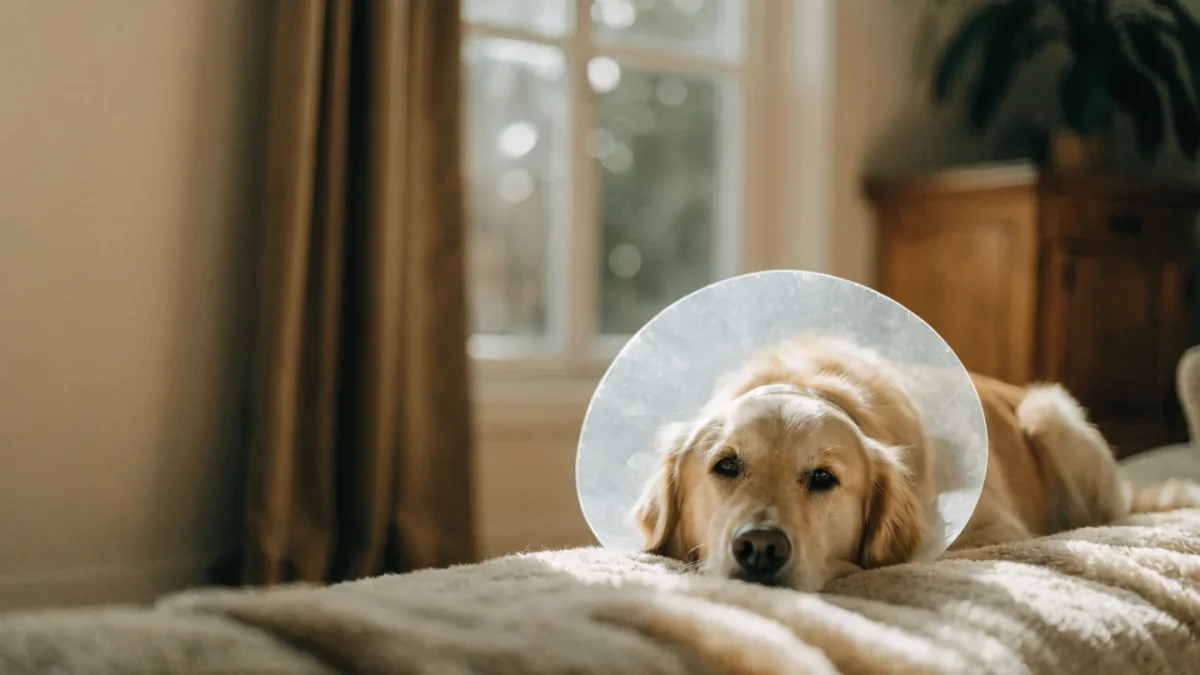
That couple with the Lab mix? They waited until ten months. A compromise. And their dog recovered in about a week, with the biggest complication being his absolute refusal to leave the cone alone.
Sounds about right.
Frequently Asked Questions
Is the surgery painful for my pet?
They're under general anesthesia during the procedure, so they feel nothing. Post-operative pain is managed with medications — most clinics send home two to three days of pain relief, and some use longer-acting injectable drugs. Most pets are surprisingly comfortable within 24-48 hours. I've had more trouble convincing them to rest than managing their pain.
My pet seems fine on day three — can I let them run and play?
No. This is the question I get the most and the one I'm most firm about. Internal healing takes ten to fourteen days regardless of how peppy your pet looks on the outside. One good sprint or jump can tear internal sutures. I've repaired dehisced incisions that happened because an owner let their dog play fetch on day five. It wasn't pretty, and it was completely avoidable.
Will my male dog's personality change?
Some behaviors will shift — less marking, less roaming, often less mounting. But his core personality stays intact. The goofball will still be a goofball. The couch potato will still be a couch potato. What changes are hormonally driven urges, not the things that make your dog your dog.
Can my pet be too old for this surgery?
Age alone isn't a disqualifier. I've spayed healthy ten-year-old dogs. The concern with older pets is underlying health issues — kidney function, heart disease, clotting disorders — that increase anesthetic risk. That's why pre-surgical bloodwork becomes even more important in senior pets. If the bloodwork and physical exam look good, the surgery is generally safe. If there's a medical reason driving the surgery (like pyometra), age takes a back seat to the emergency.
Does joint health in dogs and cats get affected by early spaying/neutering?
The research, particularly in large breeds, suggests early spay/neuter may increase the risk of certain joint conditions like cranial cruciate ligament tears and hip dysplasia. The mechanism is thought to involve growth plate closure — sex hormones help regulate when bones stop growing, and without those signals, some dogs grow slightly taller than they would have otherwise, potentially changing joint mechanics. This is one of the main reasons breed-specific timing recommendations are evolving. It's less of a concern in small breeds and cats.