

Parents of human children often feel overwhelmed by the childhood vaccination schedule — which shot, when, how many, and why. Pet owners face the same questions, often with less preparation. Vaccine conversations are among the most frequent and the most important ones new puppy and kitten owners have with their vet.
This guide covers everything: how vaccines work, which ones your dog or cat actually needs, how the schedules are structured, what reactions to watch for, and the more nuanced questions that come up around titer testing, over-vaccination concerns, and immune-compromised animals.
How Pet Vaccines Work
Vaccines introduce the immune system to a pathogen — or a component of one — in a controlled way that stimulates a protective response without causing the disease itself. There are several types used in veterinary medicine:
Modified live vaccines (MLV): Contain weakened, live organisms that replicate briefly in the body, producing a strong and durable immune response. Generally provide broader immunity and faster protection. Require careful handling — they can be inactivated by improper storage.
Killed vaccines: Contain inactivated pathogens. Typically require an adjuvant (a substance that stimulates immune response) to be effective. Often require booster doses to achieve and maintain adequate immunity.
Recombinant vaccines: Use genetic engineering to produce specific antigen components or to deliver antigens via a vector organism. Some newer feline vaccines use this approach, including a non-adjuvanted recombinant rabies vaccine that is preferred for cats due to reduced injection-site sarcoma risk compared to adjuvanted products.
Toxoid vaccines: Protect against bacterial toxins rather than the bacteria themselves. Less common in veterinary medicine than in human medicine.
The immune response to vaccination involves both antibody production (humoral immunity) and the generation of memory cells that can respond rapidly to future exposure. The time between vaccination and full protective immunity varies — most vaccines require one to two weeks to establish protection, and some require a complete series before immunity is adequate.
Why Young Animals Need a Series
The puppy and kitten vaccination series often confuses new owners: why four rounds of the same vaccine?
The answer lies in maternal antibody interference. Puppies and kittens receive passive immunity from their mothers through the placenta and particularly through colostrum (first milk). These maternal antibodies provide early protection — but they also neutralize live vaccines, blocking the immune response the vaccine is meant to trigger.
The problem is that maternal antibody levels vary significantly between individual animals, and they decline at different rates. We don't have a simple way to measure exactly when an individual puppy's maternal antibodies have dropped low enough for a vaccine to "take" properly.
The series of vaccines — typically given every three to four weeks between six and sixteen weeks — ensures that at least one or two doses are administered after maternal antibodies have waned sufficiently, regardless of when that happens for each individual animal. The final dose at fourteen to sixteen weeks is the one that reliably induces immunity in virtually all animals.
This is why skipping doses or starting late matters: the series isn't redundant. Each dose is there for a reason.
Core Vaccines: Dogs
Core vaccines are those recommended for virtually all dogs regardless of lifestyle. In most veterinary guidelines, the core vaccines for dogs are:
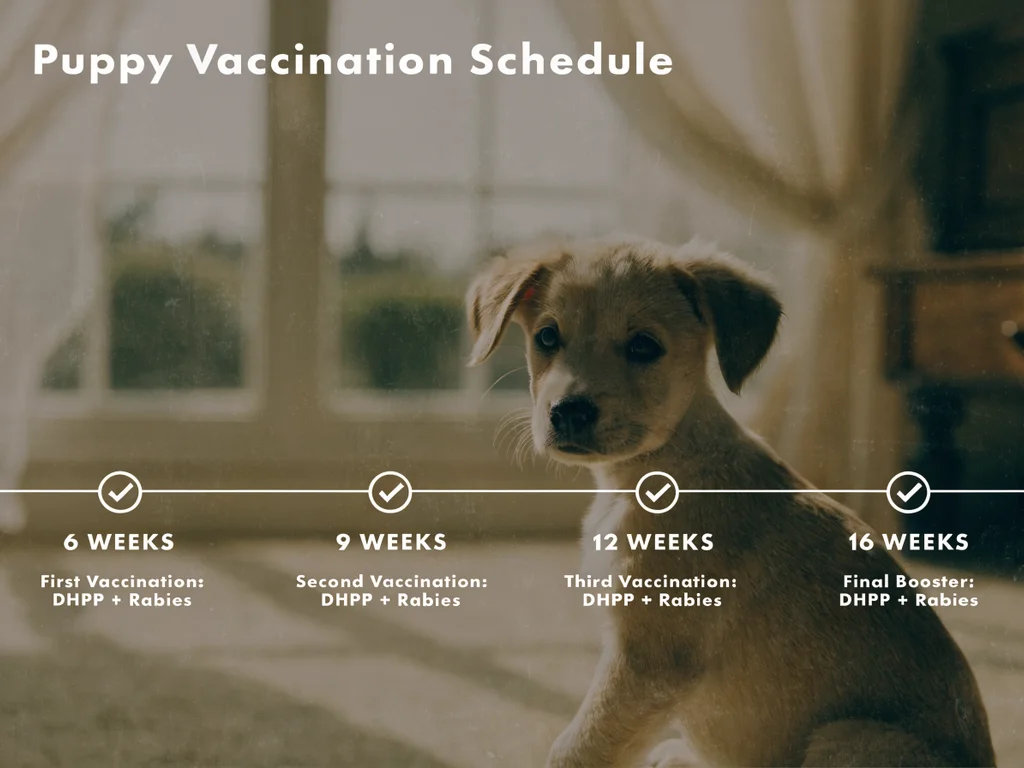
Canine distemper, adenovirus-2, parvovirus — DHPP (or similar combination)
This is the "core combination" vaccine given throughout the puppy series and into adulthood. It protects against:
- Canine distemper virus: a severe, often fatal neurological disease
- Adenovirus type 1 (hepatitis): serious liver disease; adenovirus-2 vaccine provides cross-protection
- Parvovirus: a highly contagious, often fatal gastrointestinal disease, especially devastating in puppies
- Often parainfluenza is included in the combination
Initial puppy series: typically at 6–8, 10–12, and 14–16 weeks. First adult booster at one year, then every three years for most formulations.
Rabies
Required by law in most jurisdictions for dogs. Administered at 12–16 weeks, with first booster at one year, then annually or every three years depending on the product and local regulations. See the detailed discussion of core and non-core vaccines for dogs for the full breakdown.
Core Vaccines: Cats
FVRCP (Feline viral rhinotracheitis, calicivirus, panleukopenia)
The feline core combination vaccine protects against:
- Feline herpesvirus type 1 (rhinotracheitis): a major cause of upper respiratory disease, often establishing lifelong latent infection
- Feline calicivirus: another major cause of upper respiratory and oral disease
- Feline panleukopenia (feline parvovirus): a severe, often fatal disease with particularly devastating effects on kittens
Series begins at 6–8 weeks, with boosters every 3–4 weeks until 16 weeks. First adult booster at one year, then every three years for most formulations.
Rabies
Required by law in many jurisdictions. Timing and booster intervals similar to dogs. Non-adjuvanted rabies vaccines are preferred in cats due to concerns about injection-site sarcoma (a rare but serious complication). Many veterinary guidelines specifically recommend recombinant non-adjuvanted rabies vaccines for cats.
For the full cat-specific breakdown, core and non-core vaccines for cats covers indoor vs. outdoor considerations, FeLV, and more.
Non-Core Vaccines: Risk-Based Decisions
Non-core vaccines are recommended based on geographic risk, lifestyle factors, and individual animal circumstances. They're not given to every animal, but for animals with specific exposures, they can be genuinely important.
For dogs:
- Bordetella bronchiseptica (kennel cough): Recommended for dogs who visit boarding facilities, dog parks, training classes, or grooming salons. Highly contagious.
- Leptospirosis: A bacterial infection spread through contaminated water and soil; zoonotic (can infect humans). Recommended for dogs with outdoor exposure, water contact, or life in endemic areas.
- Lyme disease: Recommended in tick-endemic regions for dogs with outdoor exposure.
- Canine influenza: Recommended in areas with active outbreaks or for dogs with significant social exposure.
For cats:
- Feline leukemia virus (FeLV): Strongly recommended for cats with outdoor access or exposure to unknown cats. The American Association of Feline Practitioners (AAFP) considers FeLV vaccination core for all kittens and cats under one year of age, with adult vaccination based on lifestyle risk.
- Feline immunodeficiency virus (FIV): Less straightforward due to concerns about vaccine interference with subsequent FIV testing; discuss with your vet.
- Chlamydophila felis, Bordetella: Occasionally recommended in multi-cat environments or catteries.
The Adult Booster Schedule
After completing the initial series and one-year booster, most core vaccines shift to a three-year interval for adult dogs and cats. Some vaccines — particularly leptospirosis and bordetella — require annual vaccination due to shorter duration of immunity.
The shift from annual to triennial vaccination for core vaccines was a significant change in veterinary guidelines over the past two decades, driven by studies demonstrating that core vaccines provide protection lasting at least three years in adult dogs and cats, and by recognition that unnecessary annual vaccination may carry cumulative risk without added benefit. Major veterinary associations including WSAVA and AAHA now recommend triennial boosters for core vaccines in adult animals.
Your vet may recommend annual wellness exams regardless of vaccination schedule — these have independent value for detecting health changes, updating non-core vaccines as needed, and discussing parasite prevention.
Vaccine Side Effects and What to Watch For
Most dogs and cats tolerate vaccines very well. Some mild, transient effects are normal:
- Slight lethargy for 24–48 hours after vaccination
- Mild soreness or swelling at the injection site
- Low-grade fever
- Reduced appetite on the day of vaccination
These resolve without treatment.
More significant reactions are uncommon but real. Watch for any of the following in the 30–60 minutes after vaccination and in the hours following:
- Facial swelling, particularly around the muzzle and eyes
- Hives (raised, itchy welts on the skin)
- Vomiting or diarrhea
- Collapse or extreme weakness
- Difficulty breathing
These signs may indicate anaphylaxis — a severe allergic reaction — which requires immediate veterinary intervention. Some clinics ask you to remain for 15–30 minutes after vaccination precisely to observe for this.
A firm lump at the injection site that persists beyond a few weeks in cats warrants veterinary evaluation due to the rare but real possibility of injection-site sarcoma. For a complete discussion of reactions and risks, vaccine side effects and reactions in pets covers the full spectrum from mild to severe.
Titer Testing: An Alternative to Automatic Boosters?
Titer testing measures the level of antibodies against a specific pathogen in the bloodstream. It can be used to determine whether an adult dog or cat retains protective immunity from previous vaccination.
Titer testing is most commonly used for distemper and parvovirus in dogs. In animals with a complete vaccination history who show protective titers, some veterinarians will defer re-vaccination rather than booster automatically.
However, titer testing has limitations:
- It measures antibody levels (humoral immunity), not cellular immunity, which also plays an important protective role
- Protective titer thresholds aren't uniformly defined for all diseases
- For rabies, titer testing has specific legal contexts (international travel, import requirements) but does not substitute for vaccination in most jurisdictions
- Cost is typically higher than vaccination itself
Titer testing is a reasonable discussion to have with your vet for adult animals with documented vaccination histories, particularly if there's a concern about over-vaccination.
Immunocompromised Animals
Animals on immunosuppressive medications (for allergies, autoimmune conditions, or post-transplant) or with conditions that affect immune function require special consideration for vaccination. Modified live vaccines may cause disease in severely immunosuppressed animals. Killed or recombinant vaccines are generally safer in this context, but timing and necessity should be individually evaluated.
Animals undergoing chemotherapy for cancer typically pause vaccination during treatment.
Vaccination Records and Proof
Keep vaccination records. Most veterinary practices provide a certificate or sticker with each vaccine administered — date, product name, lot number, and expiration date. These are required for boarding, grooming, training classes, travel, and in some cases for licensing.
A microchip linked to current contact information, combined with up-to-date vaccination records, covers the two most common administrative requirements for pet travel and facility access.
Common Questions I Hear in the Exam Room
"My dog never goes outside — does she still need vaccines?"
For rabies: often legally required regardless. For DHPP: even indoor dogs are occasionally exposed through contact with shoes, clothing, or guests' pets. Parvovirus in particular is extraordinarily environmentally stable.
"My cat is completely indoor — does she need anything beyond FVRCP?"
Core vaccines, yes. FeLV and rabies depend on local requirements and whether any indoor-outdoor access is possible (including windows, balconies, or exposure to other cats in multi-cat households).
"My puppy already had shots at the breeder — do we start the series over?"
Get documentation. If the products used were appropriate and timing is known, the series continues from where it left off. Without documentation, most vets will restart the series.
FAQ
At what age should I start vaccinating my puppy or kitten?
The series typically begins at six to eight weeks. Starting earlier than six weeks is not generally recommended because maternal antibodies interfere strongly with vaccine response.
Can I vaccinate my pet at home?
Some vaccines are available for purchase and self-administration in certain countries — particularly core combination vaccines for dogs. However, home vaccination without veterinary examination means missing the health check, risk assessment, and professional documentation that accompany a clinic visit. Rabies vaccination must be administered by a licensed veterinarian in most jurisdictions.
How long does immunity from vaccines last?
For core combination vaccines (DHPP, FVRCP), studies demonstrate protective immunity lasting at least three years and often longer in adult animals who have completed the initial series. This is why current guidelines recommend triennial boosters for these core vaccines. Some vaccines — particularly leptospirosis and bordetella — provide shorter-duration immunity and require annual vaccination to maintain protection.
My pet had a bad reaction last time. Should I vaccinate again?
This depends on the nature and severity of the reaction. Mild post-vaccination lethargy is not a contraindication to future vaccination. Anaphylaxis or significant hypersensitivity is. Your vet may pre-treat with antihistamines or corticosteroids, switch to a different product, or in some cases recommend against re-vaccination and rely on titer testing instead.
Are combination vaccines as effective as single-antigen vaccines?
Yes — combination vaccines are formulated to provide equivalent protection against each included antigen. Splitting a combination vaccine into individual components doesn't improve efficacy.
My senior dog seems healthy — do they still need boosters?
Senior pets still benefit from vaccination, though the schedule may be adjusted. Immune function can change with age, and lapsed vaccination for rabies may have legal implications. Discuss the risk-benefit analysis with your vet — it's not one-size-fits-all for older animals.