

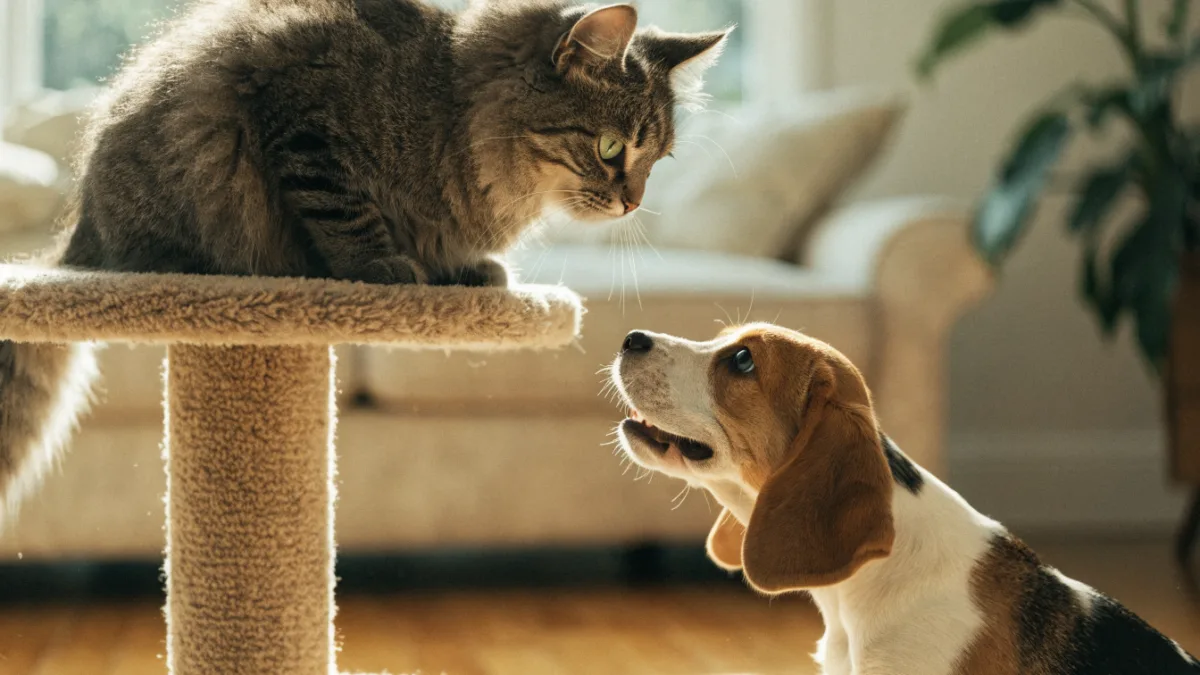
The sound a puppy makes when they’re in full bite mode is something between a tiny chainsaw and a very motivated sewing machine. When Mochi first met our twelve-week-old foster puppy, she did what cats do — she held perfectly still, assessed the situation with the cool detachment of someone who’s seen worse, and then slowly blinked at me as if to say, “You’re really going to let this happen?”
I wasn’t. But I also didn’t fully understand what I was dealing with until those needle teeth found my hand during a play session and left puncture wounds that looked like I’d lost a fight with a stapler. Puppy baby teeth aren’t just sharp — they’re architecturally designed to be. They’re needle-thin, slightly curved inward, and coated in nothing but pure chaos. On human skin they’re painful. On a cat’s delicate hide, they’re genuinely dangerous.
This is the part nobody really prepares you for. You know puppies bite. You might even know it’s normal. What you don’t always calculate is that your resident cat is standing directly in the splash zone, and they don’t have the benefit of opposable thumbs to pry a puppy off.
The Razor-Tooth Reality
Puppy nipping is a developmental phase that peaks around twelve weeks of age as they teethe. It’s not aggression — it’s exploration, communication, and mouth-based world-mapping all rolled into one. Puppies learn bite inhibition from their littermates: when one pup bites too hard, the other yelps and play stops. It’s a beautiful, self-regulating system… until you bring that puppy home and there are no littermates left to teach the lesson.
What there is, instead, is a cat. And here’s where things get complicated.
A cat’s skin is significantly thinner and more delicate than human skin. Those deciduous puppy teeth — the ones that feel “like knives” to your fingers — can puncture a cat easily, even when the puppy isn’t being malicious. Add in the fact that movement triggers a puppy’s play drive, and a cat dashing across the living room becomes the most exciting thing that’s happened all day. As one German Shepherd community discussion noted, the excitement of a moving target often overrides whatever bite inhibition a puppy has managed to learn so far.
The good news? This phase passes. The better news? You can manage it without making your cat feel like a prisoner in their own home.
Physical Management: Your First Line of Defense
Baby Gates Are Not Optional
I’ll say it plainly: if you’re bringing a puppy into a home with a cat, baby gates are non-negotiable. Not the flimsy pressure-mounted ones that a determined puppy can body-slam — I’m talking about sturdy barriers with a cat-sized escape route, or wall-mounted gates that create a genuine physical divide.
The gate lets Mochi see the puppy, smell the puppy, and make her own judgments about the puppy from the safety of elevated superiority. It lets the puppy learn that the cat exists without being able to practice the art of feline pursuit. This visual access without physical contact is how you build a foundation of “boring coexistence” — which, honestly, is the gold standard for multi-species households. Organizations like [1] emphasize this kind of gradual, controlled introduction as essential groundwork.
The Drag Leash
Here’s a trick that changed everything for us: keep the puppy on a leash indoors during the adjustment period. Not held — just dragging. The leash gives you a handle. When the puppy locks eyes on the cat and that particular body language kicks in (ears forward, body lowering, the unmistakable intensity shift), you don’t have to lunge across the room or shout. You just step on the leash.
It’s calm. It’s immediate. And it prevents the chase from ever becoming a rehearsal that the puppy wants to repeat.
The Twenty-Minute Decompression Window
Here’s something that took me far too long to learn: puppies get mouthy when they’re overstimulated, not just when they’re teething. After a walk, after outdoor play, after anything exciting — that’s peak bite risk. Your puppy comes home with their nervous system lit up like a Christmas tree, and the first moving object they see becomes a target.
The fix is almost absurdly simple: go straight to the pen. Don’t pass the couch, don’t collect cuddles. Take the puppy directly to their enclosed space with a high-value chew — something that occupies their mouth for a real stretch of time. Long-lasting chews, frozen stuffed toys, whatever keeps them genuinely engaged.
Here’s the science part: it takes roughly twenty minutes for a dog’s arousal levels to settle after a high-excitement event. That’s not a guess — that’s the physiological window for decompression. If you build that twenty-minute pen rest into your post-activity routine, you eliminate the vast majority of opportunistic nipping before it starts. This shift toward proactive management is one of the more encouraging developments in modern canine behavior work — preventing the problem rather than reacting to it.
“Let Them Work It Out” — A Bad Idea in a Trench Coat
You’ll hear this advice. Someone — a neighbor, a forum commenter, that uncle who’s “always had dogs” — will tell you that the cat will sort the puppy out. A good swat on the nose, they’ll say. That’s how dogs learn to respect cats.
I understand the appeal of this logic. Cats are absolutely capable of setting boundaries, and many of them do it with a clarity that humans could learn from. A well-placed hiss or a warning swat is legitimate communication in feline language. The Reddit dog training community has even documented cases where a confident cat’s correction seemed to dramatically reduce puppy biting overnight.
But here’s the problem with the “let them work it out” approach: it assumes both animals are reading each other’s signals correctly, and it assumes the physical consequences are acceptable. A swat to the face can injure a puppy’s eye. A puppy who gets swatted can develop a permanent negative association with cats — not respect, but fear or defensive aggression. And a cat who swats and doesn’t get the desired result learns that their boundaries don’t work, which leads to either shutdown or escalation.
The modern behavioral consensus leans heavily toward active management rather than spectator-mode parenting. You’re the adult in the room. Your job is to create interactions where the cat feels empowered to communicate — hissing from a safe distance, retreating to elevated space — and the puppy learns that those communications mean “disengage and redirect,” not “escalate and find out.”
Reading the Room: Play Drive vs. Predatory Drive
This is the distinction that actually matters, and it’s the one most owners miss.
Play biting looks clumsy, bouncy, and socially motivated. The puppy’s body is loose. They might vocalize. They’re trying to engage. It’s annoying, yes, but it comes from a place of “I want to interact with this interesting thing.”
Predatory behavior looks different. The puppy goes still. Their body drops. Their eyes lock and track. The tail might be low and rigid. There’s a stalking quality to the movement — deliberate, silent, focused. This isn’t play. This is prey drive activating, and it requires an entirely different intervention.
If your puppy is stalking your cat rather than clumsily bouncing toward them, you’re not dealing with standard teething behavior. You’re dealing with a predatory sequence, and the protocols shift from basic bite inhibition to strict counter-conditioning and, in many cases, permanent physical management. This is where you talk to a qualified professional. It’s not a DIY fix, and pretending otherwise puts your cat at real risk.
The Consistency Contract
For the more common scenario — the bouncy, mouthy, “why are you like this” play-biting puppy — the path forward is maddeningly simple and difficult in equal measure: absolute consistency.
Every single time teeth touch skin or fur, the interaction ends. A firm verbal marker — “no bite” or whatever phrase you choose — followed immediately by withdrawal of attention and redirection to a legal chew target. No exceptions. Not on Tuesday when you’re tired. Not when the puppy looks cute doing it. Not when the cat “started it” by walking too close.
The puppy is learning a rule: teeth on living things makes fun stop. Toys make fun continue. Once that pattern clicks — and it will click, because puppies are operating on fairly straightforward cause-and-effect software — the cat becomes less interesting than the squeaky alligator. Reward heavily when the puppy chooses the toy over the cat. Make the right choice the obvious one.
What Mochi Taught Me
Mochi never did swat that puppy. She did something better: she taught me that coexistence isn’t something animals figure out on their own in a chaotic living room. It’s something you build — gate by gate, chew by chew, redirected moment by redirected moment — until one afternoon you look up and they’re both asleep in the same sunbeam. Three feet apart, granted. But peacefully.
The sharper truth, though, is this: your cat was there first. They didn’t ask for this disruption, and they certainly didn’t consent to becoming a chew toy with opinions. Protecting their sense of safety isn’t just about preventing puncture wounds — it’s about honoring the trust they’ve placed in you to keep their home livable. Puppy phases end. The relationship your cat has with you, and with the dog they’re slowly learning to tolerate, is what remains. Be the human your cat already believes you are. Get the gates. Use the leash. Embrace the twenty-minute pen rests. Because freedom without boundaries is just chaos with better marketing.
Sources
- Best Friends Animal Society — bestfriends.org