

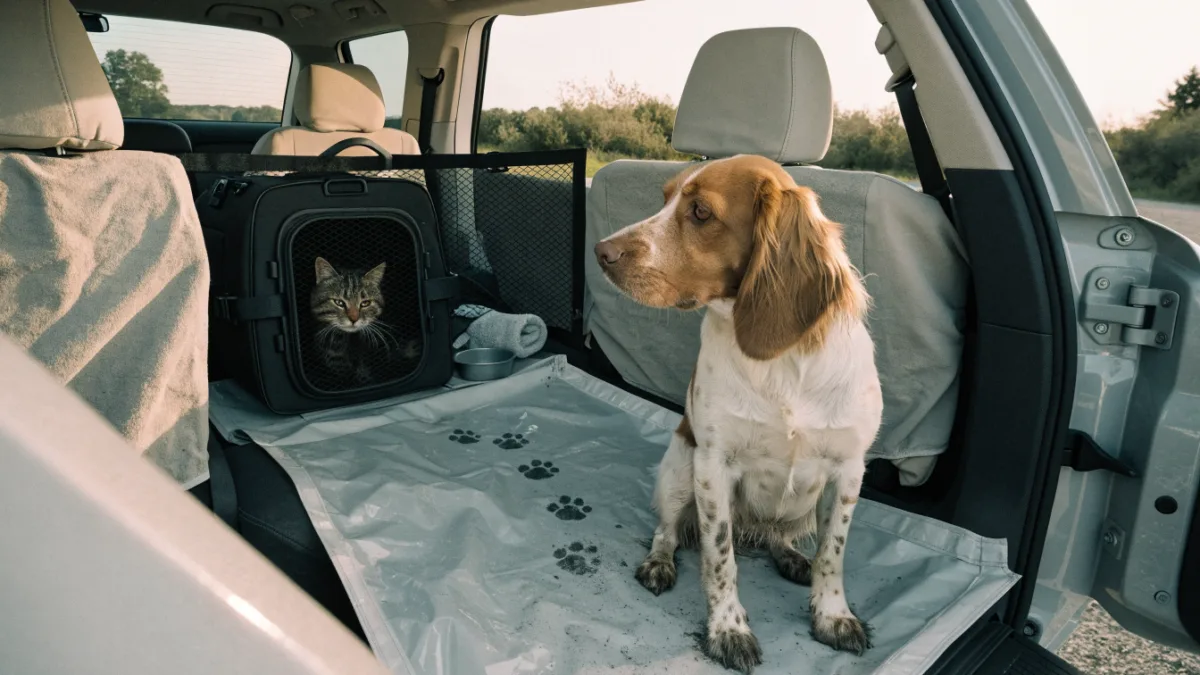
Last Tuesday, Barnaby—my overly enthusiastic spaniel mix—found what I can only describe as a portal to the underworld, also known as a hidden swamp puddle at our local trailhead. He emerged looking less like a dog and more like a swamp creature. Meanwhile, Mabel, my calico cat, was already strapped into the backseat in her carrier, glaring at me through the mesh window like I had personally orchestrated the downfall of her entire existence.
If you have ever tried to transport a dirt-caked dog and a fastidious, deeply judgmental cat in the same vehicle, you know the specific kind of dread that accompanies the drive home. You want both of your pets to experience the world, but you also desperately want your car’s resale value to survive the journey. Basic seat covers are a good start, but to achieve true harmony—and a clean upholstery—you need to engineer a dual-zone travel system.
The “Dual-Zone” System: Why Your Backseat Needs a Border
The secret to traveling with pets of different species, temperaments, and mess levels is separation. Mabel doesn’t want to spend a forty-minute drive dodging flying clumps of wet dog hair, and Barnaby doesn’t need the added stress of a cat hissing at him from three feet away.
To establish this physical border, look into a universal-fit mesh car barrier. These aren’t the rigid, rattling metal grates of the past. Modern barriers utilize flexible bungee cords that attach to the headrests and seat mounts. This flexibility is actually a brilliant piece of engineering: car seats are designed to shift slightly during impacts and adjustments. A rigid barrier fights that movement and can damage your seats or jam power seat motors. A bungee-integrated mesh barrier remains sturdy enough to keep a muddy dog contained in the far back of an SUV or the third row, but yields gracefully to the vehicle’s mechanics.
Even better, because the material is porous mesh, it acts as a literal breeze-way. It allows your vehicle’s climate control—whether it’s the blasting AC of summer or the heating of winter—to flow freely between the front and back zones. This ensures the “dog zone” stays cool, while the “cat zone” remains perfectly ventilated, keeping your feline passenger from overheating in a stagnant back corner.
Beyond the Basic Blanket: Building a Multi-Layer Defense
If you want to truly protect your vehicle from the four horsemen of the pet-pocalypse—shed hair, muddy paws, pet dander, and slobbery puddles—a single towel is not going to cut it. You need a multi-layered defense strategy.
The Hammock-Style Seat Cover
Instead of a flat mat that slides around the second second you take a sharp turn, look for a hammock-style cover. These attach to the front and rear headrests, creating a sling. Not only does this catch the incredible volume of hair and drool your dog produces, but the sides act as a barrier, preventing muddy paws from scratching the interior side panels of your doors. Look for materials with a waterproof, anti-slip backing—usually a rubberized grid—that grips the factory leather or cloth underneath.
Cargo Liners for SUVs
If you drive an SUV and keep your dog in the trunk space, a custom or semi-custom cargo liner is non-negotiable. These wrap up the sides of the trunk, protecting the plastic wheel housings where dogs inevitably lean and scratch. When Barnaby shakes off trail dust in the back of my wagon, the liner catches the entire dust cloud, saving my car’s headliner and side windows.
Door Guards: The Unsung Heroes
Dogs don’t just make messes on the floor. When they get excited, they press their faces—and their muddy, slobbery jowls—right against the rear windows. Door guards are slipcovers that go directly over the interior door panel and window sill. They are incredibly easy to toss in the washing machine and will save you from having to aggressively scrub drool off your window controls.
The Great Seatbelt Debate: What You’re Probably Doing Wrong
When it comes to keeping your cat calm and your small dog safe, where you put them matters just as much as how you clean the car. This brings us to one of the most heated debates in the pet travel community: how to actually secure a carrier.
Confession time: for years, I just looped the car’s standard seatbelt through the handle of Mabel’s hard-shell carrier and clicked it in. It felt secure. It was incredibly convenient. And according to safety advocates, it was incredibly dangerous.
The problem lies in the physics of human safety engineering. Standard vehicle seatbelts are designed to manage the weight distribution of a human body during a sudden stop. They are incredibly strong. If you loop a standard belt over, around, or through a small pet carrier not explicitly designed for that tension, the force of a sudden stop can cause the heavy human-grade belt to crush the carrier, injuring the small pet inside.
There is an ongoing push in the pet product industry toward standardized crash-testing. If you are going to use a seatbelt to secure a crate, you must ensure the manufacturer has explicitly published crash-test data proving it is safe to do so with that specific model. If they haven’t, do not use the seatbelt to anchor it. Instead, look into specialized, certified pet travel tethers and harnesses for your dog, and securely wedge the cat carrier in the footwell of the backseat (if it fits safely without airbag risk) or strap it down using the cargo anchors in the trunk of your SUV.
Protecting the Exterior: When Nature Fights Back
We spend so much time worrying about what our pets do to the inside of the car that we forget what local wildlife can do to the outside.
If you are parking at a trailhead or a rural campsite, your vehicle becomes a massive, intriguing object to local fauna. Deer, deeply attracted to the salt left behind by sweaty hikers or the lingering scent of dog treats, have been known to lick car doors and side mirrors, their rough tongues occasionally scratching the clear coat. Neighborhood or feral cats, drawn to the warmth of a recently parked engine, might crawl up into the wheel wells or underneath the chassis.
To protect your parked car without harming the wildlife, skip the harsh chemical deterrents. Instead, spray natural repellents—like bitter apple, diluted citrus sprays, or even coyote urine, which you can find at most outdoor stores—on the ground around your tires and parking area. It keeps the local animals at a respectful distance, ensuring your wheels stay untouched and the local ecosystem remains undisturbed.
Traveling with a muddy dog and a shedding cat will never be a spotless, stress-free endeavor. There will still be fur. There will occasionally be a stray paw print on the center console. But by designing a true dual-zone environment—with breathable barriers, multi-layered interior defenses, and properly crash-tested restraints—you take the stress out of the journey. You get to protect your car while still giving your pets the joy of the open road. And honestly, seeing Barnaby’s muddy, triumphant grin in the rearview mirror is absolutely worth the extra laundry.