

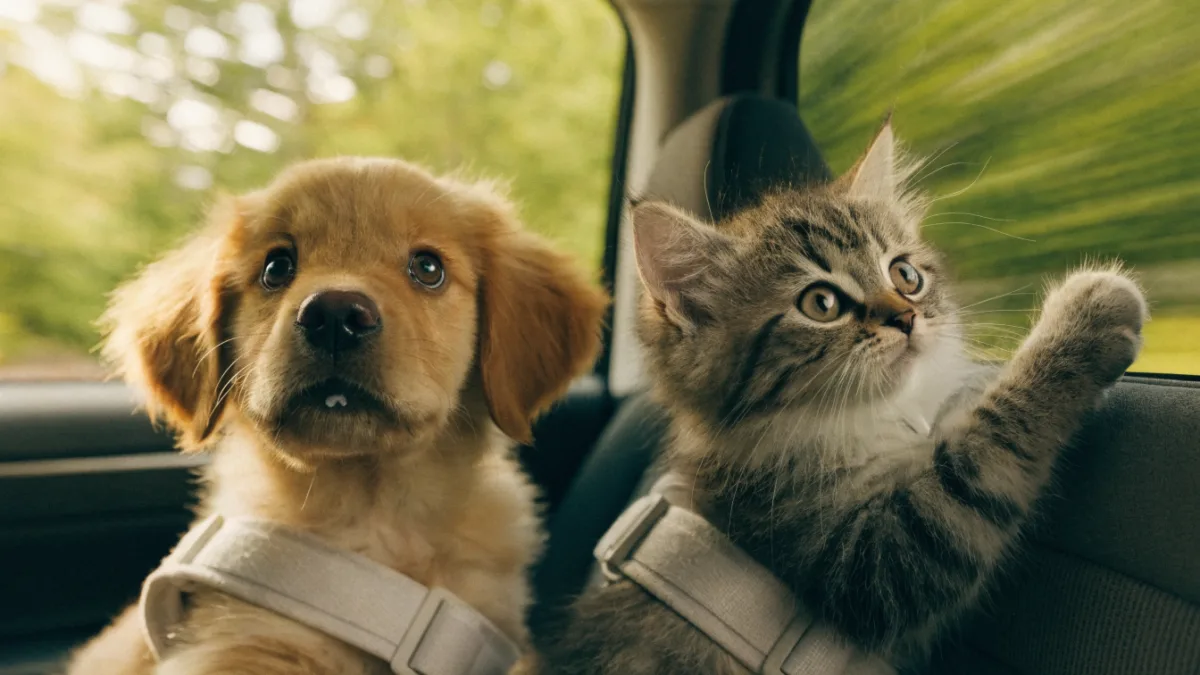
If you’ve ever heard the telltale sound of a puppy retching in your backseat, you know that uniquely awful mix of sympathy and panic. Last spring, a client named Jenna brought in an eight-month-old Golden Retriever named Cooper for exactly this reason. “He loves the car when we’re parked,” she told me, “but the second we hit the highway, he turns into a drool fountain.” Cooper had the classic presentation—excessive salivation (we call this hypersalivation), panting, whining, and inevitably, vomiting within the first fifteen minutes of any drive over 30 mph.
Car sickness is one of the most common complaints I hear from new puppy and kitten owners, and it’s genuinely miserable for everyone involved. But here’s what surprises most of my clients: puppies and kittens experience motion sickness in fundamentally different ways, and what works for one species often falls flat for the other. Understanding those differences matters if you want your pet to actually enjoy— or at least tolerate—the journey.
Why the Car Makes Them Sick: A Sensory Disconnect
Whether we’re talking about a Labrador puppy or a Bengal kitten, the root cause of motion sickness is the same: a neurological mismatch. Your pet’s vestibular system—the balance apparatus deep inside the inner ear—detects movement. But if your pet can’t see out the window, or sees the world moving in a way that conflicts with what their body feels, the brain gets conflicting signals. It’s the same mechanism that causes seasickness in humans.
In young animals, this system isn’t fully developed yet. The inner ear structures responsible for detecting motion and maintaining equilibrium are still maturing, which is why puppies and kittens are far more susceptible than adults. Most dogs—roughly the majority of cases I see—will outgrow car sickness by six to twelve months of age as those structures finish developing and as they gain more travel experience. Cats, interestingly, often don’t. And there’s a behavioral reason for that gap, which we’ll get to shortly.
You can read more about the mechanics of canine motion sickness in,[1] which covers the physiology in solid detail.
Reading the Signs: Puppies vs. Kittens
This is where things get genuinely interesting from a clinical perspective. I always tell my clients: if you can recognize the early warning signs, you can often intervene before the vomiting starts.
The Puppy Profile: Loud and Miserable
Puppies are terrible at hiding their discomfort. A car-sick puppy is usually a vocal, restless puppy. The progression typically goes something like this: first comes the pacing and inability to settle. Then the lip-licking starts—those repetitive, exaggerated tongue flicks that signal nausea building. Hypersalivation kicks in next, and you’ll notice strings of drool hanging from their jowls. Some dogs start panting heavily even when the car is cool. Whining often accompanies all of this, and if the ride continues, vomiting follows.
What many owners don’t realize is that some of this response is anxiety, not pure motion sickness. If a puppy’s only car experiences end at the vaccination clinic, they quickly make the association: car equals stress. That emotional component can actually amplify the physical nausea in a feedback loop. I saw this with Cooper—the more anxious he became about the car, the worse his physical symptoms got, even on short drives.
The Kitten Profile: Silent and Still
Cats couldn’t be more different. Where puppies broadcast their distress, kittens internalize it. A nauseous kitten typically goes completely still. They’ll crouch low in the carrier, often pressing their head against the bottom or lowering it between their paws. Their eyes may close—not in relaxation, but in an attempt to reduce sensory input. Drooling happens, but it’s often less dramatic than in dogs and easier to miss because cats groom it away quickly. Some kittens will vocalize with distressed meows, but many simply suffer in silence until they vomit suddenly, with almost no warning.
This stoic response makes feline motion sickness harder to catch early. By the time most owners realize something is wrong, the kitten has already been sick. That’s why I encourage cat owners to check on their kitten frequently during drives and watch for that frozen, hunched posture.
Training the Traveler: Different Strategies for Different Species
The good news is that both puppies and kittens can learn to tolerate— and even enjoy—car travel. But the training approach needs to match the species.
For Puppies: Make the Car a Fun Place
The most effective strategy for puppies is counterconditioning: changing the emotional association with the car from negative to positive. This means the car should not always equal the vet. Start with the engine off. Sit in the driveway with your puppy, feed them high-value treats, play with a favorite toy. Do this daily for a week. Then graduate to short drives—just around the block—and end at somewhere wonderful: a park, a friend’s house, a pet-friendly store.
Keep initial trips under five minutes and gradually increase duration. For Cooper, we started with two-minute drives ending at Jenna’s parents’ house, where he got to play with their older dog. Within three weeks, his drooling had decreased dramatically. Within two months, he was voluntarily jumping into the car.
Position matters too. If your puppy can see out the front windshield, the visual input better matches what their inner ear is feeling, which reduces that sensory disconnect. Using a travel crate or a crash-tested harness that keeps them facing forward can make a significant difference. The [2] and noted that environmental setup—temperature, airflow, and positioning—is often as important as behavioral training.
For Kittens: Start With the Carrier, Not the Car
Here’s the thing about cats: their motion sickness is almost inseparable from the stress of being put in a carrier and removed from their territory. So the training starts long before the car.
I recommend making the carrier a permanent fixture in your home. Leave it out with the door open, put a soft blanket inside, maybe a toy. Feed your kitten’s meals near it, then inside it. The goal is for the carrier to become a safe, familiar space rather than a signal that something scary is about to happen. This single change has resolved what owners thought was pure motion sickness in several of my feline patients—the cats weren’t actually that nauseous; they were terrified.
Once the carrier is a happy place, start with the car. Cover the carrier with a light blanket to reduce visual stimuli. This is crucial for cats because watching the world streak past the window at speed intensifies the sensory mismatch. With the cover in place, the kitten relies more on their body’s sense of balance, which is actually more consistent than the conflicting visual input.
Keep the first drives short and smooth—avoid sudden stops or sharp turns. And keep the car cool; warm temperatures make nausea worse for both species.
The Medication Question: What Actually Works
I’ll be honest: I used to be quick to reach for behavioral solutions before considering medication, and I’ve changed my mind on this over the years. Some animals—and particularly some cats—genuinely need pharmaceutical help to break the cycle of travel anxiety and nausea. There’s no virtue in making an animal suffer through car rides untreated while you wait for desensitization to work.
For dogs, the prescription medication maropitant citrate is widely considered the clinical gold standard. It works by blocking substance P, a neurotransmitter involved in the vomiting reflex, and it’s been a genuinely transformative option for dogs who don’t respond to training alone. If you’re considering this route, talk with your vet about whether it’s appropriate for your puppy—never give a medication without that consultation, as dosing depends on weight, age, and overall health.
For cats, the situation is a bit different. While maropitant is frequently prescribed off-label for feline patients with good results, the newer medication varenicline—recently approved in Europe for feline anxiety—shows promise for travel-related stress specifically. If you’re outside Europe, ask your vet what options are available in your region, as approvals vary.
On the natural side, I’ve had clients who swear by ginger supplements, and the evidence for ginger’s anti-nausea properties in mammals is legitimate. I don’t dismiss home remedies—there’s real reasoning behind them. But I always remind owners that supplements aren’t regulated the same way as medications, so quality and concentration vary widely. Look for products with third-party testing and talk to your vet before adding anything to your pet’s routine.
One practical tip that generates debate: fasting before travel. Many vets, including me, have historically recommended withholding food for a few hours before car rides. But some behaviorists argue that an empty stomach can actually increase nausea due to excess stomach acid. I now suggest a middle ground: a small, light, high-protein meal a few hours before travel—not a full meal, but not a completely empty stomach either.
Safety First: Why Free-Roaming Is Never the Answer
I want to address one practice that genuinely concerns me: letting pets roam loose in the car or sit on a driver’s lap because it seems to calm them down. I understand the impulse. A puppy on your lap feels comforted. A cat curled on the passenger seat looks peaceful. But in even a minor collision, an unrestrained pet becomes a projectile. And a panicked animal loose in a moving vehicle can cause a serious accident by distracting the driver or interfering with the pedals.
Use a crash-tested crate or a properly fitted harness for dogs. For cats, a secure, seatbelted carrier is non-negotiable. This isn’t about being overly cautious—it’s basic safety, the same reason we buckle ourselves in.
The bottom line is this: car sickness is highly treatable, but the approach has to match the animal in front of you. A drooling Golden Retriever puppy needs different handling than a silent, hunched kitten in a covered carrier. Start training early, be patient, set up the environment thoughtfully, and don’t hesitate to ask your vet about medication if behavioral approaches aren’t enough. Every animal deserves to travel without suffering—and with the right combination of strategies, almost all of them can.
Sources
- this helpful overview from Small Door Veterinary — smalldoorvet.com
- Washington Post recently covered this topic — washingtonpost.com