

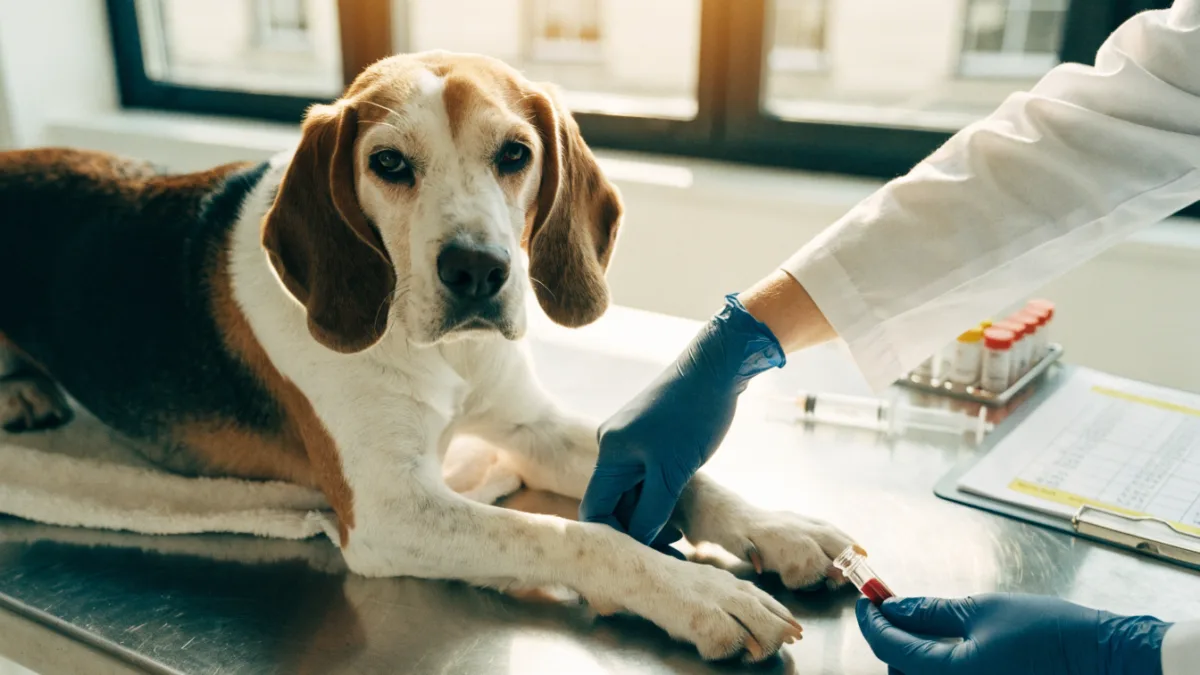
Just last week, I had a 12-year-old Golden Retriever named Baxter in my exam room. His owner, Mark, was beaming. “He’s slowing down a bit on our morning walks,” Mark told me, “but he’s still chasing squirrels in the backyard. He’s doing great!” On the outside, Baxter looked fantastic. His coat was shiny, his weight was perfect, and he was bright-eyed. But when I ran his routine senior blood panel, the results painted a very different picture. Baxter’s liver enzymes were significantly elevated, and his kidney values were creeping up.
Stories like Baxter’s are exactly why I harp on routine bloodwork. Pets are masters of disguise. Instinct tells them to hide weakness, meaning by the time they show obvious symptoms of illness, a disease is often quite advanced. A physical exam only shows me the outside; a blood panel gives me a crucial snapshot of what’s happening on the inside. If you’ve ever looked at your pet’s lab results and felt like you were trying to read a foreign language, you aren’t alone. Let’s break down exactly what those numbers mean, why we run them, and how they can actually save your best friend’s life.
When Does “Senior” Actually Start?
Time moves much faster for our pets than it does for us. Generally, we consider dogs to enter their senior years around age seven, though giant breeds like Great Danes age even faster, hitting senior status around five or six. Cats typically cross the senior threshold around age ten.
For my senior patients, I recommend annual blood panels as an absolute baseline standard. However, I strongly encourage twice-yearly testing. Think about it: if a dog ages roughly seven years for every one of ours, waiting twelve months between blood tests is like a human skipping a decade between doctor’s visits. A lot can change in six months. Establishing what is “normal” for your specific dog or cat while they are healthy is the best gift you can give them—and your vet. When we have a healthy baseline, it’s much easier to spot subtle, dangerous shifts later. As,[1] we are moving away from a purely reactive model—waiting until a pet is visibly sick—to a proactive model focused on catching asymptomatic diseases before they cause irreversible damage.
Decoding the Alphabet Soup: What Are We Actually Testing?
When I hand a client a sheet of lab results, their eyes usually glaze over at the rows of acronyms and numbers. A standard senior panel is broken down into three main sections. Here is how I explain them to my clients.
The CBC (Complete Blood Count)
Think of the CBC as the “cellular workforce” report. This test measures three main types of cells: red blood cells, white blood cells, and platelets.
- Red Blood Cells (RBCs): These are the delivery trucks carrying oxygen to the rest of the body. If these numbers drop too low, it means your pet is anemic. I recently saw a nine-year-old domestic shorthair cat named Willow whose owner noticed she was sleeping a lot more and eating less. Her CBC revealed a severe anemia that pointed to an underlying inflammatory bowel disease. We were able to treat the inflammation, and her energy rebounded beautifully.
- White Blood Cells (WBCs): These are the body’s security guards. An elevation in specific types of white blood cells tells me there is an infection, inflammation, or stress somewhere in the body.
- Platelets: These are the first responders for blood vessel repair. Without enough platelets, a pet might bruise easily or have trouble stopping a bleed.
The Chemistry Panel: Organ Function
This is where we look under the hood at the major organs. As pets age, their organs naturally endure wear and tear, but the chemistry panel tells us if that wear has turned into an active disease.
Two areas I pay incredibly close attention to in senior pets are the kidneys and the liver. For instance, kidney disease is a leading cause of illness in aging cats and dogs. We look at specific metabolic markers (like BUN and Creatinine) that act as the kidney’s “exhaust pipe.” If the kidneys aren’t filtering waste efficiently, those numbers build up in the blood. The liver is similarly evaluated by looking at enzymes (like ALT and ALP). If these enzymes are elevated, it means liver cells are irritated or leaking. Catching elevated kidney or liver values early means we can change their diet, add supplements, or prescribe medications that significantly extend their lifespan and keep them comfortable.
The Thyroid Check
The thyroid gland acts like the body’s thermostat, regulating metabolism. In senior pets, thyroid dysfunction is incredibly common, but it looks very different depending on the species.
In older cats, we almost always screen for hyperthyroidism (an overactive thyroid). I often have clients bring in a skinny, older cat who eats constantly but is ravenous, vocalizes at night, and has a rapid heart rate. Their metabolism is essentially stuck in overdrive.
Dogs, on the other hand, typically suffer from hypothyroidism (an underactive thyroid). They gain weight easily, seem lethargic, and often have chronic skin or ear infections. Both conditions are highly treatable, usually with a daily, lifelong medication that restores their quality of life almost immediately.
The Normal Aging Debate: When Is It Just “Getting Older”?
One of the most common discussions I have with pet owners—and something even vets debate internally—is figuring out where the line is between normal aging and active disease. If you,[2] you’ll notice that “normal” changes as pets age.
I’ve actually changed my mind on this over the course of my career. Early on, if I saw a slight increase in a dog’s kidney values or a mild bump in liver enzymes, I was tempted to brush it off as the pet simply getting older. I’d tell owners, “Well, it’s just wear and tear.” But research and clinical experience have taught me that “normal aging” is a bit of a trap. If a value is creeping up, it means an organ is losing functional reserve. Instead of waiting for the pet to crash, we now intervene much earlier with specialized diets that are easier on the kidneys, or we investigate mild liver changes with an ultrasound before they turn into a crisis.
I never use the phrase “just getting old” anymore. Aging is not a disease; it’s a stage of life that requires a little more fine-tuning.
But My Pet Seems Fine! (Addressing the Cost)
I completely understand the hesitation. Bringing an seemingly healthy pet to the clinic for a needle stick and a hefty lab bill can feel like a lot, and the financial cost of preventative testing is a very real barrier for many families. It’s completely natural to want to avoid the expense when your dog is happily playing fetch or your cat is eagerly greeting you at the door.
However, I always gently remind my clients that preventative medicine is an investment, both financially and emotionally. Treating a pet in a state of emergency—like a cat in acute kidney failure or a dog with a ruptured liver mass—is exponentially more expensive, invasive, and emotionally devastating than running routine bloodwork. Routine screening is a vital tool that [3] and catches hidden diseases early. Early detection gives us the privilege of time: time to plan, time to treat medically rather than surgically, and most importantly, time to enjoy more healthy, happy days together. Always consult with your own veterinarian to determine the best screening schedule for your specific pet’s breed and lifestyle.
While this article focuses on our domestic dogs and cats, the underlying principle—understanding an animal’s baseline physiology to protect its future—scales up to wildlife conservation, too. Just as a simple blood draw helps us safeguard the health of an aging family pet, field biologists rely on similar blood panels to monitor the health of vulnerable wild populations, from sea turtles to snow leopards. By prioritizing preventative care at home, we cultivate a deeper respect for the internal well-being of all animals, supporting a broader culture of conservation and compassionate stewardship for the creatures with whom we share this planet.
Sources
- preventative veterinary medicine continues to evolve — poolervet.com
- look closely at senior lab results — noahvets.com
- provides a baseline of organ function — lapoflove.com