

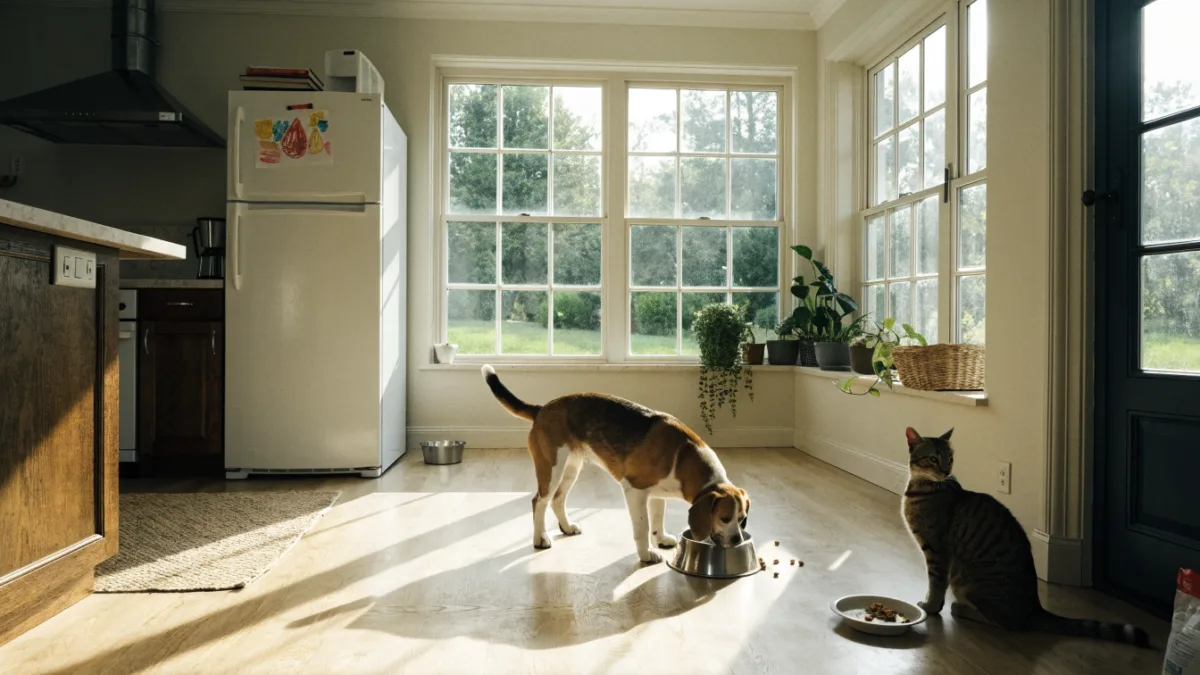
Feeding time in my house looks like two completely different events happening simultaneously. On one side of the kitchen, my dog Biscuit approaches his bowl like it’s the last meal he’ll ever see — inhaling kibble so fast I’m genuinely surprised he hasn’t figured out how to bypass chewing entirely. On the other side, my cat Mochi eats exactly six pieces of food, walks away, naps for two hours, comes back, eats three more pieces, and then stares at me like I’ve personally wronged her by letting the bowl get to half-full. Same household, same feeding schedule, two entirely different philosophies about what mealtime means. Turns out, there’s actual evolutionary biology behind why dogs scarf and cats graze — and understanding it might change how you feed your own pets.
The Feast-or-Fast Heritage
Dogs didn’t evolve to eat three square meals a day. Their wild ancestors — wolves, coyotes, and other canids — lived feast-or-fast lifestyles where a successful hunt meant gorging on as much food as possible before competitors showed up. When you catch a deer, you don’t politely pace yourself. You eat until you physically can’t anymore, because there’s no guarantee your next meal is coming tomorrow.
This pack-hunting history also meant something crucial: competition. When multiple animals are eating from the same kill, the slow eaters lose out. The fast eaters get the calories. Over thousands of generations, “eat quickly and eat a lot” became a survival advantage baked directly into canine DNA. Modern dogs haven’t lost this programming just because we put their food in a ceramic bowl at 7 AM and 5 PM.
So when Biscuit vacuum-cleaners his breakfast in forty-five seconds flat, he’s not being greedy or badly trained. He’s answering an ancient call that says “eat everything in front of you because the wolves next to you might steal it.” The fact that there are no other wolves — just Mochi glaring at him from the counter — doesn’t turn off that instinct.
Why Free-Feeding Doesn’t Work for Dogs
Here’s where a lot of well-meaning dog owners go wrong: leaving food out all day. I tried this with Biscuit for exactly one week after adopting him, operating under the assumption that he’d self-regulate like a reasonable adult. He did not. He ate the entire day’s ration in one sitting and then spent the afternoon looking personally betrayed that the bowl was empty.
Dogs aren’t biologically designed to graze. Their natural eating rhythm involves periods of eating followed by periods of genuine fasting — and that fasting component actually matters for their health. Short-term fasting allows the body to shift energy from digestion toward cellular repair and maintenance. It’s the same principle behind why intermittent fasting has become popular in human nutrition circles, except dogs come by it naturally. Continuous grazing disrupts that rhythm and can contribute to obesity, digestive issues, and a loss of healthy hunger cues.
The Solo Hunter’s Schedule
Cats come from completely different stock. Where dogs evolved as pack hunters taking down large prey together, cats evolved as solitary hunters catching small prey — mice, voles, birds, insects. A single mouse is roughly thirty calories. That means a wild cat needs to catch and eat somewhere between eight and twelve small prey items per day to meet their energy needs.
This fundamental difference shapes everything about how cats approach food. They’re not built for one big meal. They’re built for many small successes scattered throughout the day and night. Mochi’s eat-a-little-leave-come-back routine isn’t pickiness — it’s her operating exactly as her biology intended. Every quick visit to the bowl mirrors a wildcat making one small catch, eating it, and then moving on to patrol her territory (or, in her case, nap on my laptop keyboard).
The solitary nature also means cats never developed the competitive scarfing instinct. When you hunt alone, there’s no pressure to eat fast before someone else takes your food. Cats can afford to be leisurely, selective, and frankly a little dramatic about the whole experience.
Teeth Tell the Story
If you want to understand why pets eat the way they do, look inside their mouths. The dental architecture of dogs and cats reveals a lot about their evolutionary feeding strategies — and explains some behaviors that puzzle their humans.
The Canine Mouth
Dogs have teeth designed for tearing and crushing, but here’s something that surprised me: small dogs actually have very limited space for chewing. Their jaws are compact, which means even when they theoretically could chew their food, there’s not much room to do it effectively. This is why small breed dogs often seem to inhale kibble without any mastication whatsoever — structurally, they’re somewhat working against their own anatomy.
The Feline Mouth
Cats take this to another level entirely. They completely lack grinding teeth. No molars designed for chewing side-to-side like humans or herbivores possess. Their teeth are built almost exclusively for shearing meat off prey and crushing small bones. When a cat eats dry kibble, they’re not really chewing it — they’re essentially cracking it into pieces just small enough to swallow. This is why cats often seem to eat so deliberately and in such small amounts. The whole process is less efficient for them, especially with dry food, and their bodies seem to know it.
This anatomical reality is also why wet food often makes more sense as a significant portion of a cat’s diet. It’s closer to the texture and moisture content of what their teeth and digestive systems were designed to process. But I’ll let your vet guide that conversation — every cat’s needs differ based on age, health, and hydration status.
Decoding the Weird Stuff
Now we get to the behaviors that make pet owners question their life choices.
Why Cats Scratch the Floor Around Their Bowl
Every cat owner has watched their pet approach a full food bowl, sniff it, and then vigorously scratch the floor next to it like they’re trying to bury the whole thing in an imaginary litter box. It feels insulting. You bought the good food. They asked for the good food. And now they’re treating it like waste.
But this behavior has two completely natural explanations, and neither involves your cat being a jerk. First, it can be a food-storing instinct — wild cats often cover leftover prey to hide it from other predators and save it for later. Your cat might be saying “I’ll come back to this.” Second, and somewhat less flatteringly, it can mean they’re rejecting the food and attempting to bury it as they would waste in the wild. Context matters here. If Mochi scratches and then walks away without eating, she’s probably telling me the food isn’t fresh enough. If she scratches, eats some, and leaves, she’s saving it for later.
When Cats Decide Dog Food Is Better
Nothing tests your patience quite like spending money on premium cat food only to find your feline friend elbow-deep in the dog’s bowl. Cats sometimes develop strong preferences for dog food — different texture, different smell, different flavors. Dog food isn’t toxic to cats in small amounts, but it lacks the specific nutrients cats need, particularly taurine, an essential amino acid that cats can’t produce on their own. Chronic dog food consumption can lead to serious health issues over time. So even if your cat has decided the grass is greener on the canine side, it’s worth redirecting them back to their own bowl.
The Free-Feeding Debate
Here’s where the veterinary community is having genuinely interesting conversations right now. Traditional wisdom says cats are grazers, so free-feeding — leaving food out continuously — respects their natural eating pattern. And honestly, for many cats, this works fine. Mochi self-regulates beautifully when I leave her food out. She eats when she’s hungry, stops when she’s full, and maintains a healthy weight without any drama.
But some veterinary nutritionists are pushing back on this model. The argument: while cats may prefer grazing, it doesn’t necessarily mean grazing is optimal for their long-term health. The growing interest in structured meal-feeding and even intermittent fasting for cats mirrors the conversation happening around canine feeding. Proponents suggest that periods without food give the body time to repair cells, regulate insulin, and maintain healthy metabolic function — benefits that continuous eating might undermine.
There’s also emerging discussion about once-daily feeding for cats. Some vets argue it more closely mimics the natural fasting-and-feeding cycles that wild cats experience, even if it conflicts with the “many small meals” model. This is genuinely contested territory. Talk to your own vet before making major changes to your cat’s feeding routine — what works for one cat might be completely wrong for another, especially if there are underlying health conditions like diabetes or kidney issues.
What does seem clear across the board is that the old default of filling a bowl and forgetting about it is falling out of favor. Whether you’re feeding meals, puzzles, or timed portions, intentional feeding is replacing passive food availability.
Working With Biology, Not Against It
The takeaway isn’t that there’s one right way to feed your pets. Dogs and cats come to us with different evolutionary histories, different anatomical equipment, and different instincts about what mealtime means. Dogs want to feast because their ancestors survived by eating fast and eating plenty. Cats want to graze because their ancestors survived by catching small meals throughout the day. Both strategies worked in the wild. Our job is to honor those instincts while keeping our pets healthy in a domestic context where food is always available and exercise is optional.
For Biscuit, that means measured meals twice a day, served in a slow-feeder bowl that forces him to work for each mouthful. For Mochi, it currently means timed portions across multiple small meals, though I’m watching the research on fasting protocols with genuine curiosity. The point is understanding why they eat the way they do — so we can make informed choices rather than just filling bowls and hoping for the best.
And honestly? Once you understand the “why” behind the scarfing and the grazing, the whole feeding routine stops feeling like a chore and starts feeling like a small daily act of respecting who your animals actually are. Messy, opinionated, occasionally infuriating — and entirely the product of thousands of years of survival instincts doing exactly what they were designed to do.