

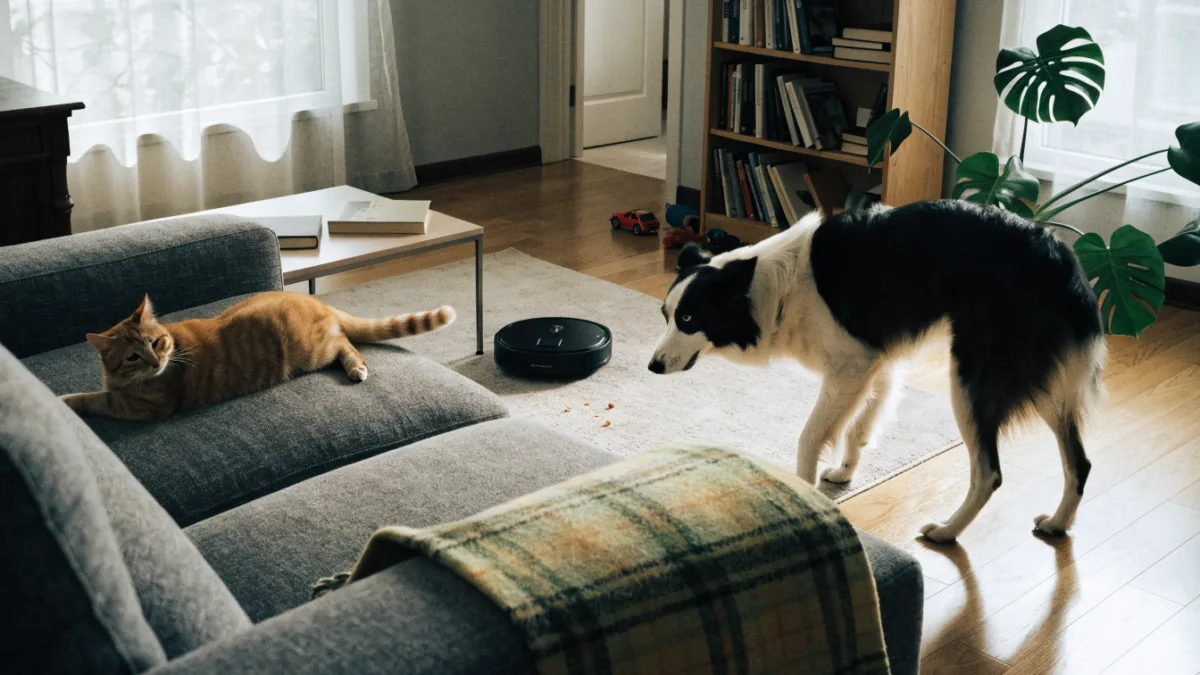
My cat Mabel once sat on a running Roomba for forty-five minutes while my partner’s sister’s terrier, Olive, had a full existential crisis in the corner of the kitchen. Same room, same machine, same noise level — two completely different realities unfolding simultaneously. Mabel looked like a queen on a slow parade float. Olive looked like she was negotiating for her life. And honestly, that about sums up the great robot vacuum divide in most multi-pet households.
The Canine Meltdown: Why Dogs Lose Their Minds
Here’s the thing about dogs and robot vacuums — and I say this with deep affection for every panicked golden retriever currently body-slamming a Roomba somewhere in suburban America — dogs seem to genuinely process these little disc-shaped invaders as alive. Not “suspicious object” alive. Not “weird moving chair” alive. More like “a low-slung predator with no eyes and no soul has entered my territory and I need to address this immediately.”
The autonomous movement is what does it. A regular vacuum cleaner is annoying, sure, but it’s attached to a human. Dogs understand that equation. Human picks up loud tube, makes noise for a while, puts it away. Threatening but comprehensible. A robot vacuum, on the other hand, moves on its own. It changes direction. It navigates around furniture. It shows up in a different room than where you last saw it. From a canine cognitive standpoint, that’s not machinery — that’s a creature.
And dogs respond accordingly. Some go full fight mode — barking, lunging, biting at the wheels, herding it into corners like it’s a particularly offensive sheep. Others choose flight, cramming themselves under beds or behind sofas with the wide-eyed intensity of someone hiding from a home invasion. I’ve seen videos of dogs that refuse to enter a room for weeks after a single Roomba encounter. The trauma is real.
What’s fascinating is that even naturally confident or dominant dogs will completely modify their reaction based on what their human does. If you laugh and film it, they often escalate. If you calmly intervene, many will back off.
This is where it gets interesting from a behavior standpoint. Dogs are obsessively attuned to human social cues. They watch our faces, our body language, our tone of voice. When a robot vacuum enters the picture, they’re not just reacting to the machine — they’re reacting to your reaction to the machine. If you get tense, they get tense. If you seem amused, they might interpret that as encouragement. Some trainers have debated whether owners laughing at their dogs attacking the vacuum actually reinforces the aggression, or whether the dog is too deep in instinct mode to even register human feedback. My completely non-expert opinion? It’s probably a little of both, depending on the dog.
The Feline Cold Shoulder: Why Cats Simply Do Not Care
And then there are cats. Glorious, dismissive, unbothered cats.
If you’ve spent any time on social media, you’ve seen the viral clips — a Roomba slowly making its rounds while a cat sits on top of it like a ride at a very boring amusement park. Or the classic standoff: Roomba approaches cat, cat refuses to move, Roomba gently bumps into cat, cat does not acknowledge this event has occurred, Roomba redirects and continues on its way. The cat’s expression throughout remains somewhere between “I’m thinking about dinner” and “I am thinking about nothing because I am a cat and thoughts are optional.”
The contrast is genuinely striking, and there are a few reasons for it. Cats process threats differently than dogs. Where dogs often default to active confrontation or active avoidance, cats lean toward what behaviorists sometimes call “passive resistance” — they assess, they decide whether something is worth their energy, and ninety-nine percent of the time, they conclude that it is not.
A robot vacuum registers to most cats as a mildly annoying environmental factor. The noise is unpleasant but tolerable. The movement is slow enough to be non-threatening. There’s no sudden lunging, no aggressive pursuit. From a feline perspective, this “noisy monster” is roughly equivalent to a large beetle — noteworthy, perhaps, but not worth abandoning a sunny napping spot over.
The Power Move of Sitting on Top
And then there are the cats who take it a step further and simply claim the Roomba as a moving throne. This isn’t bravery, exactly. It’s more like the ultimate expression of feline entitlement — “this object exists in my space, therefore it belongs to me, and I will repurpose it as transportation.” There’s something deeply funny about watching a cat ride a robot vacuum around a living room with the expression of someone being carried through an airport on a luggage cart. Bored. Slightly regal. Completely unimpressed by the whole affair.
What’s happening cognitively is a bit different than with dogs. Cats don’t seem to perceive the vacuum as a creature. They don’t treat it with the kind of social curiosity or territorial alarm they’d direct at a new animal. They treat it like furniture that has unexpectedly developed opinions about where it wants to go. And cats, as a rule, are not interested in negotiating with furniture.
Do They Actually Know It’s Not Alive?
This is where the conversation gets genuinely interesting, and where pet owners, behaviorists, and animal cognition researchers all have slightly different answers.
The honest truth is that we can’t know with total certainty what’s happening inside an animal’s mind when they encounter a robot vacuum. But the behavioral evidence suggests something pretty nuanced. Dogs seem to fall into a gray zone — they recognize that the Roomba doesn’t smell like an animal, doesn’t respond to social signals, and doesn’t behave like prey or a predator in any consistent way. But the self-directed movement is enough to trigger their “something alive is in my space” response, even if the rest of the data doesn’t quite add up. It’s like their instincts and their higher reasoning are having a disagreement, and instincts are winning.
Cats, on the other hand, seem to categorize the vacuum almost immediately as “inanimate but mobile” — a distinction that apparently makes perfect sense to a species that has spent thousands of years watching wind blow things around and doors swing shut on their own. Cats have a very practical relationship with the concept of movement. Things move. Not all moving things are alive. The Roomba goes in the “moving but not alive” file, right next to ceiling fans and the feather wand toy when no one’s holding it.
There’s an ongoing debate among pet enthusiasts about whether this makes cats “smarter” than dogs in this specific scenario. I’d argue it’s not really about intelligence — it’s about different evolutionary priorities. Dogs evolved to cooperate with humans and monitor their environment for threats alongside their social group. Cats evolved as solitary hunters who needed to conserve energy and ignore irrelevant stimuli. Both approaches are brilliant. They’re just built for different jobs.
The Poopocalypse: A Warning I Beg You to Take Seriously
Okay, but before we get too deep into animal cognition, let’s address the practical nightmare that every robot vacuum owner with pets eventually faces. You’ve probably heard rumors. You may have seen the photos. You thought it couldn’t happen to you.
It can. And it will.
Here’s the scenario: your dog has an upset stomach. Or your cat kicks litter out of the box in a pattern that happens to include a stray piece of waste on the floor. Or your rabbit leaves a trail of pellets outside their litter area. You go to bed. The robot vacuum is scheduled to run at 2 AM. You wake up to a home that looks like a crime scene.
Robot vacuums do not have the judgment to stop when they encounter pet waste. They don’t pause and think, “Hmm, this is organic material, perhaps I should go around.” They drive directly through it and then continue their cleaning route, distributing the mess across every surface they touch. I have read accounts — and I am not exaggerating — of people having to replace carpet, repaint walls, and temporarily relocate. One person in a dog owners’ group described it as “the worst day of my life, and I’ve been through a divorce.” Another simply posted a photo with no caption, and the comments were just hundreds of people saying “I’m so sorry” like they were at a funeral.
The fix is simple but requires discipline: check your floors before scheduling a cleaning cycle. If you have a pet prone to indoor accidents — a puppy in training, a senior dog with incontinence issues, a cat with a habit of litter-box rebellion — either run the vacuum manually when you’re home and alert, or set up physical barriers. Talk to your vet if accidents become frequent; there’s usually a reason, and it’s worth investigating rather than just living in fear of the 2 AM Roomba.
The Multi-Pet Reality: Why Some Households Now Own Multiple Robot Vacuums
If you have one pet, a robot vacuum is a convenience. If you have multiple pets — especially a mix of species — a robot vacuum becomes a survival tool.
I run a small zoo at home: two cats, and they shed enough fur to construct a third cat on a weekly basis. My friend has three dogs, two cats, and a rabbit. Another person in my circle keeps indoor chickens (yes, really — and before you ask, they wear tiny diapers designed for birds, which is a sentence I never expected to type). The sheer volume of fur, dander, feathers, hay, and miscellaneous pet debris in multi-pet households is genuinely staggering. Sweeping and vacuuming manually becomes a daily physical burden, and for people with back issues or mobility limitations, it’s not just annoying — it’s genuinely painful.
This is why a growing number of pet-heavy households are investing in multiple robot vacuums. One for each floor, or one for the pet areas and one for the kitchen, or — in particularly ambitious setups — a small fleet that covers different zones on staggered schedules. It sounds excessive until you’ve watched a single Roomba try to clean a living room that three German shepherds and a Maine Coon cat have spent the day occupying. That machine comes back to its dock looking like it fought a war. Which, in a sense, it did.
When you’re shopping for a vacuum in a pet household, what matters is suction power strong enough to pull fur out of carpet, a tangle-resistant brush roll (because pet hair will wrap around traditional brushes and eventually stop them entirely), and ideally some kind of obstacle detection that at least attempts to identify objects on the floor. No system is perfect, but the technology has improved significantly in recent years.
So Should You Get One?
If you have pets and you’re tired of living in a perpetual state of visible fur accumulation, a robot vacuum will probably change your life. But go in with realistic expectations. Your dog may need time to adjust. Your cat will probably ignore it. At some point, it will run over something it shouldn’t have. And you will, at least once, find yourself filming the chaos instead of intervening, because some moments are too absurd to interrupt.
Just check the floor first. Trust me on this one.
And if your cat decides to ride the Roomba like a tiny furry emperor surveying their domain? Let them. They’ve earned it. We’re all just living in their house anyway.