

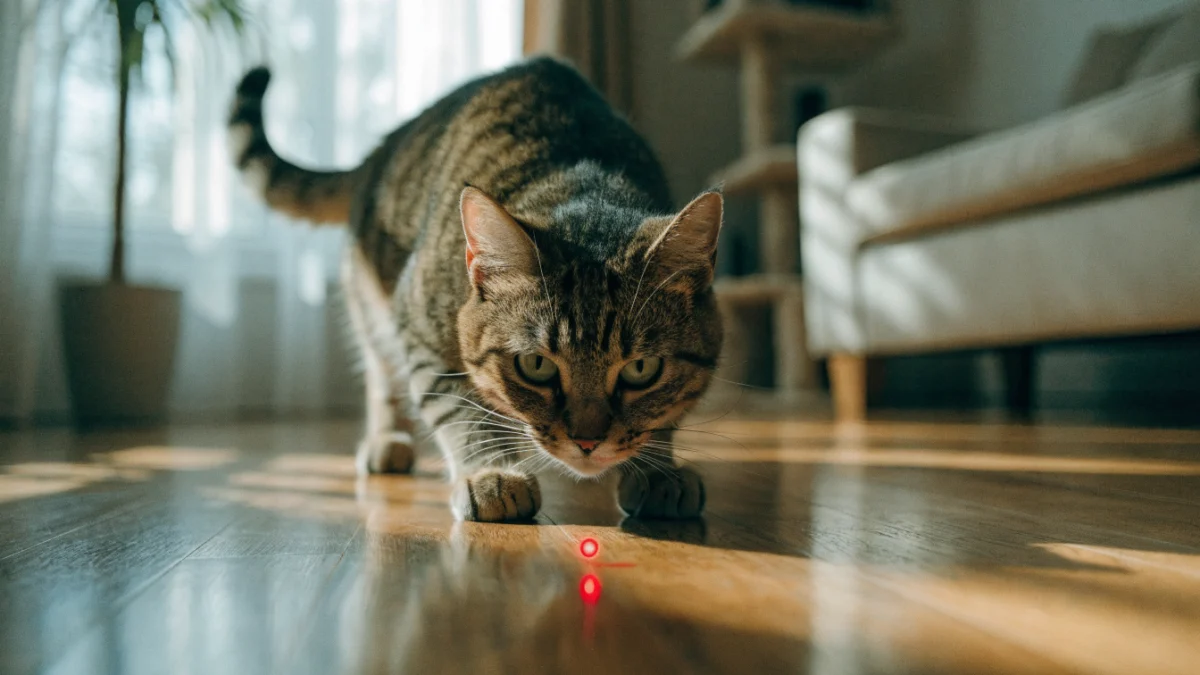
For two years, laser play in my apartment ended the same way every time: I’d click the pointer off, and my cat Waffles would spend the next ten minutes patrolling the exact spot where the dot died, sniffing the baseboards like the thing had left a body. No closure. Just a very small detective working an unsolvable case. My other cat, Olive, watched the whole ritual from her tree with the expression of someone reviewing a movie she already knew was bad. Meanwhile, the internet is split down the middle — half of it insists laser pointers are borderline cruel, and the other half calls them the greatest apartment cat invention since the scratching post. Having lived with both the meltdown and the cardio, I can tell you the truth is annoyingly in the middle, and it comes down to one thing the dot never gives a cat: the catch.
Why Cats Can’t Resist the Dot (Hint: It’s Not the Color)
Here’s the first thing that surprised me: cats literally cannot see red the way we do. Cats are dichromats — they lack the red cone receptors in their eyes, so that vivid red dot you’re waving around registers to them as a dull yellow-gray smudge. What hooks them isn’t color at all. It’s movement. Cats detect motion considerably better than we do; their eyes pick up flicker at roughly twice the rate human eyes can. A dot that darts, stalls, and bolts across the floor behaves exactly like fleeing prey, and that triggers a chase circuit your cat is powerless to override.
And I do mean powerless. The predatory drive is completely independent of hunger — a well-fed cat still hunts, because the wiring doesn’t check the food bowl first. Waffles will chase the dot twenty minutes after dinner, every single time. When we say cat prey drive play, we’re really talking about rehearsal: indoor play is your cat practicing the full predatory sequence, which runs roughly stalk → chase → pounce → catch → bite → satisfaction → groom → sleep. Keep that sequence in mind, because it’s the key to this entire debate.
The Case Against Lasers: The Hunt That Never Ends
The problem with a laser pointer isn’t the chase — it’s that the chase is all there is. The dot stops the predatory sequence at step two and never lets it finish. There’s nothing to catch. There’s no bite, no “kill,” and crucially, no neurological payoff — that satisfying resolution that follows a successful pounce, when the brain essentially signals hunt over, stand down, and the cat settles into grooming and a nap.
Without the catch, many cats are left in a state of unresolved arousal: revved up with nowhere to put it. That’s why some cat professionals are blunt about it..[1] — enthusiastic for the cat in the moment, frustrating and unsatisfying in the end. Some behaviorists also report a link between laser-only play and frustration behaviors, including compulsive light- and shadow-chasing: cats staring at glints on the wall, pouncing at reflections, patrolling floors. To be fair, much of that evidence is anecdotal — plenty of cats chase dots for years with zero drama. But the underlying welfare concern is legitimate: asking a predator to hunt something it can never, ever catch is a strange gift.
This is where the “cruel” question comes up, and it deserves a straight answer — [2] My take: a laser pointer isn’t cruel. An eternally unfinished hunt is a real problem. Those are different things, and the difference is fixable.
The Case For Lasers: The Dot Gets Cats Moving
Now the other side, which is equally real. By recent surveys from the Association for Pet Obesity Prevention, over half of U.S. cats — around 61% in the latest figures — are overweight or obese. Indoor cats are chronically under-exercised, and if you live in an apartment, you know the struggle: there’s only so much sprinting a cat can do in 400 square feet. The laser is one of the few tools that reliably gets a sedentary cat doing full-speed, furniture-adjacent athletics. [3] reflects the mainstream veterinary middle ground: lasers can be a safe and effective source of exercise and mental stimulation when used correctly. General guidance suggests 10–15 minutes of interactive, hunting-style play once or twice a day, and the dot is genuinely excellent at the first half of that job.
The Fix: End Every Session With a Catch
Here’s the part that changed everything in my house, and it’s almost embarrassingly simple: never end a laser session with the dot. End it with something your cat can physically catch, bite, and “kill.” Land the dot on a feather toy, a crinkle ball, a handful of treats — let the dot “become” real prey at the last second. This completes the hunt cycle, delivers the payoff, and heads off the frustration before it builds. Since I started doing this, Waffles’ post-session floor patrol has stopped completely. She catches, she bites, she gets a treat, she grooms, she sleeps. The full sequence, every time.
How to Structure a Session That Ends Right
- Warm-up: Move the dot slowly and low along the floor so your cat shifts into stalking mode instead of panic-sprinting immediately.
- The chase: Build intensity — quick bursts, direction changes, pauses that mimic prey hesitating.
- Wind-down: Slow it down and bring it back toward your cat and toward the floor.
- The catch: Park the dot directly on a physical toy or a treat and let your cat pounce on it for real.
- The reward: Follow the catch with a small treat or part of a meal. Then get out of the way — the groom-and-nap phase runs itself.
The Non-Negotiables
- Never shine the beam into your cat’s eyes — or anyone’s. Even consumer-grade pointers can cause retinal damage with direct exposure. This is the one rule with no exceptions.
- Keep the dot on the floor. Don’t run it up walls, curtains, or shelving — you don’t want your cat launching off a bookcase at full speed after an illusion.
- Skip the fully automatic laser toys, or at least don’t make them the main event. They’re the worst offenders for incomplete hunts because no catch is ever possible — a supervised manual session with a proper ending beats a robot dot every time.
Beyond the Dot: Toys That Finish the Job
Even with the perfect ending, I treat the laser as one tool in the rotation, not the whole toolbox. When people ask me about the best cat toys, my honest answer is: whatever lets your cat complete the entire predatory sequence. That usually means:
- Wand or fishing-pole toys with feather or fur attachments — the gold standard, because your cat gets to stalk, chase, pounce, catch, and bite in one session, and you get to control the prey’s dramatic arc.
- Kicker toys — long, soft prey-shaped toys built for the grab-and-rabbit-kick phase that the dot can never offer.
- Puzzle feeders and foraging mats — they mimic the hunting-and-gathering side of the sequence and slow down mealtime while they’re at it.
- Treat-tossing toys — good for cats who need solo play between your interactive sessions.
Rotating a few of these keeps play from getting stale and lets different parts of the sequence get their workout. Waffles gets her dot fix a couple of times a week, always with the ending; the rest of the week it’s wand toys and a puzzle feeder that she has definitively decided is her nemesis.
So no, a laser pointer isn’t bad for your cat — an unfinished hunt is. The red dot is a brilliant piece of exercise equipment with one design flaw, and the fix costs you nothing: give the hunt an ending, every single time. And there’s a bigger-picture win here too. A cat whose prey drive gets genuinely satisfied through structured indoor play is a cat who doesn’t need the outdoors to feel whole — which matters, because free-roaming cats take an enormous toll on songbirds and small wildlife (research estimates run into the billions of animals per year in the U.S. alone). Play the full sequence indoors, end with the catch, and everybody wins: your cat gets real satisfaction, your furniture gets a break, and the birds outside get to go about their day.
Sources
- One vet has gone as far as calling lasers "terrible toys" — facebook.com
- owner communities debate it constantly — facebook.com
- PetMD's position — petmd.com