

Discovering a puddle of cat urine on your favorite rug or catching the unmistakable scent of spray near a window is one of the most frustrating experiences a cat owner can face. But before you assume your feline companion is acting out of spite, it helps to understand that not all house soiling is created equal. Feline behaviorists and veterinarians draw a critical distinction between two very different behaviors: urine marking and inappropriate elimination. Decoding which of these your cat is doing is the first and most important step toward resolving the problem, restoring harmony to your home, and ensuring your cat’s well-being.
The Chemistry of Communication: What Is Urine Marking?
To understand urine marking, you have to look at the world through a cat’s nose. Cats are highly territorial, solitary hunters by nature, and they rely heavily on chemical communication to navigate their social landscape. Urine marking is not simply a bathroom break—it is a sophisticated messaging system.
When a cat marks, the urine contains extra communication chemicals, including pheromones, that convey complex social and reproductive messages to other cats. These chemical signals can communicate information about the cat’s identity, sexual availability, and emotional state. It is, in essence, the feline equivalent of leaving a detailed Post-it note for anyone who passes by.
“Urine marking is not a house-training problem; it is a communication behavior driven by a cat’s instinctual need to establish territory or cope with stress.”
The motivation behind urine marking is almost always psychological or social. Cats may mark in response to perceived territorial threats—such as a new pet in the household or the sight of outdoor strays lingering near a window. Anxiety, stress, and frustration can also trigger marking. Even seemingly minor changes, like rearranging furniture or a change in the owner’s work schedule, can push a sensitive cat to start broadcasting its uneasure through scent.
Spraying vs. Squatting: Reading the Signs
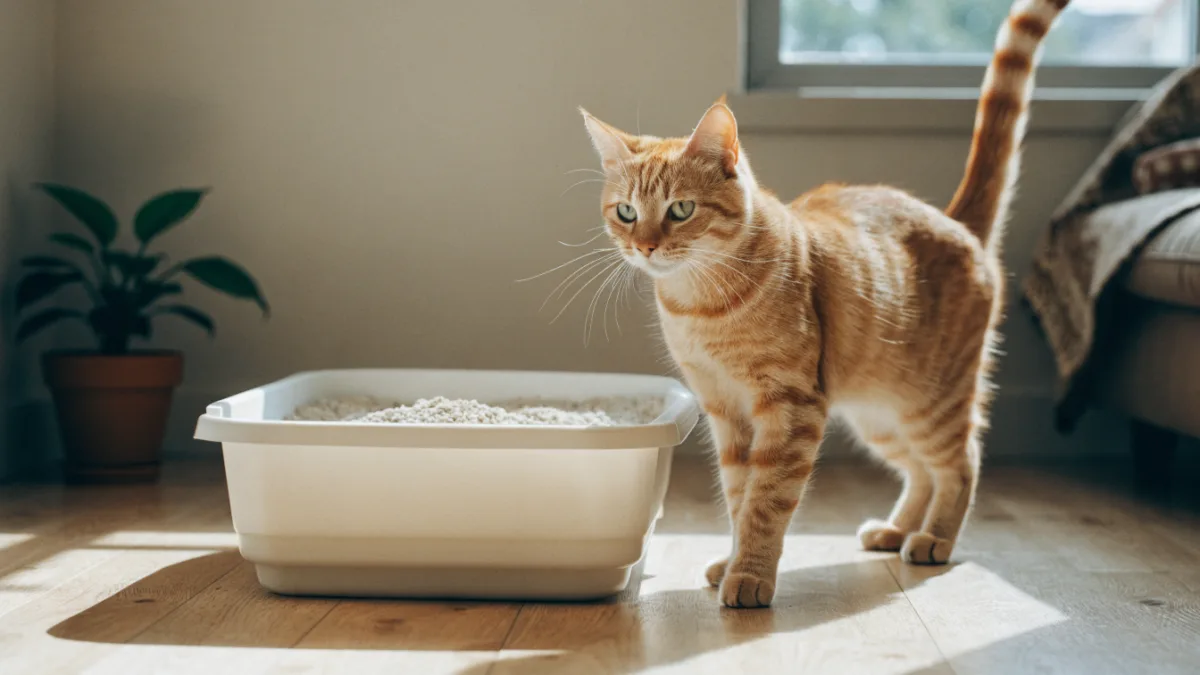
One of the most reliable ways to distinguish marking from inappropriate elimination is to observe the cat’s posture. Marking cats, particularly when spraying, typically stand upright with their tail erect and quivering. They back up to a vertical surface—such as a wall, a doorframe, or the side of a chair—and release a small amount of urine. The urine is usually directed backward and often leaves a distinctive trail running down the vertical surface.
In contrast, cats that are simply toileting outside the box usually squat horizontally on a flat surface—whether that is a floor, a bed, or a pile of laundry—and deposit a larger volume of urine. While cats can mark with both urine and stool, urine marking on vertical surfaces is by far the more common expression of the behavior. Recognizing this physical difference is essential because the two behaviors require entirely different approaches to resolve.
When It’s Not a Message: Understanding Inappropriate Elimination
If urine marking is communication, inappropriate elimination is simply a cat answering nature’s call in the wrong place. Also referred to as “toileting,” this behavior occurs when a cat chooses to eliminate outside its litter box not to send a message, but because something about the litter box situation is unsatisfactory.
The causes of inappropriate elimination are most frequently environmental or medical. A cat may develop an aversion to its litter box for a variety of reasons: the box may not be cleaned frequently enough, the type of litter may feel unpleasant underfoot, or the box location may be inconvenient or intimidating. In multi-cat households, bullying or guarding behavior by another pet can make a cat afraid to approach the litter box. Alternatively, a cat may have simply developed a preference for a different substrate—such as the soft, absorbent feel of a bathmat or laundry pile—or a different location in the home.
The key distinction is motivation. Where marking is about saying something to the world, inappropriate elimination is about finding a acceptable place to relieve oneself when the designated option is, for whatever reason, unacceptable.
The Golden Rule: Rule Out Medicine First
Before addressing any behavioral explanation for house soiling, veterinarians emphasize one non-negotiable principle: any cat that begins urinating outside the litter box must be evaluated by a veterinarian. This is considered the “Golden Rule” of feline house soiling, and for good reason.
A wide range of medical conditions can cause a cat to eliminate outside the box. Urinary tract infections, bladder inflammation (feline lower urinary tract disease, or FLUTD), bladder stones, kidney disease, diabetes, and arthritis can all contribute to the problem. A cat experiencing pain while urinating may begin to associate the litter box with that pain and start seeking out other locations. In other cases, a medical condition may cause increased urgency or frequency, making it impossible for the cat to reach the box in time. For male cats especially, a urinary blockage is a life-threatening emergency that requires immediate veterinary intervention.
This is why the debate between behavioral and medical causes is so important. Owners often mistake house soiling for a deliberate behavioral act or even revenge—perhaps the cat was left alone too long or is punishing the owner for something. Animal behaviorists are emphatic on this point: cats do not act out of spite. They are either sick, stressed, or reacting to an environment that does not meet their needs. Assuming malice where there is illness or anxiety only delays proper treatment and damages the human-animal bond.
Unpacking the Causes: Stress, Environment, and the Litter Box
Once medical issues have been ruled out or addressed, the focus shifts to environmental and behavioral factors. This is where careful observation and a willingness to make changes become essential.
The Impact of Stress and Territory
A cat’s environment deeply influences its behavior, and stress is a powerful driver of house soiling. Cats are creatures of routine and territory, and disruptions to their sense of security can manifest in marking behavior. Common triggers include:
- The introduction of a new pet or person into the household
- Outdoor stray cats visible through windows or detected by scent
- Moving to a new home or significant renovations
- Changes in the owner’s schedule or routine
- Conflict or tension between cats in a multi-cat home
When a cat feels its territory is threatened or its routine has been upended, marking becomes a way to re-establish a sense of control and communicate its presence. Understanding this motivation is key to addressing the behavior with empathy rather than punishment.
Litter Box Logistics
For cats engaging in inappropriate elimination, the litter box itself is often the culprit. Cats can be surprisingly particular about their bathroom habits, and several factors can lead to rejection:
- Cleanliness: Cats have a highly developed sense of smell. A box that is not scooped daily and thoroughly cleaned regularly may be rejected.
- Litter Type: Preferences vary widely. Some cats dislike scented litters, while others may object to the texture of certain materials. Sudden changes in litter type can trigger aversion.
- Box Location: A litter box placed in a noisy, high-traffic, or hard-to-reach area may be avoided. Similarly, a box placed near loud appliances like washing machines can be intimidating.
- Box Design: Covered boxes can trap odors and make some cats feel trapped or vulnerable, especially in multi-cat homes.
- Number of Boxes: The general rule is one litter box per cat plus one extra. Too few boxes can create competition and stress.
Addressing these factors can often resolve inappropriate elimination without the need for further intervention. Sometimes, simply relocating a box, switching to an unscented clumping litter, or adding an additional box in a quiet area can make all the difference.
Modern Approaches to Treatment
The landscape of feline veterinary behavioral medicine has evolved significantly in recent years, offering cat owners more tools than ever to address house soiling. Current protocols, such as those outlined in guidelines from the American Association of Feline Practitioners (AAFP), strongly advocate for a structured, multi-modal approach. This framework involves differentiating between marking and toileting, identifying the underlying cause, and building a comprehensive treatment plan that may combine several strategies.
Environmental Modification
The foundation of any treatment plan is environmental management. For marking behavior triggered by outdoor cats, simply blocking visual access—by closing blinds, applying window films, or using motion-activated deterrents outside—can dramatically reduce the behavior. Enriching the cat’s environment with vertical spaces, scratching posts, and interactive play can also help reduce stress and frustration by providing appropriate outlets for natural behaviors.
Pheromonotherapy
One of the most significant advancements in treating feline house soiling has been the development of synthetic pheromones. The understanding of the communication chemicals found in cat urine has led to products like Feliway, which mimic the calming facial pheromones that cats naturally deposit when they rub their cheeks on objects in their environment. These synthetic pheromones are widely used in veterinary medicine to signal safety and reduce the anxiety and territorial stress that often drive urine marking. Available as diffusers, sprays, and collars, these products offer a non-invasive, drug-free option that can be particularly effective when combined with environmental modification.
Pharmaceutical Intervention
In cases where stress and anxiety are severe or deeply ingrained, veterinarians may recommend anti-anxiety medications. There is ongoing discussion within veterinary behavioral medicine about the optimal balance between environmental modification and pharmaceutical intervention, but the consensus is that medication can be a valuable tool—particularly when used in conjunction with, rather than instead of, behavioral strategies. Medications such as fluoxetine or clomipramine may be prescribed to help reduce the underlying anxiety that fuels marking behavior, making the cat more receptive to environmental changes and behavioral modification.
Patience, Empathy, and the Bigger Picture
Resolving feline house soiling requires patience, careful observation, and a willingness to see the world from the cat’s perspective. Whether the behavior is driven by a medical issue, environmental stress, or litter box dissatisfaction, the key is to remember that your cat is not being difficult—they are trying to communicate a need or cope with a problem they cannot solve on their own.
The welfare implications of understanding these behaviors extend far beyond the individual household. House soiling is consistently cited as one of the leading causes of cat abandonment and surrender to animal shelters. Many cats lose their homes—and their lives—simply because their owners did not have the information needed to decode the behavior and address its root cause. By approaching house soiling as a solvable problem with identifiable medical, environmental, and behavioral triggers, we can keep more cats in loving homes and reduce the burden on shelters. Every puddle outside the box is a message; learning to read it is one of the most compassionate things a cat owner can do.