

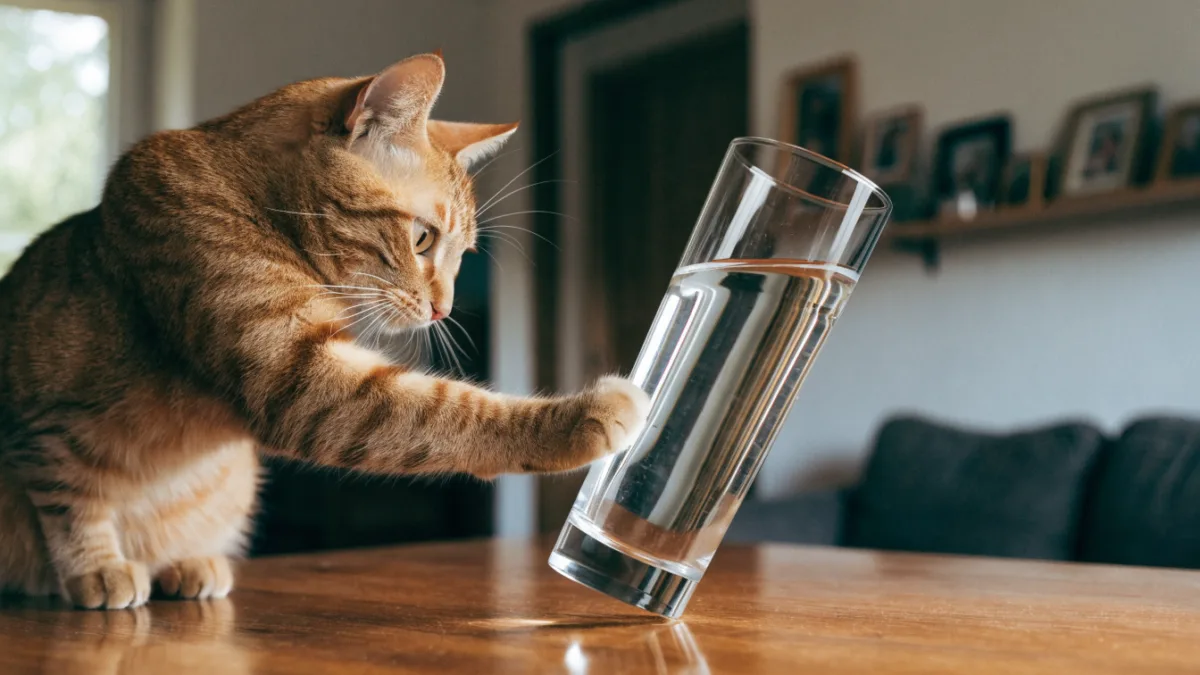
It happened during a work call. Mochi hopped onto the side table, placed one paw on my water glass, and made unbroken eye contact with me as she began the slow push. Not a swat — a slow, deliberate shove, with a dramatic pause in the middle, as if to say last chance to negotiate. My client heard the crash. My cat heard applause, because I’m embarrassed to admit I laughed. If you’ve ever frantically searched “cat knocks things off table” while picking shards out of a rug at 7 a.m., I have good news: your cat isn’t a vandal, and this is one of the most fixable “behavior problems” out there. But first, let’s talk about what’s actually happening.
It’s Not Spite. It’s a Hunting Drill.
Cats are ambush predators, and everything about the table-shove is a condensed version of the hunt: stalk, paw, bat, then chase the thing that moves. In the wild, a cat will bat at prey to test it — if it runs, it gets chased; if it doesn’t, dinner is served. A pen rolling off a table and bouncing across hardwood is the closest your living room ever gets to fleeing prey. As,[1] this is instinct-driven play and exploration, not misbehavior.
There’s also a tactile element we forget: a cat’s paw pads are packed with nerve endings. Cats investigate objects with their paws the way we’d pick something up and turn it over in our hands. Sometimes the knock-off isn’t even the goal — it’s just the investigation’s messy conclusion. The object cooperated by falling, and now it’s interesting twice.
And this isn’t a kitten phase. Adult cats do it just as enthusiastically, and there are real physical payoffs: batting refines paw-eye coordination, and all that climbing and pouncing builds muscle. One cat owner on:[2] her cat nudging a coin off the piano so her other cat could chase it across the floor — which tells you cats can turn this into solo games, social games, or full two-cat heist operations. Gravity is a toy that never gets old.
Congratulations, You’re the Reward
Here’s the part nobody tells you: if you want to know why cats push things off counters so persistently, look at what happens immediately after. Glass hits the floor, and a human materializes — laughing, scolding, sighing, retrieving. Cats don’t neatly sort attention into “good” and “bad.” Attention is attention, and to a bored cat, an annoyed human sprinting into the room is genuinely entertaining. [3] owners routinely reinforce the behavior without realizing it.
I learned this the hard way. The first thing Mochi ever pushed off a table was a lamp, and I — a fool — filmed it and sent it to three people. Within a week she’d identified that lamp as a magic human-summoning device. The behavior isn’t stubbornness; it’s cause and effect, learned exactly the way we want cats to learn things. Just, you know, the wrong things.
Do Cats Actually Understand Gravity?
The “gravity experiments” framing is charming, and weirdly, it might not be entirely wrong. Researchers in Japan have studied causal reasoning in cats and found that cats seem to form expectations about objects — when a container that should contain a rolling ball produces nothing, cats stare longer at the impossible outcome. That suggests some intuitive physics, not just reflex.
Plenty of behaviorists would push back, though: batting produces movement, movement is self-rewarding, and no physics degree is required. Honestly, both can be true. Your cat doesn’t need to understand gravity to exploit it beautifully. What she definitely is not doing is seeking revenge or running a personal research program against your décor. The day you stop narrating the behavior as spite is the day you can actually do something about it — because spite isn’t redirectable, but play drive is.
How to Stop a Cat Breaking Things (Without Becoming the Villain)
The plan has four parts, and you need all of them. Skip one and the whole thing wobbles like — well, like a glass near the edge of a table.
Rig the Environment in Your Favor
Move the heirlooms behind glass or into another room. This isn’t surrender; it’s choosing your terrain. For things that must stay out, use removable museum putty or non-slip mats designed for securing objects — the feature you want is “holds firmly, peels off clean.” Then make your counters and tables boring: fewer lightweight, rollable, bat-able objects means fewer irresistible targets. A cat can’t knock off what isn’t there, and cats are shockingly pragmatic about unproductive hunting grounds.
Give the Hunt a Better Outlet
Daily interactive play is the single best substitution, and most cats do well with one or two 10–15 minute sessions. The key detail: let the cat complete the whole sequence — stalk, chase, pounce, catch, and a final “kill” bite. A wand toy that just dangles and never lets the cat win leaves the hunting loop open, and an open loop goes looking for your water glass. Puzzle feeders are excellent for food-motivated cats, and rotate toys weekly — cats habituate fast, and a toy that vanished for a while comes back smelling like news.
Kill the Payoff
When a safe object hits the floor, do not react. No eye contact, no theatrical sigh, no immediate retrieval while the cat is watching. Come back later, or fake a phone call and leave the room first. This is the hardest step because it requires everyone in the household to comply — one person laughing on day three resets the whole counter. Cats are patient scientists. You have to be a boring one.
Go Vertical
Cats end up on counters partly because high ground is prime real estate and you’ve left exactly one option. Add a tall cat tree or window shelf near the scene of the crimes. If the most interesting vertical object in the room is your kitchen counter, the cat will reasonably conclude it’s for her.
What Not to Do
No spray bottles, no yelling, no punishment. Aversives teach a cat to fear you, not to reconsider gravity — and the underlying need for play doesn’t vanish, it just relocates to 4 a.m. Declawing is never an answer either; it’s an amputation of the toe bone at the last joint, and it’s banned or restricted in a growing number of places for good reason. And if the shoving suddenly escalates alongside other changes — appetite, litter box habits, grooming — mention it to your vet, since big behavior shifts occasionally have physical roots.
Here’s the takeaway I’d offer anyone eyeing their first cat: that shove is inheritance. Your sofa leopard’s wild ancestor, the African wildcat (Felis lybica) — still thriving across Africa and parts of the Middle East, currently listed as Least Concern — passed down that paw-first curiosity essentially intact. You can’t train the wildcat out of a housecat, and honestly, you wouldn’t want to; it’s the same engine that makes them playful, weird, and worth living with. So put the vase behind glass, buy the wand toy, and when the inevitable crash comes anyway, deploy your best bored face. Mochi still runs gravity experiments in my house. She just does it now with objects I’ve chosen, on surfaces I’ve approved, while I pretend — convincingly, I think — not to care.
Sources
- Fear Free Happy Homes explains — fearfreehappyhomes.com
- Reddit described — reddit.com
- PetPlace makes the same point — petplace.com