

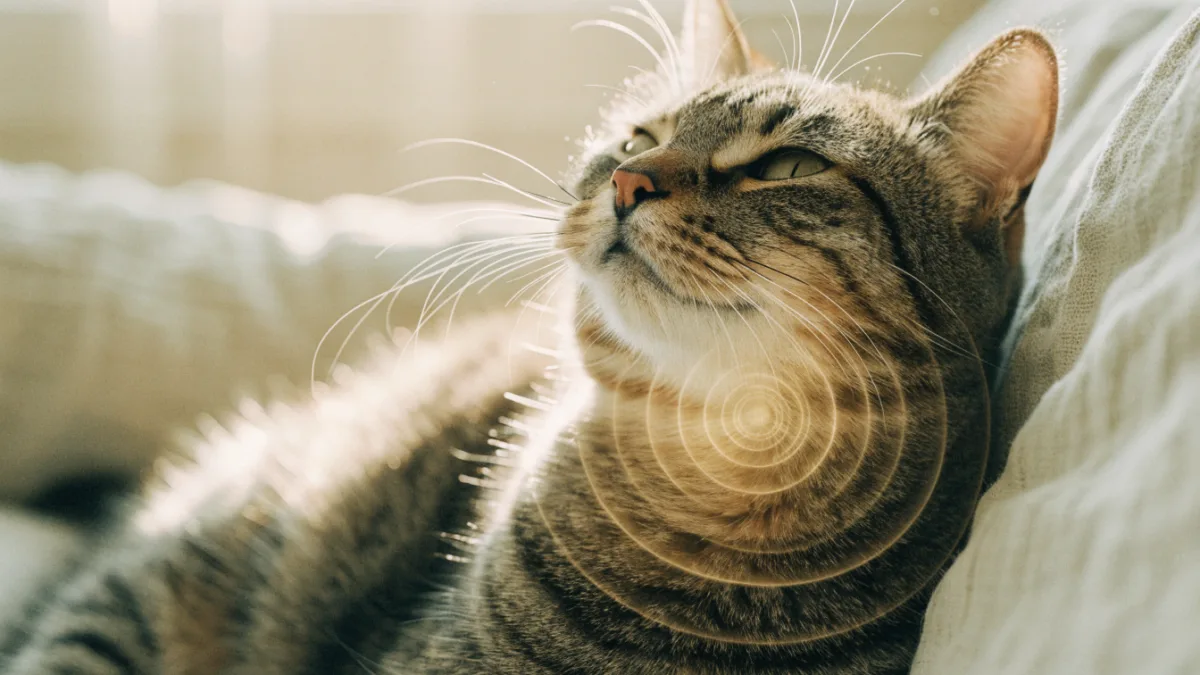
Here’s a fact that stopped me mid-scroll: a twenty-pound Maine Coon and a four-pound Singapura purr at essentially the same frequency — somewhere between 25 and 150 Hertz. That’s genuinely weird. Almost every other vocalization in the animal world scales with body size, which is why a lion’s roar rattles your ribcage and a kitten’s meow sounds like a squeaky toy. Purring ignores body size completely. And once you start asking why, the tidy little story of “cats purr because they’re happy” unravels into something much stranger and, honestly, much better.
Purring Is Not a Happiness Meter
Let’s clear this up first, because it’s the biggest myth in all of catdom. If you’ve ever searched “why do cats purr,” you probably found “contentment” as the first answer. Contentment is on the list — it’s just not the whole list.
A purr is a continuous sound produced during both inhalation and exhalation, which is what gives it that unbroken, motor-like quality. Barking, meowing, and howling all happen on the exhale only. Purring is the rare vocalization that runs on a full breath cycle, and that continuity is exactly why it’s so hard to pin to one meaning.
Kittens start purring at around two days old — blind, deaf, and roughly the size of a baked potato. At that stage the purr is contact communication: it tells the mother “I’m here, I’m nursing, all systems normal.” That’s likely the purr’s original evolutionary job, and everything else got layered on top.
Here’s where it gets uncomfortable for the happiness theory: cats also purr when they’re stressed, sick, injured, or in labor. Purring is associated with endorphin release, which is why researchers think it doubles as a self-soothing mechanism. My senior tabby, Mabel, purred through her entire vet exam last year while being, per the tech, “a fist with fur.” She wasn’t happy. She was coping. Once you know cats do this, you can’t un-know it — a purr is information, not a mood ring.
The Hyoid: One Tiny Bone Chain Split the Cat Family in Two
The purr-versus-roar trade-off
Deep in every cat’s throat sits the hyoid apparatus — a chain of small bones anchoring the larynx to the skull. The rigidity of that chain is, by the classic distinction, what decides a cat’s entire vocal destiny.
Purring cats — domestic cats, cheetahs, cougars, lynx, bobcats — have a fully ossified hyoid: solid, rigid bone from end to end. That stiffness lets the larynx vibrate continuously through both phases of breathing. Roaring cats — lions, tigers, jaguars, leopards, the genus Panthera — have a segment of flexible cartilage where bone would otherwise be. That flexibility is what produces a deep, resonant roar that carries for miles. The catch: it makes continuous purring anatomically impossible.
So evolution handed wild cats a choice, and they had to commit. Purr or roar — not both. This is why a cheetah, the fastest land animal on Earth, chirps like a songbird and purrs like a housecat instead of roaring, and why the mountain lion is the largest purring cat on the planet. Nature is not subtle about its trade-offs.
The mechanism (and a 2023 plot twist)
The long-standing theory: laryngeal muscles contract and relax roughly 25 to 30 times per second, vibrating the vocal folds nonstop through inhale and exhale alike. A muscular drumroll sustained for minutes at a time — more than I accomplish before coffee.
Then in 2023, Christian Herbst and colleagues published a study in Current Biology that shook things up. They showed that cat larynges, detached from any brain or nerves, could produce purr-frequency sounds with airflow alone — the vocal folds carry built-in tissue pads, including fatty tissue, that may do much of the vibrational work passively. Critics reasonably note that an isolated larynx in a lab isn’t a living, breathing cat, so the debate isn’t settled; even casual biology threads still argue about it. But a lot of the purr may simply be baked into the anatomy. (This came decades after scientists abandoned the 1991 theory that purring came from turbulent blood flow in a major vein. Purr science has a proud history of confident wrong answers.)
Cat Purring Healing Frequencies: The Fascinating, Unproven Part
Now, the claim you’ve probably seen shared by someone’s aunt: cat purrs heal bones. Here’s what’s real, and where it gets speculative.
The real part: biomedical research on vibration therapy has associated frequencies in the 25–50 Hz range with increased bone density, faster fracture healing, tendon repair, and pain relief. Domestic cat purrs sit squarely inside that window. Bioacoustics researcher Elizabeth von Muggenthaler connected those dots and proposed that purring may be self-medicative — which would explain why cats purr when injured, ill, or even dying. A cat that could stimulate its own tissue repair while lying still would have a genuine survival advantage, and cats do have a well-earned reputation for bouncing back from injuries that would finish other animals.
The honest part: no controlled study has demonstrated that a purr actually heals tissue in the cat producing it, let alone in the human serving as furniture. A frequency match is not a therapeutic dose — clinical vibration devices deliver amplitures vastly stronger than anything a cat’s throat can manage. As the BBC’s reporting on the complicated truth about purring makes clear, the healing hypothesis is intriguing and built on real physics. It’s just not proven medicine, and anyone stating otherwise is running ahead of the evidence.
The Solicitation Purr, or: How Cats Hacked Humans
My cat Gus has a 5:40 a.m. purr that could wake the dead, and for years I assumed he was simply thrilled about dawn. Then I learned about the solicitation purr and realized I’d been played.
Karen McComb’s research at the University of Sussex found that when cats want food, they embed a high-frequency cry component — around 300 Hz, acoustically similar to a human infant’s cry — inside the ordinary purr. That happens to be roughly the one sound human nervous systems are least able to ignore. Listeners in the study rated solicitation purrs as more urgent and harder to tune out than regular purrs, even when they couldn’t explain why.
So cats aren’t just asking. They’re asking in a frequency that hijacks our hardwired parental instincts. Gus isn’t happy at 5:40 a.m. — he’s running a con, and it’s been working on our species for millennia.
So Why Don’t Dogs Purr?
Here’s where I have to be honest about the hyoid story: the rigid-versus-flexible distinction explains the split within cats. It does not explain why dogs don’t purr, and anyone who tells you otherwise is overselling one small bone.
Dogs come up short for a different reason. Every bark, howl, whine, and woofer is exhalation-only, and dogs lack the neuromuscular setup to sustain vocal fold vibration continuously across the entire breath cycle, in and out, the way a purring cat does. Purring means running the vocal machinery without interruption while breathing — dogs simply don’t have that wiring.
One fair caveat, because the internet loves this debate: some dogs do produce a low, rumbling contentment sound that owners describe as purr-like, and even dog-focused pages have called out cats for hogging the purring credit. It’s a real noise from real happy dogs — but acoustically it’s not a purr, since it doesn’t run through both breath phases. Think of it as the dog equivalent of a happy engine idle. Different mechanism, equally sincere.
Learning to Read Your Cat’s Purr
Since a purr means several different things, context does the interpreting for you:
- The content purr: loose, relaxed body, slow blinking, kneading, possibly drooling on your favorite sweater. The classic.
- The solicitation purr: a noticeably higher-pitched overlay, delivered near food locations, paired with unbroken eye contact that borders on harassment.
- The stress or pain purr: shows up at the vet, during illness, or when your cat is withdrawn, tense, or breathing oddly. If a cat is purring but something seems off — hiding, not eating, acting differently — that’s worth a call to your vet.
My takeaway after falling down this particular rabbit hole: the purr isn’t a happiness signal so much as a multi-tool — part kitten-bonding device, part self-soothing system, part human-manipulation instrument, possibly part vibrational first-aid kit. And it comes with a gentle reminder that purring doesn’t belong only to the cats asleep on our couches. Cheetahs purr — those long-legged, bird-chirping speed demons, currently listed as Vulnerable with populations declining across their range — and so do lynx, bobcats, and mountain lions, many facing shrinking habitat and quiet losses. The hum you feel when your cat conks out on your chest is ancient felid engineering, one of evolution’s better ideas, linking your housecat directly to cats most of us will only ever see on a screen. Which, if you ask me, makes the 5:40 a.m. solicitation purr a little easier to forgive. A little.