

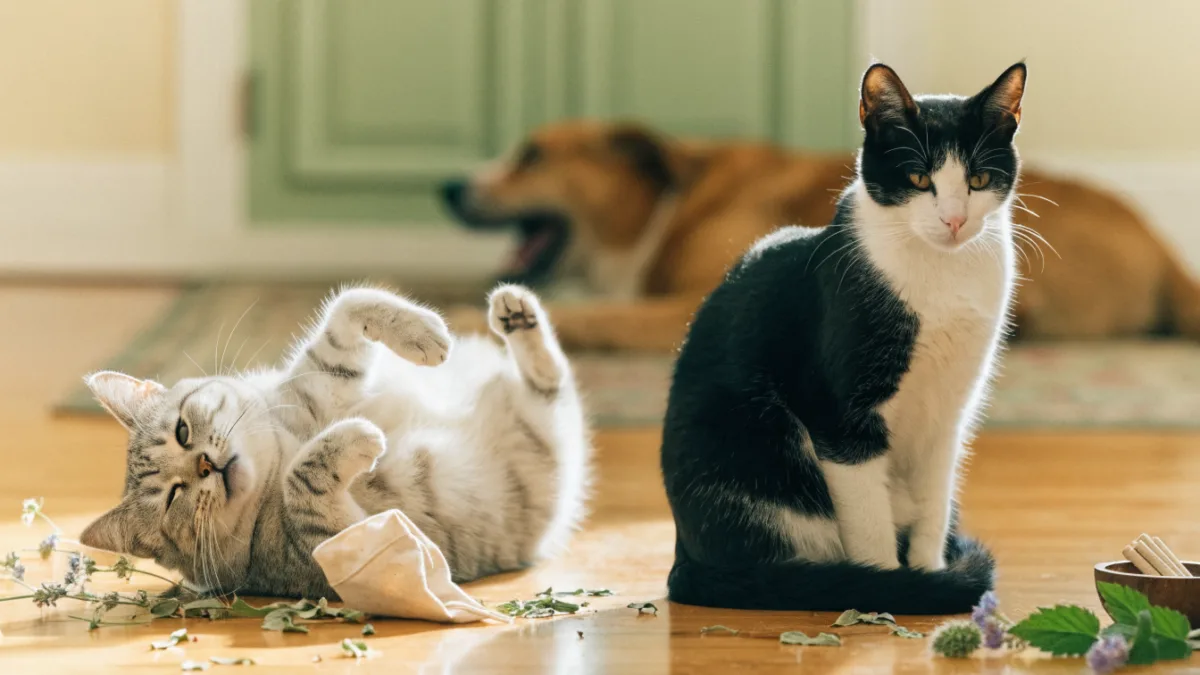
Last week I sprinkled a pinch of dried catnip on the floor for my two cats, and I need you to picture the scene. Mochi did three full barrel rolls, cheek-rubbed the carpet like it owed her money, sprinted a lap around the coffee table, and then passed out in a sunbeam. Waffles walked over, gave the pile one slow sniff, looked directly at me — I swear with disappointment — and left the room. Same couch, same catnip, same DNA lottery ticket, two completely different evenings. If you’ve ever watched your cat ignore catnip while a friend’s cat is doing gymnastics, it’s not your catnip. It’s genetics. And if you’re wondering why your dog couldn’t care less, that’s genetics too — just a different plot twist.
What the “High” Actually Is (Spoiler: Not Really a Drug)
The magic ingredient in catnip — Nepeta cataria, a member of the mint family — is a compound called nepetalactone, and here’s the part most people get wrong: your cat doesn’t need to eat it. The response is triggered entirely through smell. That’s why sniffing, head-rubbing, and chin-cheeking come first, and the drooling and rolling follow.
The classic catnip routine lasts about 10 minutes (anywhere from 5 to 15), followed by a refractory period of roughly 30 minutes to two hours during which your cat is simply immune to more. It’s non-addictive, non-toxic, and cats can’t fatally overdose on it, per.[1] The worst case from a gluttonous session is some mild stomach upset.
So is your cat “high”? Not the way the headlines want you to believe. The leading explanation is that nepetalactone mimics feline sex pheromones, binding to scent receptors and lighting up the amygdala and hypothalamus — the brain’s emotion and behavior command centers. A landmark 2021 study from Iwate University in Japan went further: when researchers gave cats naloxone, an opioid blocker, the euphoric rubbing stopped. The “buzz” runs on β-endorphin, the body’s own natural opioid. Your cat isn’t intoxicated; she’s experiencing a rush of her own feel-good chemistry through a pheromone-triggered reflex. And unlike actual intoxication, a startled cat snaps out of it instantly — a leaf blower outside will end the party immediately.
The Genetic Lottery: Why One in Three Cats Just Shrugs
Roughly 60 to 70 percent of adult cats respond to catnip, which means about one in three carries zero sensitivity. The trait is inherited as an autosomal dominant characteristic — meaning a single copy of the “responder” gene from one parent is usually enough. Waffles lost the coin toss; Mochi, obviously, did not.
Why kittens can’t feel it
If you’ve offered catnip to an 8-week-old kitten and gotten nothing, don’t write them off yet. The response doesn’t switch on until 3 to 6 months of age, around sexual maturity. Before that, kittens are indifferent — some studies suggest they even mildly avoid it. Wait until at least six months before you conclude anything, and test with fresh catnip rather than a dusty jar that’s been losing potency since the Obama administration.
The family tree goes way back
My favorite detail in all of this: the response isn’t limited to house cats. Lions, jaguars, leopards, cougars, bobcats, and lynx all respond — tigers are famously inconsistent about it — which suggests this trait is ancient, inherited from a shared feline ancestor. Zoos regularly use catnip and silvervine as big-cat enrichment, so somewhere out there, a 400-pound lion is currently rolling around in exactly the same undignified way Mochi does on my rug.
Catnip Alternatives for Cats Who Feel Nothing
Here’s the genuinely good news for the Waffles of the world: a non-responder to catnip is not a non-responder to everything. A 2017 study in BMC Veterinary Research tested several plants, and the standout was silvervine.
Silvervine: the MVP of catnip alternatives
Silvervine (also called matatabi, from Actinidia polygama, a plant in the kiwi family) gets a response from about 80 percent of cats — higher than catnip — and here’s the kicker: roughly 75 percent of cats who ignore catnip respond to silvervine. Its active compound is nepetalactol, a close chemical cousin of nepetalactone. It comes as a powder you sprinkle, or as chew sticks that double as a dental toy, which is a rare two-for-one in the cat world. When Waffles tried silvervine for the first time, I finally got to see the barrel rolls. I nearly cried.
The rest of the bench
- Valerian root — around 50 percent response rate. Contains actinidine, and has the fun quirk of sedating humans while exciting cats. My herbal tea ingredient is my cat’s party drug.
- Tatarian honeysuckle — also around 50 percent, but the wood needs to be split or moistened to release the scent. A damp honeysuckle log is apparently a whole experience.
- Cat thyme — not culinary thyme, and not particularly pleasant-smelling to humans, but it anecdotally wins over some of the most stubborn non-responders.
Offer a non-responder all four plants and you’ll catch the vast majority of cats. Nobody has to live a buzz-free life.
Getting the most out of any of them
- Freshness is everything. The compounds are volatile — they evaporate. Store catnip airtight, away from light, and replace it when the smell fades. Most catnip sprays are simply too weak to bother with.
- Dose small. About a teaspoon is plenty. This is a situation where more is not better.
- Put it away after 10 to 15 minutes. Limiting sessions keeps the response potent — constant exposure leads to habituation, and then even responders stop responding.
- Talk to your vet if your cat has health issues or eats the whole stash and has a rough time afterward, but for the average cat, [2] and the stakes are low.
If you want a second opinion from the trenches, the eternal confusion of [3] is very reassuring — you are not the first person whose cat has looked at you like a fool.
Why Dogs Just Yawn (and What They Get Instead)
Dogs don’t ignore catnip because their noses are inferior — it’s the opposite. Dogs have roughly 220 to 300 million scent receptors to a cat’s 80 million. The problem is upstream: nepetalactone mimics feline pheromones, and the receptor sensitivity that triggers the whole cascade is inherited in the cat family. Dogs simply never got the hardware. To a dog, catnip is a plant. Jake’s dog once ate an entire catnip mouse and his official review was a nap, which, to be fair, is his review of everything.
Catnip isn’t toxic to dogs, and in small amounts it’s even used as a mild calmative in some canine supplements. But dogs do have their own botanical party trick: anise, the licorice-scented spice sometimes called “the dog’s catnip.” It’s used to scent lures in greyhound racing and dog sports, and plenty of dogs get gleeful about it. Everybody gets their own plant. It’s very fair, actually.
And here’s my favorite plot twist from the 2021 Japanese research: when cats euphorically rub themselves in catnip and silvervine, they’re coating their fur in nepetalactone, a natural mosquito repellent that earlier Iowa State research suggested can outperform DEET at comparable application. One leading theory is that the entire euphoric response evolved precisely to trick cats into applying bug spray. The “high” might be nature’s oldest mosquito-protection marketing campaign.
So, the final score: about two in three cats carry the catnip gene, swap in silvervine and it climbs to four in five, and dogs never got invited to the party at all. A small practical note before you go — catnip, valerian, and honeysuckle are all common, widely cultivated plants with no conservation concerns, but silvervine’s wild-harvested matatabi sticks have grown popular enough that demand is pressing on the mountain forests of Japan and China where it grows. Look for suppliers who cultivate it rather than wild-harvest, and the plant stays abundant for everyone’s cats, zoo lions included. Your non-responder cat isn’t broken — he’s just waiting for you to bring home the right plant.
Sources
- PetMD's breakdown of how catnip affects cats — petmd.com
- catnip is considered safe — smalldoorvet.com
- owners asking cat advice communities to explain catnip — reddit.com