
Somewhere in your house — a closet, under the stairs, the back of the garage — there’s a plastic box your cat has personally declared war on. It comes out once or twice a year, and every time it does, the evening ends with somebody bleeding. Usually you. If you’ve ever typed “cat hates carrier” into a search bar while nursing fresh scratches, here’s the part that changes everything: your cat doesn’t hate the box. She hates what the box predicts. And predictions can be rewritten.
Why the Carrier Became the Enemy
For most cats, the carrier exists in exactly one context: vet day. So the sight of it doesn’t just mean “we’re going somewhere.” It re-triggers the entire emotional memory of the last visit — the car, the barking in the lobby, the thermometer you’d rather not think about. Fear at that level runs on association, not logic. Nobody reasons their way out of it, least of all your cat.
This matters more than it sounds. Cats get to the vet at roughly half the rate dogs do, and industry surveys consistently put carrier struggles and owner stress near the top of the list of reasons cat owners skip appointments entirely. The box is literally keeping cats out of the exam room.
Here’s the encouraging part. A 2023 peer-reviewed study by Squair found that how a clinic handles an animal measurably changes its stress levels — and that stress climbs in discrete steps, like walking onto the scale or the physical exam itself, rather than one giant wall of dread. Steps can be trained. One at a time. That’s the whole opportunity.
The Counterconditioning Plan: From Fear Object to Nap Spot
A client of mine, Dana, has an orange tabby named Cheddar. Their last vet trip took two adults, one towel, and a tipped bookcase, and Cheddar spent the rest of the day under the bed. That’s not a flaw in anyone’s character — it’s just what the box had trained both of them to do. So we rebuilt the box from scratch.
The goal isn’t a cat who tolerates the carrier. It’s a cat who naps in it on a random Tuesday for no reason at all.
The six steps
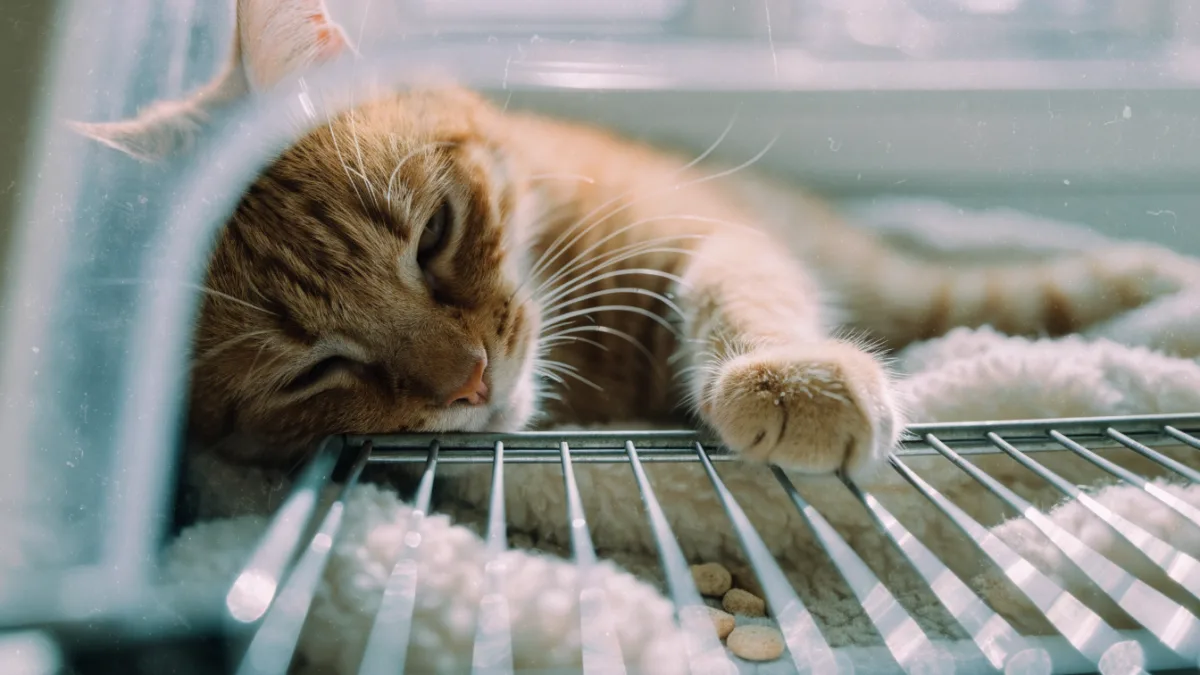
- Make it furniture. The carrier comes out of the closet permanently. Put it where your cat actually spends time — next to the couch, near a sunny window. If it only appears on vet day, it stays a fear object.
- Make it comfortable. Soft bedding, a shirt that smells like you, and take the door off entirely for now.
- Move the food. Dinner beside the carrier, then at the open door, then inside. Let your cat set the pace — if she stops eating near it, you’ve moved too fast. Back up a step.
- Add the door back. One second closed, then open, then a treat. Build to a minute. You’re teaching a prediction again, just a good one this time.
- Add motion. Lift the carrier an inch, set it down, treat. Then a full pickup. Then a walk to the door.
- Make the car boring. Engine running in the driveway, then around the block — and most trips end somewhere pleasant or right back home. Never only the clinic. If every car ride ends with a thermometer, you’ve rebuilt the old problem in a new location.
Cheddar took five weeks before he’d eat a full meal inside the carrier, and about two months before he napped there on his own. On the next vet day he walked in himself for a sprinkle of treats. Some cats turn the corner in two weeks. Some need months. Some need medication on top of training. All of those are normal outcomes — watch the cat, not the calendar.
One equipment note: get a top-load or removable-top carrier if you can. Chasing a cat into a front-loader is a wrestling match. Dropping a treat into a top-loader is an invitation. Clinics like,[1] publish versions of this same protocol, and the top-loading preference shows up in all of them for good reason.
The Dog Version: Lobbies, Scales, and Reading the Room
Dogs usually don’t have a carrier problem — they have a lobby problem. Wallace, a labradoodle I worked with, was fine in the parking lot and would plant himself like a fence post at the clinic door, ears back, trembling. The fix wasn’t courage. It was logistics: wait in the car until the exam room was ready, then walk straight in. Half of most dog vet anxiety tips come down to managing the lobby, because that’s where the chaos actually lives.
- Practice the scale at home. Put your bathroom scale out, scatter treats on it, feed a meal on it. The clinic scale becomes a bigger version of something already boring.
- Learn the fear ladder. Lip licks, yawns, whale eye, tucked tail, and the full-body shake-off when it’s over are all data. Catch the early rungs and you can adjust before your dog needs to shout.
- Condition a muzzle happily, if one’s needed. Basket muzzle, a smear of something great, short sessions. A dog with a well-trained muzzle stays in the room and keeps learning. A dog who bites gets flagged and feared forever.
- Let your dog opt out. If he pulls away from a handle, pause and try again more gently. Cooperation isn’t a luxury — it’s information about his threshold.
Travel Day — and the Homecoming Nobody Warns You About
On the day itself: spray a towel with a synthetic pheromone spray (feline and canine versions exist) fifteen minutes ahead and drape it over the carrier. The trial evidence on these is honestly mixed, but the downside risk is about zero. Run the seatbelt through the carrier handle, and ask the front desk if you can wait in the car until the room’s open. Many clinics offer quieter cat-only appointment blocks — it never hurts to ask.
Then there’s the part that blindsides people. When your pet walks back in smelling like disinfectant, alcohol, and a hundred strangers, housemates sometimes stop “recognizing” them and react with hissing or outright aggression. Dr. Marty Becker [2] and it’s most common in cats. It’s usually temporary. Keep them briefly separated, swap scent by rubbing towels on each animal and trading them, then reunite with food and supervision. Don’t punish anyone — it’s smell confusion, not betrayal.
Fear Free Certification, Handling, and When to Ask About Meds
Handling that doesn’t start a fight
None of your home training survives contact with a clinic that pins your cat to the table. What low-stress handling looks like in practice: minimal restraint, towel “burrito” wraps, cats examined while sitting in the bottom half of their own carrier, non-slip surfaces, treats during the exam. Yes, there’s a trade-off — an exam done in a carrier bottom may be less complete than a full orthopedic workup — but a panicked animal gets nothing done anyway. Scruffing is still used in some clinics for staff safety, though Fear Free and most feline behaviorists discourage it. It’s a fair question to ask before you book.
How to find a clinic that does this
Fear Free was founded by Dr. Marty Becker and started certifying professionals in 2016. It now covers tens of thousands of vets, technicians, groomers, boarding facilities, and trainers, with a searchable directory on their site. The American Association of Feline Practitioners runs a parallel Cat Friendly Practice program, and the AAHA has a solid rundown of [3] in practice.
When training isn’t enough
Pre-visit medication has gone mainstream: gabapentin for cats and trazodone for dogs, typically given an hour or two before the appointment. Some owners flinch at the idea of “drugging” their pet. I used to flinch too. Then I watched unmanaged fear compound visit over visit — each terrified trip rehearsing the next one — and realized the rehearsal is the real harm. Meds aren’t a replacement for training. They’re what lets the training land. Dosing is individual, so that’s a conversation with your vet, not an internet purchase.
Here’s the takeaway worth sitting with: stress-free vet visits aren’t a temperament some pets are born with — they’re a plan, built in small steps that anyone can start tonight. And it genuinely matters, because cats especially mask illness, and an animal who dreads the carrier gets seen less and diagnosed later. Drag the box out of the closet, pull the door off, drop a treat inside. That’s the whole first session. Somewhere down the road there’s a version of your pet napping in a plastic box while you schedule a checkup without dread — and every small step you take tonight is how they get there.
Sources
- Westpark Animal Hospital — westpark.vet
- has flagged this publicly — facebook.com
- what a better cat visit looks like — aaha.org