

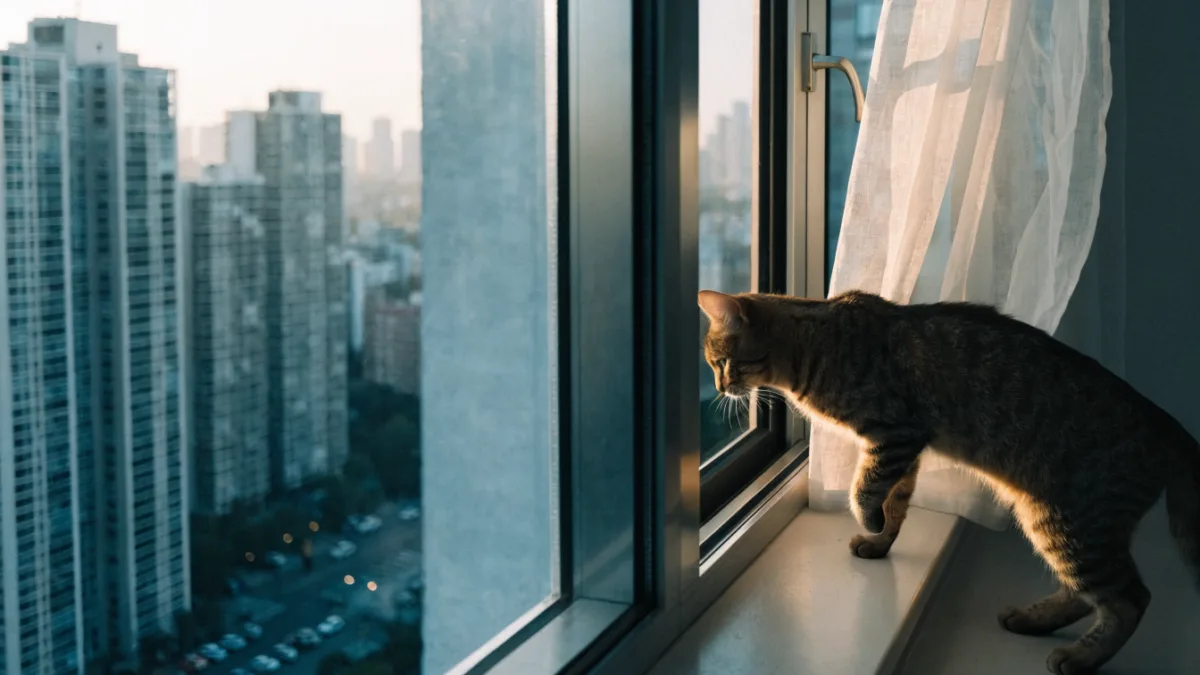
Every year, the first genuinely warm week brings the same phone call to our clinic: “My cat fell out the window — I don’t understand, she sits on that sill every day.” I’ve heard some version of that sentence more times than I can count, and every owner says the same thing about the same window. Cats are careful, yes. But careful isn’t the same as safe, and the difference shows up in my waiting room every open-window season. We have a name for this: high-rise syndrome in cats — the injuries a cat sustains falling from a second story or higher, usually through an open or poorly screened window. Here’s what’s actually happening, what the famous survival numbers really mean, and how to make sure your apartment never produces one of these cases.
“High-Rise Season” Is a Real Thing in Veterinary ERs
Urban emergency clinics brace for it. From roughly May through September, whenever windows swing open across a city,,[1] because the falls come in waves. Last June it was Olive, a two-year-old brown tabby whose owner I’ll never forget. Olive spent hours watching pigeons from her fourth-floor window — until a pigeon strayed too close, Olive launched, and the loose window screen popped out under her weight like it wasn’t there. Her owner found her under a hedge twenty minutes later, breathing fast and silent.
“She’s watched birds from that window every day for two years. It never occurred to me that the screen wouldn’t hold her.”
It doesn’t occur to most people. A standard window screen is built to keep bugs out, not cats in — it will pop free of its frame under ten pounds of determined cat. And the triggers are almost never recklessness. In case after case, the story is one of four:
- Prey drive. A bird, a fly, a squirrel on the fire escape — predatory instinct can override every ounce of feline caution in a fraction of a second.
- Panic. A loud noise, a stranger, a dog visiting the apartment — a fleeing cat doesn’t assess the window, it just goes through it.
- Sleep. Cats sleep deeply on warm sills, and a cat that rolls over mid-dream doesn’t check for a drop first.
- Loose or missing screens. Sometimes the cat doesn’t jump at all — it simply leans against a screen that gives way.
Cats do have genuine instinctive caution around heights; anyone who’s watched a cat hesitate at the top of the stairs has seen it. But that caution evaporates when they’re frightened, hunting, or bored — and their depth perception looking straight down is poorer than we assume. If you want a sense of how often this happens, [2] all end the same way: nobody expected it.
The Physics of a Falling Cat
The righting reflex: real, but not a rescue
The old saying that cats always land on their feet is half true. Kittens develop a righting reflex — the ability to twist mid-air and reorient feet-first — by six to seven weeks of age, and it works astonishingly fast. But landing on your feet is not landing uninjured. A cat that rights itself from a short fall arrives feet-first with all that force channeled into two small front legs, a jaw, and a chest. Righting is navigation, not protection.
The paradox everyone misquotes
Now the famous part. In 1987, two New York veterinarians, Whitney and Mehlhaff, reviewed 132 cats treated after falls from city buildings — some from as high as 32 stories — and reported that roughly 90% survived with veterinary care. Oddly, cats in that study falling from seven stories and up seemed to fare better than cats falling from two to six. The leading explanation: a falling cat reaches terminal velocity — about 60 mph, roughly half a human’s — after about five stories. At that point, the theory goes, the cat stops accelerating, relaxes, and splays its limbs into a flying-squirrel posture that increases drag and spreads the impact across the whole body. From lower floors, the cat is still mid-righting and lands with concentrated force.
Early in my career I repeated that paradox to worried owners almost as reassurance — and I’ve changed my mind. Two problems. First, survivorship bias: that 90% counts only cats who made it to a clinic. Cats that died on impact never entered the dataset, so the true survival rate is lower — nobody knows how much lower. Second, a 2004 Croatian study of 119 cats by Vnuk and colleagues found fracture rates actually increased with fall height, flatly contradicting the New York findings. I now treat the height paradox as fascinating physics trivia, not a safety plan. The one reliable takeaway is that middle-floor falls — two to six stories — are genuinely dangerous: not enough height to stabilize, more than enough to break things.
What Actually Breaks
When a cat strikes the ground, the chin often hits first, which is why shattered jaws and split palates are so common, along with broken teeth and facial fractures. But the injuries that kill are usually in the chest: pneumothorax (a collapsed lung from air leaking into the chest cavity), pulmonary contusions (bruised, bleeding lung tissue), and internal bleeding with shock. Fractured forelimbs and pelvises round out the list. In triage, I worry about the chest before I worry about any broken bone.
Olive, for the record, spent a week with us — a wired jaw, a chest tube, and a bill in the thousands. Surgical high-rise cases routinely exceed $5,000. She went home and now watches pigeons through a window that opens four inches, maximum. Her owner calls it “bird TV with a safety rating.”
Why Dogs Rarely Leap
The contrast in that title is real: high-rise cases are overwhelmingly cats. Dogs almost never perch on a narrow sill, and they don’t pursue prey vertically — a squirrel is a chase across the grass, not a launch off a ledge. Physics matters too. A dog’s greater body mass relative to its surface area means far higher impact force from the same height, and the righting reflex that works beautifully on a five-pound cat is nearly useless on a forty-pound body. We do occasionally see it — typically small breeds on balconies, often startled by fireworks or thunder. One Fourth of July, a Chihuahua came in with a broken pelvis after a firework sent him scrambling over a rail. But for every dog, we see many, many cats. Dogs don’t leap because dogs don’t put themselves in positions where leaping is possible. Cats specialize in exactly those positions.
Balcony and Window Safety for Cats: The Checklist
- Secure, intact screens on every window — heavy-duty, pet-resistant mesh in frames that are screwed or firmly anchored, not just popped into place. Push on it hard; if it flexes or shifts, assume your cat will find out.
- Window stops or limiters so windows open no more than about four inches — enough for a breeze, not enough for a cat. This is the single highest-value fix I recommend.
- A “catio” or full balcony enclosure — mesh netting over the entire balcony — for cats who deserve real outdoor time. The options for pet-safe netting and enclosures have never been better.
- Remove the launch pads. Move planters, chairs, and cat trees away from sills and railings. Cats use furniture the way pilots use runways.
- Harness and leash only for balcony time, always supervised, never tethered and left alone.
- A window perch behind a secure screen. A cat doesn’t need to be outside the glass to be happy — a perch with a bird’s-eye view of the street is enrichment gold.
If your cat falls
- Go to a vet immediately, even if your cat looks completely fine. Collapsed lungs and internal bleeding can take hours to show symptoms, and those hours matter.
- Keep her horizontal — on a flat board or in a top-opening carrier — and avoid pressure on her chest.
- Search fast. Injured cats hide instinctively. Check under bushes, cars, and stairwells before anything else.
If you want a shareable reminder, [3] circulate every spring for good reason — but the checklist above is the version I’d tape next to the latch.
Here’s my takeaway after years of these cases: cats don’t survive falls because they’re smart, and they don’t fall because they’re foolish. They survive on physics and luck, and they fall because they’re cats — hunters, sprinters, deep sleepers, and supremely confident leaners-on-of-screens. You can’t change any of that. What you can change is the window. A four-inch opening, a screwed-in screen, a meshed-in balcony — these small, unglamorous fixes are the entire difference between a cat who watches the pigeons and a cat who chases one into thin air. Before you open that first window this season, give the hardware ten minutes of your attention. Your cat’s judgment was never the safety feature. The latch is.
Sources
- the ASPCA and urban veterinary ERs issue their annual warnings — aspca.org
- the first-person accounts from cat owners online — reddit.com
- warnings about open windows and cats — facebook.com