

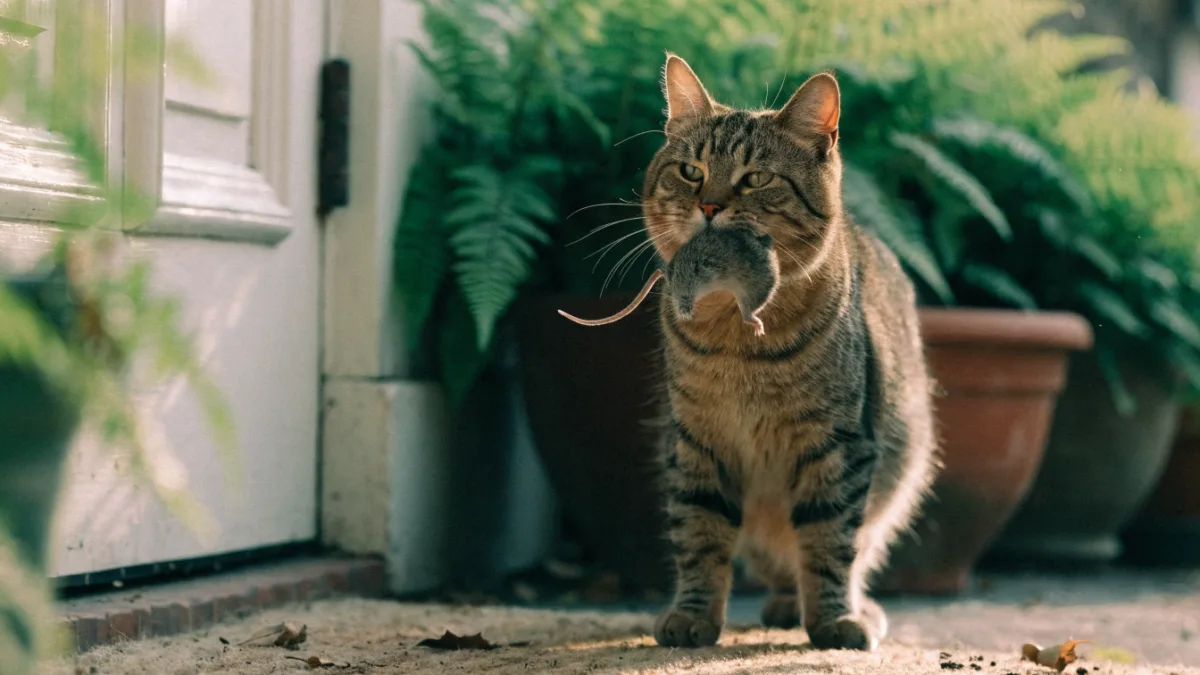
It was 6 a.m. on a Tuesday when Clementine — my orange tabby, retired barn cat, absolute professional — announced her achievement from the front doorstep at a volume usually reserved for fire alarms. The mouse was arranged on the mat with the care of a museum curator. She looked up at me with an expression I can only describe as expectant performance review. I’ve spent enough years around cats to know roughly what was happening, and it was still somehow both disgusting and oddly touching. Because that mouse wasn’t about hunger, and it wasn’t an accident. It was the visible tip of roughly nine thousand years of programming — and my dog runs the exact same software, just with more rolling in it.
The Mouse Isn’t About Hunger
Here’s the fact that reframe everything for me: well-fed cats hunt anyway. Satiety doesn’t matter. The drive comes down from the African wildcat (Felis lybica), and it’s triggered by movement and sound — a flicker in the grass, a squeak — regardless of how recently dinner happened. Hunting and eating run on separate circuits in a cat’s brain, which is why the cat who just licked her bowl clean will still launch herself at a feather.
We also, frankly, bred for it. When cats and humans first partnered up in the Fertile Crescent over 9,000 years ago, the deal was grain storage in exchange for rodent control. Cats who hunted earned their keep; cats who didn’t offered less. Over millennia, we inadvertently selected for exactly the behavior we now find horrifying on our doormats. We asked for this. Collectively. Sorry.
The full hunting sequence goes: stalk, chase, pounce, kill bite. Indoor cats with no outlet still run the program in pieces — my other cat, Basil, has never caught anything in his life and spends his mornings chattering at sparrows through the window like a frustrated sports fan. That chattering is a truncated hunt. The instinct is there whether or not it ever gets to finish.
So Why Hand It to You? The Leading Theories
This is where cat people start arguing, and honestly the arguing is half the fun. The theories, roughly in order of scientific popularity:
- The teaching instinct (the front-runner). Mother cats bring prey home in stages — dead first, then injured, then live — to teach kittens how to hunt. One influential idea, drawn from anthrozoologist John Bradshaw’s work, is that cats relate to humans the way they relate to other cats. Under that lens, you may be a large, beloved, catastrophically hopeless kitten who somehow never learned to feed herself. It’s a hypothesis, not settled science, but it explains a lot about Clementine’s demeanor.
- Sharing with the group. Prey brought into a cat’s core, trusted territory is a form of social sharing — the “gift” framing, which [1] and which behaviorists gently side-eye as anthropomorphizing. The two readings aren’t mutually exclusive.
- The trophy. Showing off. Some cats do seem to want witnesses.
- Safe transport. Cats carry prey back to their den area to eat in safety. Your doormat is the den. Your reaction is incidental to the plan.
- Arrested development. Neutered cats may retain maternal provisioning behavior into adulthood, keeping the “feed the family” instinct switched on with no kittens to receive it.
Whatever the true motive, the [2] is the same, and it’s short:
- Stay boring. Dramatic shrieking is either reinforcing (attention!) or confusing, and either way the mouse is still on your mat.
- Dispose of it quietly, wearing gloves.
- Check your cat for scratches or punctures — small wounds from prey can go bad fast.
- Mention the hunting at vet visits, since hunters carry higher parasite exposure. That’s a conversation for your vet, not the internet.
- Don’t punish. The drive cannot be scolded out of a cat; it can only be redirected.
Your cat isn’t trying to horrify you. She’s running software that’s about 9,000 years old and doesn’t have an off switch.
The Canid Version: Wearing the Evidence
Dogs express the same ancient inheritance differently. Where cats deliver the kill to the doorstep, dogs put it on. My dog, Pete — a shepherd mix with the nose of a saint and the judgment of a toddler — once found a week-old carp on the lakeshore and went shoulder-first into it before I’d finished saying “don’t.” He walked back to the car glowing. That’s not defiance, and it’s definitely not spite.
Scent-rolling is documented in wild canids. Wolf researchers, including the late Patricia Goodman’s captive wolf studies, watched wolves deliberately roll their necks and shoulders into carcasses and other foul-smelling matter. The proposed explanations: scent masking (hiding your own smell from prey), scent advertising (carrying interesting odors back so the whole pack gets the news), or plain scent preference — dogs genuinely seem drawn to decaying herbivore and fecal odors the way we’re drawn to bakery doors.
The key point: rolling is self-reinforcing. The behavior is the reward, which is exactly why scolding after the fact accomplishes nothing — by the time you’re mid-bath, the payoff already happened. If you want a bombproof “leave it” or a cue that lets your dog roll on a designated smelly towel instead of a dead seagull, that’s my colleague Jake’s department. I stick to the cats.
The Part Nobody Wants at the Dinner Party
Now the awkward bit, because this article would be dishonest without it. That landmark 2013 study in Nature Communications (Loss, Will and Marra) estimated free-ranging domestic cats kill 1.3 to 4 billion birds and 6.3 to 22.3 billion mammals every year in the U.S. alone — one of the largest human-caused sources of wildlife mortality on record. In the U.K., the Mammal Society put the toll at around 275 million prey animals a year, some 55 million of them birds. The domestic cat sits on the IUCN’s list of the 100 worst invasive alien species and has been implicated in at least 63 vertebrate extinctions — the Stephens Island wren being the famous, heartbreaking case. Even Toxoplasma gondii from cats reaches the ocean and turns up in California sea otters.
The outdoor-cat debate this fuels is genuinely heated, and I’m not here to referee it. But GPS tracking projects like Australia’s Cat Tracker have shown pet cats roam much farther than their owners believe — some covering more than a kilometer a night on their “just sits in the garden” patrols. Which means the “presents” on your mat represent only a fraction of what actually happens out there.
Giving Ancient Software a Safer Outlet
For cats: finish the hunt
The best news in years came from a 2021 University of Exeter study published in Current Biology: cats fed a meat-rich diet and given just 5 to 10 minutes of daily play reduced their hunting by roughly 25–36%. That’s it. The play matters most when it completes the whole sequence — let her stalk a wand toy, chase it, pounce, and “kill” it, then feed her immediately. That mimics the natural hunt-eat-groom-sleep cycle, and it tells her brain the hunt ended. Puzzle feeders, food balls, window perches, and catios stack on top of that.
For dogs: drain the nose
Scent work and nose-work classes, snuffle mats, scattered “find it” games, a flirt pole in the yard — anything that gives the hunting sequence a legal target. A towel rubbed in interesting (safe) smells like grass clippings can even become the sanctioned rolling spot. A tired nose is a calm dog.
If your cat goes outside: shrink the toll
Two devices have real trial data behind them. Brightly colored collar covers — the rainbow-cape style — exploit birds’ excellent color vision so they spot the cat before she’s in striking range; field trials have shown reductions in birds brought home as high as ~87%, though they don’t help with nocturnal mammal hunting. A soft bib that drapes over the chest and disrupts the last second of the pounce cut prey returns by roughly 45–81% in trials. Bells have mixed, underwhelming evidence. And the options at the far end — full containment, leash training, a catio — are why cities like Canberra now mandate 24-hour cat containment, with more municipalities following.
None of this means loving your cat less or living with fewer dead things out of fear. It means the instinct that put a mouse on your mat and a carp on your dog’s shoulders is the same instinct that makes them who they are — and it deserves an outlet that doesn’t cost a songbird. Two years after retiring to full-time indoor life, Clementine now conducts her hunts through a feather wand at 7 p.m. sharp, and the doormat has been mouse-free ever since. Mostly. The point isn’t to switch the old software off; it’s that a billion-year-old predator living in your hallway was never going to stop hunting — but with a wand toy, a meatier dinner, and a rainbow collar, she can hunt in a way the sparrows can live with. That’s the deal we signed up for nine thousand years ago. We might as well honor it well.
Sources
- cat owners debate endlessly — reddit.com
- practical handling advice — amyshojai.com