

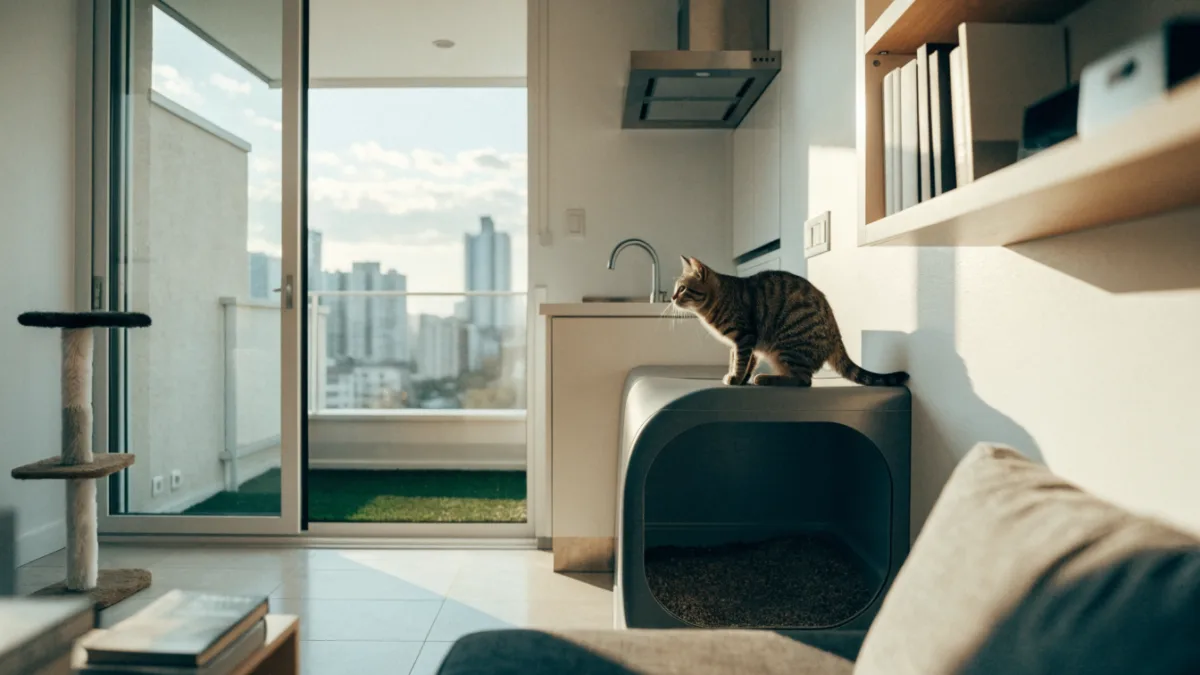
Living in a city apartment with pets is basically an advanced spatial reasoning puzzle where the stakes are your sanity and your security deposit. I share roughly 700 square feet with Mochi, a 12-pound tuxedo cat who believes every surface is hers, and Whiskey, my roommate’s senior beagle who has strong opinions about bathroom schedules. The litter box situation alone took me three attempted configurations, two near-breakdowns, and one very honest conversation with my vet before I found something that worked. And I know I’m not the only one — every city pet owner I know has a bathroom logistics story that sounds like a war memoir.
The Litter Box Standoff: What Cats Actually Want vs. What Your Apartment Can Handle
Here’s the thing nobody tells you before you move into a 5th-floor walk-up with a cat: the litter box is going to become the most debated object in your home. Not the couch. Not the bed. The box where your cat poops.
The core tension is simple. Humans in small apartments want the litter box covered, hidden, enclosed, and ideally disguised as a piece of furniture. Cats want the opposite — an open, accessible space where they can see what’s coming and don’t feel trapped in a smelly plastic cave. The San Francisco SPCA [1] as one of the most common reasons cats stop using their designated bathroom, and a major culprit is the covered box itself. Cats’ senses of smell are dramatically more sensitive than ours. A covered box that seems “contained” to you is, to your cat, essentially a portable outhouse with the door shut.
But I get it. In a studio apartment, you can’t always leave an open pan of cat waste sitting in your kitchen corner. The compromise I landed on with Mochi was a large, open box placed inside a dedicated cabinet with a cat-sized entrance cut into the side. She gets the openness she wants; I get the visual containment I need. Ventilation matters enormously here — whatever enclosure you use, make sure air can circulate. A sealed cabinet with a box inside is just a covered box with extra steps.
Litter Depth Is Not a Detail — It’s a Dealbreaker
This sounds absurd until you’ve watched a cat stand in a litter box, dig for seven seconds, and then walk away to pee on your bathmat instead. Litter depth matters. Too shallow, and your cat feels the hard plastic bottom when they dig — many cats find this deeply offensive and will refuse to use the box. Too deep, and some cats feel unstable, like they’re standing in loose sand on a steep dune. Most cats prefer somewhere around 2 to 3 inches of litter, but individual preferences vary wildly. Mochi likes exactly the depth where she can dig a respectable hole without hitting bottom. My previous cat, Oliver, wanted it shallow enough that he was basically standing on the pan. They’re specific about this, and the only way to figure out your cat’s preference is to experiment and observe.
Doing the Multi-Cat Math in 600 Square Feet
The well-known veterinary guideline for multi-cat households is one litter box per cat, plus one extra. So if you have two cats, you need three boxes. Three cats means four boxes. In a house with a basement and a laundry room, this is manageable. In a one-bedroom apartment, it becomes a genuine spatial challenge.
But here’s why the math actually matters and isn’t just veterinary overkill: increasing the number of litter boxes in a multi-cat home is a proven method for reducing tension, stress, and inter-cat aggression. The reasoning is behavioral and fairly straightforward. In the wild, a cat’s bathroom location is a territorial marker. When one cat in a multi-cat household controls access to the only box, that cat essentially controls the territory. The other cats are left with two bad options: confront the dominant cat at the box, or find somewhere else to eliminate — which usually means your bed, your couch, or that rug you really liked.
Resource documents from multi-cat behavior discussions [2] — not clustering them in one room — is what actually defuses the conflict. Two boxes side by side count as one territory in cat logic. They need to be in separate locations, ideally with multiple exit routes so no cat feels cornered.
Modern litter box designs have gotten genuinely clever about this. You can now find low-profile boxes, corner-shaped boxes, and boxes designed to tuck under furniture or fit into narrow gaps between appliances. The goal isn’t to cram nine boxes into your living room — it’s to make the ones you do need fit into the awkward dead spaces your apartment already has. That gap between the fridge and the wall? A slim box fits there. The corner behind the bathroom door? Another one. With odor-control advancements in both litter and box design, multiple boxes in a small apartment no longer automatically means your home smells like a shelter.
The Turf Question: When Grass Patches Enter the Chat
Now, if you have a dog in a high-rise — or both a dog and a cat, like I do — you’ve probably considered an indoor turf patch. These are essentially trays of real or synthetic grass that give dogs a designated indoor bathroom spot, which sounds like a miracle when it’s 11 PM, the elevator is broken, and your dog is giving you the look.
Turf patches work well for some situations. Small dogs, dogs with mobility issues, puppies in early training, and dogs who get anxious about outdoor elimination in busy urban environments can all benefit. Real grass patches tend to control odor better than synthetic ones because the living root system actively processes some of the waste. Synthetic turf requires more frequent cleaning but lasts longer and doesn’t need replacing.
But here’s where I’d push back on the idea that turf is universally “cleaner” than a litter box. Turf patches have their own learning curve. Dogs don’t automatically understand that the grass square on your balcony is different from the rug in your hallway. Jake — my roommate’s beagle — took about three weeks to reliably use his turf patch, and during that time there were several incidents that I will describe only as “character-building.” If you’re going the turf route, look for a patch with a solid, sealed tray underneath, good drainage, and grass that’s replaceable or washable. The tray design matters more than the grass itself — a flimsy tray that lets urine pool underneath will make your apartment smell within days.
I’m not going to give training advice here because dog training is genuinely Jake’s area of expertise and I’d butcher it. What I will say is that consistency, patience, and realistic expectations are non-negotiable. If you’re not prepared for a transition period, turf training will frustrate you.
Elevated Solutions for Mixed-Pet Households
The messiest problem in my apartment wasn’t the litter box itself — it was the dog getting into the litter box. If you have both cats and dogs, you already know what I’m talking about. Dogs, for reasons that defy human understanding, are attracted to cat waste. In a small apartment where the litter box can’t be hidden behind a closed door, this creates a genuinely gross hygiene problem.
Elevated litter box setups — where the box sits on a raised platform or inside a piece of furniture the dog can’t access — solve this remarkably well. The concept has gained traction recently, with designs like the [3] demonstrating how raising the box keeps it out of a dog’s reach while also making it ergonomically easier for the human to clean without hunching over. For anyone with back issues or limited mobility — which, living in a walk-up apartment with no elevator, I deeply relate to — this is a meaningful design improvement, not just a gimmick.
The key feature to look for in any elevated setup is stability. A wobbly platform will terrify your cat, and a terrified cat does not use the bathroom where you want them to. The platform needs to support the cat’s weight plus the box plus the litter without any movement. The access point needs to be easy for the cat but genuinely impossible for the dog — and remember that small dogs and determined medium dogs can be surprisingly athletic when motivated by cat waste.
Before You Change Anything, Call Your Vet
I want to be really clear about this because it’s the one thing I’d want someone to tell me if I were dealing with sudden bathroom accidents: if your cat or dog was using their designated bathroom area and then suddenly stopped, talk to your vet before you change a single thing about your setup.
Inappropriate elimination is often split into medical and behavioral causes, and medical issues need to be ruled out first. Urinary tract infections, bladder crystals, kidney issues, arthritis that makes it painful to climb into a box — these are all common, they’re all treatable, and none of them will be solved by a new litter box or a turf patch. The SF SPCA’s guidance reinforces this: behavioral modification only works once you’ve confirmed the animal is physically healthy.
Mochi went through a phase where she started avoiding her box, and I spent two weeks rearranging boxes, switching litter types, and reading every article I could find. Turned out she had a low-grade urinary infection. One course of antibiotics and she was back to normal. I could have saved myself a lot of emotional energy by calling the vet first.
The messiest problems in city apartments rarely have a single elegant solution. They have a solution that works for your specific pet, your specific space, and your specific tolerance level. The litter box versus turf debate isn’t really about which method is objectively better — it’s about matching your bathroom strategy to your animal’s instincts, your apartment’s layout, and the reality that living with pets in small spaces will always involve some degree of compromise on both sides.
And honestly? That’s fine. The tradeoff for a few bathroom logistics headaches is getting to share your ridiculous, too-small, overpriced apartment with a creature who makes you laugh every single day. Just measure your spaces before you buy anything, keep your vet’s number saved, and never — I mean never — assume a covered box will solve your odor problems on its own.
Sources
- specifically identifies litter box aversion — sfspca.org
- emphasize that distributing boxes throughout the home — facebook.com
- LoftyLoo elevated litter box — instagram.com