

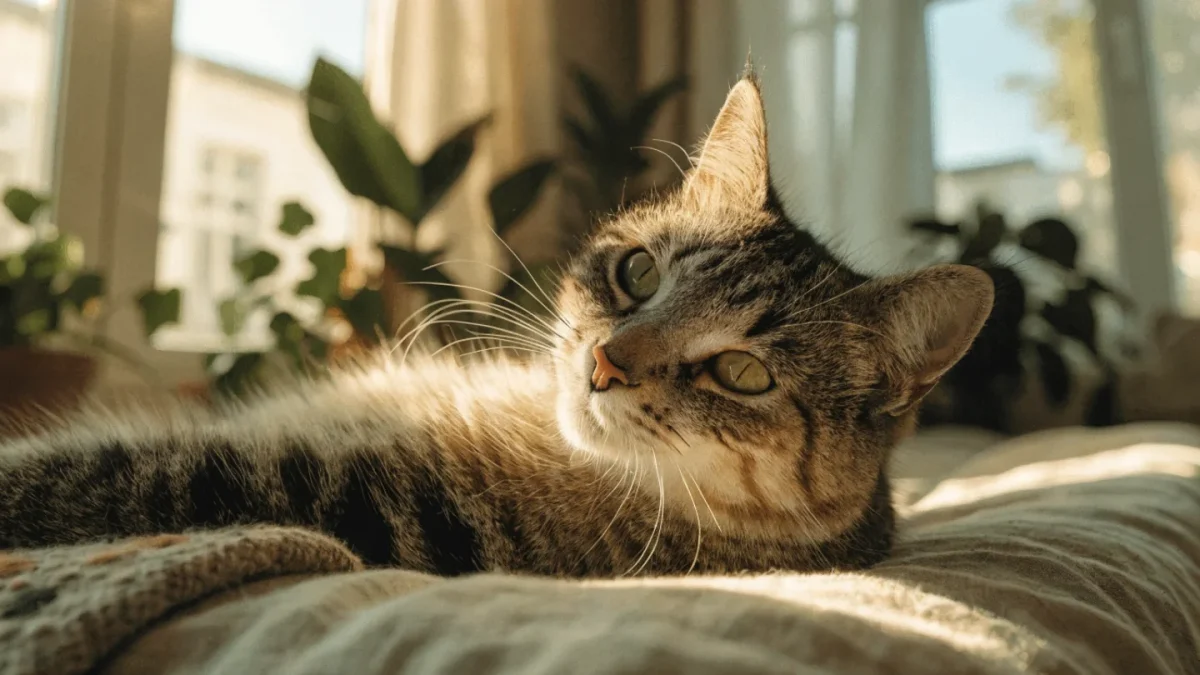
Here's what's actually going on when your older cat starts acting different: aging changes everything, and most of it is completely normal. The hard part is knowing which changes deserve a "huh, interesting" and which ones deserve a call to the vet.
My cat Miso is thirteen now. Last year, I started noticing she'd lost interest in the laser pointer — her entire reason for living at age four. She sleeps in different spots. She meows at nothing at two in the morning. For a few weeks, I was quietly spiraling. Then I started paying closer attention, and I realized some of what I was seeing was just Miso getting older. Other things, honestly, needed attention.
Senior cat behavior changes are one of those topics where the difference between "normal" and "concerning" depends almost entirely on how things change — not just what changes. Gradual shifts over months are usually age. Sudden changes in days or weeks are a different story.
When Does a Cat Become a Senior?
Most cats are considered senior at around ten years old, though that varies by breed and individual health. The 2021 AAHA/AAFP Feline Life Stage Guidelines use "mature" for ages seven to ten and "senior" for ten-plus (American Animal Hospital Association, 2021). "Geriatric" gets used colloquially for the oldest cats, but the current guidelines treat it as a health-status description rather than a fixed age bracket.
The important thing here isn't the label — it's that the biology genuinely shifts. Cats in their senior years process nutrients differently, sleep more, move differently, and experience gradual changes in cognition and senses. What looks like a personality change is often the cat adapting to a body that works slightly differently than it used to.
Normal Senior Cat Behavior Changes
Sleeping More (A Lot More)
If your senior cat has taken sleeping from a hobby to a full-time occupation, you're in good company. Older cats genuinely need more rest — their bodies are working harder to maintain the same basic functions, and recovery from any exertion takes longer.
Miso went from sleeping roughly sixteen hours a day to what feels like twenty-two. She picks warmer spots than she used to — near the radiator in winter, in a sunny patch in summer. This is normal, and it's also a hint: senior cats often feel the cold more acutely, so if you haven't already, a soft bed near a heat source is one of the kindest things you can do.
The line to watch is where they sleep and how they get there. Moving to ground-level spots after a lifetime of sleeping on high shelves usually means jumping hurts — not that something is acutely wrong.
Playing Less and Moving More Carefully
A senior cat isn't broken if they ignore the wand toy. Play drive decreases with age, and the high-intensity hunting simulation that kittens live for often becomes something a ten-year-old cat tolerates briefly before walking away.
Honestly, most older cats still want some play — it just looks different. Slower toys, shorter sessions, lower-energy activities like batting a toy across the floor rather than leaping and spinning. If your cat has gone completely unresponsive to play, that's worth noting, but a decline in enthusiasm is expected.
What matters more: are they moving stiffly when they first get up? Do they hesitate before jumping onto furniture they used to fly onto? These are signs of discomfort that deserve a vet conversation — researchers finally confirmed what a lot of us suspected: a landmark study found that 90% of cats over twelve had radiographic evidence of degenerative joint disease, yet only 4% had it noted by owner or vet (Hardie et al., Journal of the American Veterinary Medical Association, 2002). Cats hide pain extraordinarily well, which is exactly why it goes untreated.
Changes in Social Behavior
This one surprises a lot of people because it goes both directions. Some cats become noticeably clingier as they age — they want to be near you more, follow you from room to room, sleep pressed against you when they used to prefer their own space. Others become more reclusive, less interested in interaction, quicker to walk away.
Both can be normal. A cat that's experiencing some sensory loss (hearing, vision) often wants to stay closer to familiar people and environments. A cat that's achy and tired may simply have less patience for being handled.
Reading your cat's body language carefully matters more in the senior years than at any other stage — understanding your cat's body language gives you better tools for figuring out whether they're content in their quiet moments or actually uncomfortable.
Grooming Changes
Senior cats often groom less efficiently. You might notice their coat looks a bit duller, or they're developing mats in spots that were never a problem before. This usually comes down to flexibility — it's harder to reach certain spots when joints are stiff. It's not laziness, and it's not a sign of illness on its own.
Some cats also over-groom in specific areas when they have localized pain or skin irritation, so bare patches or thinning fur in one spot deserves attention.
Helping out with a gentle brush a few times a week does two things: keeps their coat in good shape, and gives you a chance to notice lumps, sore spots, or skin changes that might otherwise go undetected.
Appetite Fluctuations
Senior cats can become either pickier or, in some cases, hungrier. Changes in smell perception (which dulls with age) affect appetite significantly — food that smells less interesting gets eaten less enthusiastically. Warming food slightly can help with this.
A gradual decline in appetite over months, with a corresponding gradual weight loss, is something to monitor and discuss with a vet. But it's different from the sudden dramatic changes covered below.
Senior Cat Behavior Changes That Need Attention
Sudden Personality Shifts
A gradual drift from playful to calm over a year — normal aging. A sociable cat becoming reclusive over two weeks — not something to wait out.
Sudden personality changes in older cats often point to pain, illness, or the early stages of feline cognitive dysfunction (the cat equivalent of dementia). Pain makes cats withdraw. Cognitive changes can make them seem confused, distant, or anxious in ways that look like personality change but are actually neurological.
The real question isn't whether your cat has changed — they will, and that's fine. The question is how fast the change happened.
Nighttime Yowling or Disorientation
If your senior cat has started yowling at night — especially a loud, almost mournful sound that's different from their usual vocalizations — take it seriously. This is one of the more recognizable signs of feline cognitive dysfunction (FCD), also referred to as cognitive dysfunction syndrome (CDS) in veterinary literature (PMC — Cognitive Dysfunction in Cats, 2024).
The cat may seem confused, stare at walls, get "stuck" in corners, or forget where the litter box is. These aren't quirky senior moments. They're the cat's brain misfiring in ways that cause genuine distress.
Feline cognitive dysfunction is manageable. There are environmental modifications, enrichment strategies, and in some cases medication that can help. But it needs to be caught and assessed — don't assume nighttime yowling is attention-seeking just because your cat is old.
Litter Box Accidents
A senior cat that's reliably used the litter box for twelve years and suddenly isn't — that's a red flag, not a behavior problem. Arthritis can make climbing into a high-sided box painful. Cognitive decline can mean they simply forget. Kidney disease and hyperthyroidism (both more common in older cats) can cause increased urgency or volume that exceeds what they can control.
If you notice litter box regression, first look at the box itself: is it easy to access? Low-sided boxes, more of them placed conveniently, can solve an arthritis-related problem immediately. If that's not it, a vet visit is the next step.
Sudden Weight Loss or Gain
Weight changes in senior cats are rarely benign. Hyperthyroidism causes weight loss despite increased appetite — one of its most recognizable signatures, and one the Cornell Feline Health Center specifically flags as a reason to act rather than wait (Cornell University College of Veterinary Medicine). Diabetes can cause weight loss and increased thirst. Kidney disease comes with progressive weight loss and usually decreased appetite.
Since cats hide illness so effectively, weight is one of the few objective things you can track at home. A monthly weigh-in using a kitchen scale (weigh yourself holding the cat, subtract your weight) can catch changes long before they become obvious.
Changes in Drinking or Urinating
Increased thirst paired with increased urination is almost always worth investigating in an older cat. It's associated with kidney disease, hyperthyroidism, and diabetes — all manageable when caught early, all significantly more difficult when caught late.
This is especially easy to miss if you use an automatic water fountain or can't easily track intake. If you're noticing the water bowl emptying faster than usual, or the litter box is unusually wet, mention it at the next vet visit — or make a vet visit happen sooner rather than later.
Supporting a Senior Cat Day to Day
Understanding what's changing is half the work. The other half is adjusting the environment to match where your cat actually is.
A few things that made a real difference for Miso: switching to a low-sided litter box so she doesn't have to climb, putting a small step stool next to her favorite couch spot, and moving her food and water dishes to the room where she spends most of her time rather than making her walk across the house. None of these are expensive. All of them reduced friction she didn't need.
Senior cats also benefit from routine more than younger cats. Predictable feeding times, sleeping spots they can count on, minimal rearranging of furniture — these aren't you being overly cautious, they're accommodations that help a cat whose senses and cognition are changing feel oriented.
If you've noticed behavioral changes that feel like stress or anxiety rather than simple aging — the clingy-but-anxious variety, not the content-and-calm variety — stress and anxiety in cats is worth reading through. Senior cats can develop anxiety that's distinct from, but sometimes overlapping with, cognitive changes.
How Often Should Senior Cats See the Vet?
Most vets recommend twice-yearly checkups for cats over ten — not because older cats are in crisis, but because a lot can change in six months and bloodwork that looks fine at one visit can show emerging kidney changes or thyroid shifts at the next. The 2021 AAHA/AAFP Feline Life Stage Guidelines back this up, recommending senior cats be seen at least every six months (AAHA/AAFP Feline Life Stage Guidelines, 2021).
At home, you're looking for: gradual changes (normal, note and monitor), sudden changes (act on these), and anything that comes with obvious signs of distress — vocalization, hiding more than usual, changes in bathroom habits.
You know your cat's normal. Trust that. If something feels off, it probably is — and with older cats, earlier is always better than later.
Frequently Asked Questions
At what age is a cat considered senior?
Most vets consider cats senior starting around age ten to eleven, though some use "mature" for cats aged seven to ten and reserve "senior" for eleven-plus. The term matters less than the fact that regular veterinary monitoring increases significantly in value once a cat is past ten.
Why is my senior cat yowling at night?
Nighttime yowling in older cats is most commonly associated with feline cognitive dysfunction (sometimes called feline dementia), pain, or sensory loss such as decreased hearing or vision. It's worth a vet visit rather than assuming it's a behavioral quirk, especially if it started recently or has been getting more frequent.
Is it normal for senior cats to sleep all day?
Increased sleep is normal in senior cats — they often need sixteen to twenty or more hours of rest. What matters is the quality of their rest and how they move when they're awake. A cat that sleeps a lot but gets up comfortably and seems generally content is probably fine. One that seems stiff, reluctant to move, or distressed is worth monitoring more closely.
My senior cat is getting skinnier but still eating. Is that normal?
No — weight loss in a cat that's still eating normally is a classic sign of hyperthyroidism, one of the most common conditions in older cats. It's very treatable, but it does need diagnosis and management. Schedule a vet visit rather than waiting to see if it resolves.
My older cat has started missing the litter box. What should I do?
First, look at the box: high sides, inconvenient location, or too far from where they spend time can all create problems for a cat with stiff joints. Low-sided boxes or ramps can help immediately. If access isn't the issue, or if the behavior is accompanied by other changes, a vet visit is the right move — kidney disease, hyperthyroidism, and cognitive changes all affect litter box use.
Can senior cats get anxiety?
Yes — and it often looks different from anxiety in younger cats. Senior cats may become clingy in an anxious way rather than an affectionate way, or they may startle more easily, become more vocal, or seem unsettled in environments that never bothered them before. Sensory changes and cognitive decline both contribute. If you're seeing signs of distress rather than just low-energy contentment, it's worth discussing with a vet.