

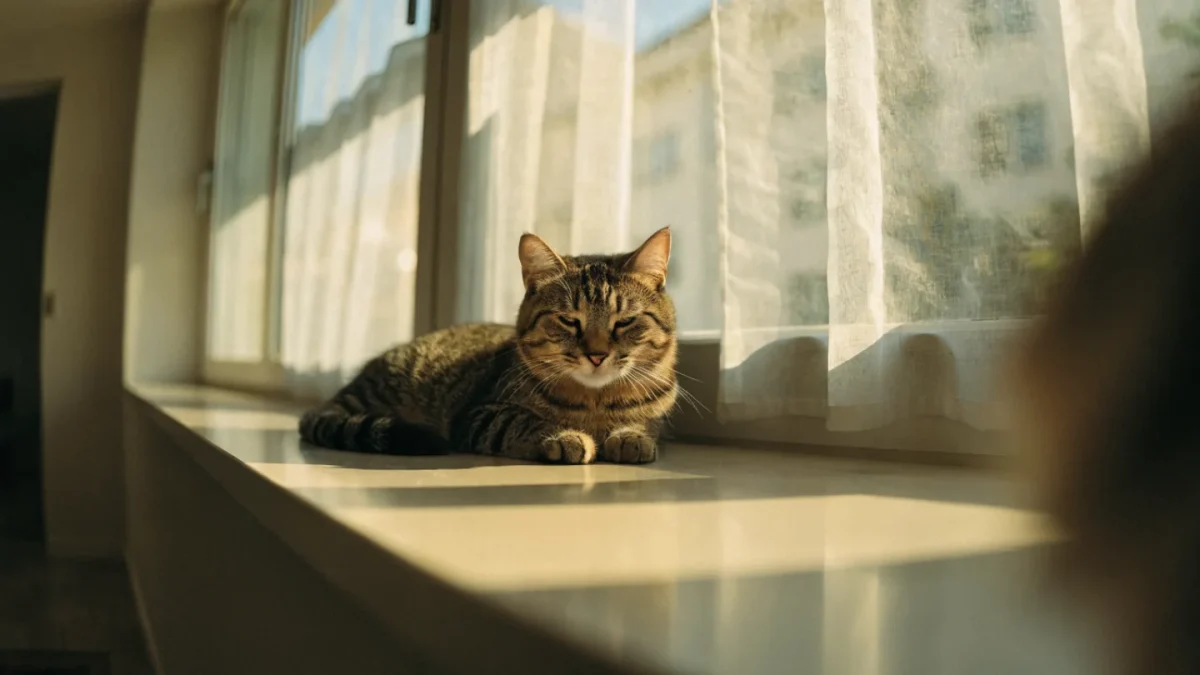
Here's what's actually going on when your cat stares at you from across the room, tail swishing slowly: they're not being mysterious for the fun of it. They're talking. You're just not fluent yet.
Cat body language is a full communication system — tail, ears, eyes, whiskers, posture, and even the position of the body relative to yours all carry meaning. The problem is that most of us learn one or two signals ("puffed tail = scared, purring = happy") and stop there. That partial understanding leads to a lot of missed signals, accidental startles, and the occasional inexplicable scratch that felt like it came from nowhere.
It didn't come from nowhere. You just missed the chapter before it.
This guide walks through every major body region — what it signals in isolation, and more importantly, how to read the whole picture at once. My cat Mochi has been my unwitting lab partner for years, and I'll use her whenever a concrete example helps.
Why Cat Body Language Is Different From Dog Body Language
Most people come to cats after dogs, or at least with dog-shaped instincts about what animal signals mean. This is a recipe for confusion.
Dogs evolved as cooperative social animals — their body language is largely about affiliation, submission, and status within a group. A wagging tail means enthusiasm. Direct eye contact from a dog you know usually means engagement and trust.
Cats evolved as solitary hunters. Their communication system is built more around reducing conflict than resolving it through social hierarchy. Where a dog might escalate confrontation and then submit, a cat's first preference is usually to avoid the situation entirely — and their body language reflects that. Signals are subtler, easier to miss, and more context-dependent.
Honestly, once you accept that cats communicate differently (not less), everything gets easier to interpret.
Reading the Tail: The Most Expressive Signal
If you only have one second to assess your cat's mood, look at the tail. It's the most legible part of their body language, and the one most people actually get right — once they know what they're looking at.
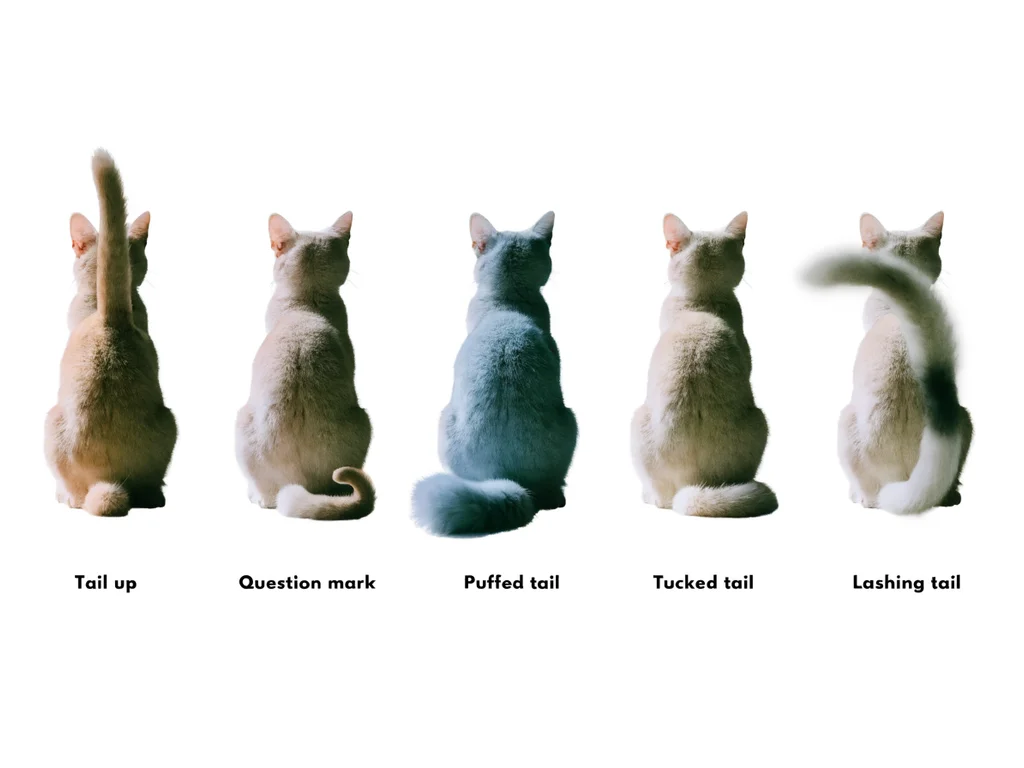
Tail straight up, tip slightly curved (question-mark shape): This is the greeting tail. When Mochi rounds the corner to meet me in the morning, this is what I see. It means the cat is happy to see you, relaxed, and open to interaction. In feral or multi-cat households, cats use this signal with each other too. It's the feline equivalent of a friendly wave.
Tail straight up, fully erect: Similar to the question-mark, but often more intense. High confidence, sometimes in a slightly aroused or excited state. Can appear right before play behavior. Also common when a cat is investigating something they find very interesting.
Tail held low or tucked between legs: Anxiety, fear, or submission. The lower the tail, the more uncomfortable the cat. A tail tucked entirely under the body usually means the cat is quite distressed.
Tail puffed up (piloerection): The classic "Halloween cat." The fur along the tail — and often the spine — stands on end, making the cat look larger. This is an involuntary fear or threat response. The cat is either very frightened or preparing to defend itself. Either way, give them space.
Tail lashing side to side slowly: Not happiness. This one trips people up because it looks like a wagging dog tail. A slow, deliberate side-to-side lash means the cat is irritated, conflicted, or overstimulated. If you're mid-petting session and the tail starts doing this, wrap it up. The scratch you're about to receive is not actually unpredictable.
Tail flicking at the tip: Mild interest or concentration. Often seen during predatory focus — when a cat is watching a bird through the window, the tip of the tail may give a small, quick flick. Less intensity than the full lash.
Tail wrapped around another cat or around your leg: Affection and social bonding. This is deliberate physical contact meant to signal closeness.
Reading the Ears: Direction and Position Tell a Story
Cats have 32 muscles controlling each ear. That's more than humans have in both ears combined. They use them.
Ears forward and slightly outward: Relaxed and attentive. This is the baseline "interested in the world" position. A cat sitting with forward ears is comfortable and engaged.
Ears swiveling independently: The cat is tracking multiple sounds at once. Not a mood signal — this is just active listening. Cats do this constantly in new environments or when there are sounds from multiple directions.
Ears rotating back (not flat, just angled back): Beginning of discomfort or irritation. The cat is registering something unpleasant or overstimulating. Watch for this during handling — it's an early warning that often gets missed because it's subtle. If you see this while petting, it's time to slow down.
Ears flattened sideways (airplane ears): Clear distress or fear. The cat is trying to protect its ears and make itself look smaller. You'll see this at the vet, during baths, or when a cat is genuinely frightened.
Ears fully flattened against the head: Defensive aggression. The cat is scared enough or angry enough that it's ready to fight. This is the "back off" position. Combined with a puffed tail and crouched posture, this cat is not bluffing.
One thing worth noting: the context matters enormously. A cat with ears back during a vigorous play session with a toy is not the same as a cat with ears back while being cornered. The position might look identical. The body and the situation tell you which it is.
Reading the Eyes: Pupils, Blinks, and the Slow Stare
Slow blink: This is the one everyone loves, and it's real. When a cat makes eye contact with you and slowly closes and reopens their eyes, they're communicating relaxation and trust. You can return it. Make soft eye contact and slowly close your eyes — many cats respond in kind. It's not a trick or a hack; it's just how they say "I'm comfortable with you." If this interests you, cat vocalizations explained explores a closely related behavior.
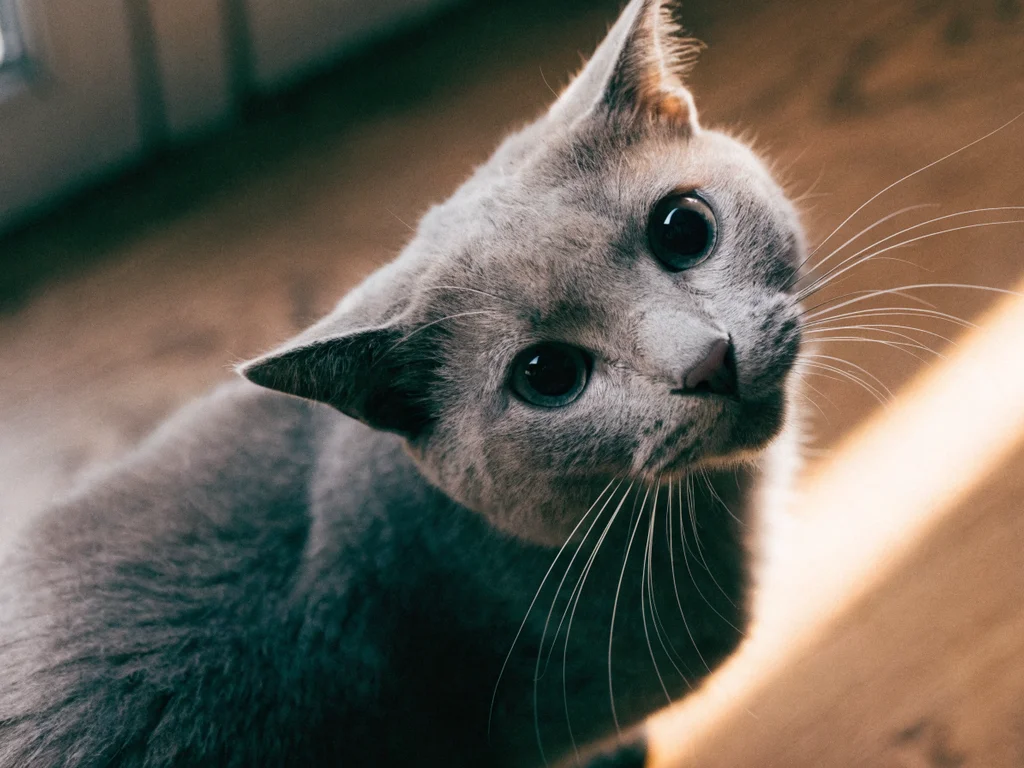
Dilated pupils (large, round): Arousal of some kind — could be fear, excitement, playfulness, or overstimulation. Pupils alone don't tell you which; you need the rest of the body. A cat with dilated pupils mid-play is in a very different state than a cat with dilated pupils backed into a corner.
Constricted pupils (narrow slits) in normal light: Confidence, sometimes mild aggression. An alert, calm cat often has slightly constricted pupils even in moderate light. A very confident cat staring at something it considers beneath it (another cat, a dog, an annoying noise) may show this combined with a steady direct gaze.
Hard, unblinking stare: In cat communication, this is a challenge or a warning. Between cats, a direct stare is confrontational. This is why you should never try to stare down a cat you don't know — it reads as a threat. Look slightly to the side and blink slowly if you want to de-escalate.
Half-closed eyes, unfocused gaze: Total relaxation. If your cat is sitting near you with half-lidded, slightly unfocused eyes, they are deeply content. Mochi does this when she's on the couch in a patch of sun, and honestly it's one of the most satisfying things to witness.
Reading Posture and Body Position
The way a cat holds its entire body is the backdrop against which all the other signals play out.
Loaf position (paws tucked under, body compact): One of the most reliable comfort signals. A cat doesn't tuck its paws when it feels threatened — it keeps them ready. The loaf says "I'm relaxed and not going anywhere."
Rolled onto back, belly exposed: Often misread. A dog exposing its belly is usually requesting a belly rub. A cat is not doing the same thing. Belly exposure in cats signals trust and relaxation — they're showing you the most vulnerable part of their body. But this doesn't necessarily mean they want you to touch it. Some cats actively enjoy belly contact; many do not. Pay attention to whether your individual cat solicits it versus just happens to be lying that way.
Arched back with fur raised: Classic defensive aggression, usually fear-based. The cat is trying to look bigger. Combined with a sideways orientation (presenting its full profile), this is the classic Halloween cat pose.
Crouched low to the ground, weight forward: Predatory behavior — hunting mode. The cat is focused on a target and preparing to pounce. Usually directed at toys or prey, and the expression is fixed, intent concentration.
Crouched low, weight back, head down: This is different from predatory crouching. Weight shifted back, head low, body compressed — this is fearful submission. The cat is trying to minimize itself and is not comfortable.
Standing tall, weight slightly forward, direct eye contact: Confident challenge. This cat is not backing down from whatever it's facing.
Turned sideways, full body presented: This is the threat posture designed to make the cat look as large as possible. Different from the body-forward challenge — this cat is escalating defensively.
The slow approach with head extended: Investigation or social initiation. A cat that approaches you slowly with its nose extended wants to smell you and assess whether you're worth more attention. Don't reach forward aggressively — let them come to you and sniff first.
Reading Whiskers and Facial Expressions
Whiskers are proprioceptive organs — they're extremely sensitive and the cat uses them actively, not just passively.
Whiskers forward and fanned out: Interested, curious, investigating something. This often accompanies the predatory crouch or active exploration. The whiskers are gathering information.
Whiskers held back flat against the face: Discomfort, fear, or defensive posture. This is the facial equivalent of making yourself smaller.
Whiskers relaxed and roughly parallel to the face: Neutral, calm state. This is the baseline.
Slow, deliberate cheek rub against your hand or furniture: Scent marking combined with social bonding. A cat that rubs its cheek on you is depositing scent from its facial glands — this is a marking behavior, but in the context of a known, trusted human, it's also social contact and affection. Mochi does this on my laptop corners constantly, which is both charming and annoying.
Reading the Whole Cat at Once: Context Is Everything
Here's the real question with cat body language: how do you put it all together?
The honest answer is that you practice looking at the whole picture simultaneously, and you get better at it over time. Some quick examples of how signals combine:
"Content and approachable": Tail up with slight curve, ears forward, pupils normal, slow blink, body weight neutral or slightly toward you, whiskers relaxed. This cat wants to interact.
"Overstimulated — stop petting": Tail beginning to lash, ears rotating back or flattening, pupils slightly dilated, body becoming stiff. This is the setup for the classic "unprovoked scratch." There's nothing unprovoked about it — these signals were there for 30 seconds before the bite.
"Fear, not aggression": Tail tucked or low, ears flattened sideways (not pinned), crouched with weight back, pupils dilated, body oriented away from the perceived threat. This cat wants to escape, not fight. Give it a route out.
"Defensive aggression": Fur raised, body sideways, ears flat and back (pinned against skull), pupils may be dilated or constricted depending on intensity, growling or hissing. This cat has no escape route and is prepared to defend itself. Back away slowly.
"Happy and social": Tail upright, walking directly toward you, possibly with a chirp or trill vocalization, head tilting up as they get close, may do a head bump. This is a cat being genuinely happy to see you.
Learning these clusters matters more than memorizing individual signals. And honestly, once you start reading them in combination, it clicks fast. Cats are remarkably consistent communicators — they're just not translating into human.
Common Misreadings and What They Actually Mean
The slow tail lash during petting: Not contentment. Irritation or overstimulation. Stop petting.
The belly flop in front of you: Not necessarily a belly rub invitation. Trust signal. Test gently whether your cat wants contact there before assuming.
The biting after seeming relaxed: Not random. They gave signals for 60 seconds. You missed the tail, the ear rotation, the slight body stiffening. Keep an eye on those next time.
Hiding when you have guests: Not antisocial, not broken. This is a cat doing exactly what a solitary-evolved animal should do when its territory is suddenly full of strange humans. Give them a safe space and stop asking why they won't come out.
The 3 a.m. yowl: Often territorial, sometimes related to unmet needs, and — researchers have confirmed what many owners of older cats already suspected — it does increase with age-related cognitive changes. Excessive nighttime vocalization is one of the recognized signs of Feline Cognitive Dysfunction Syndrome, according to a review published in the Journal of Feline Medicine and Surgery (Landsberg et al., 2010). If it's new behavior, worth a vet check. If it's your cat's established 3 a.m. schedule, that's a different problem.
Staring at the wall: Almost certainly sound-based, not paranormal. Cats can hear from roughly 48 Hz up to 85 kHz — compared to our ceiling of about 20 kHz — giving them a hearing range that researchers have called one of the broadest among mammals (Heffner & Heffner, Hearing Research, 1985). They're tracking sounds through walls that we genuinely can't perceive at all.
FAQ
Q: What does it mean when my cat slow blinks at me?
A slow blink is a relaxation and trust signal. The cat is communicating that it feels safe in your presence and isn't in a heightened alert state. You can return it by making soft eye contact and slowly closing your eyes — many cats will blink back. It's one of the clearest positive signals in the feline communication repertoire.
Q: Why does my cat show its belly but then scratch me when I touch it?
The belly exposure signals trust — your cat is showing you the most vulnerable part of its body. But that doesn't mean it's an invitation for contact in that spot. Some cats enjoy belly touches; many don't. When your cat rolls over, wait to see if it actively solicits petting there (reaching toward you, pawing at your hand) versus just happening to be lying that way. When in doubt, stick to the areas most cats tolerate: chin, cheeks, and the base of the head.
Q: What does it mean when my cat's tail is puffed up?
A fully puffed tail (piloerection) is an involuntary response to intense fear or perceived threat. The cat's nervous system is triggering this to make the cat appear larger. You'll often see it paired with an arched back and raised fur along the spine. Give the cat space and remove whatever is causing the fear if possible.
Q: Why does my cat stare at me without blinking?
Context determines meaning here. In a relaxed setting where you have an established bond, a steady gaze can simply be focused attention — your cat finds you interesting. A slow blink back from you is appropriate. In an unfamiliar or tense context, a hard unblinking stare is more confrontational. Between cats who don't know each other, direct staring is a challenge. If the stare seems intense and is paired with other tension signals (stiff body, twitching tail), redirect the cat's attention rather than staring back.
Q: What does it mean when my cat's ears are flattened?
It depends on how they're flattened. Ears angled back (not fully flat) indicate mild discomfort or irritation — an early warning worth heeding. Ears pressed fully flat sideways signal genuine fear. Ears pinned tightly against the skull, especially combined with direct eye contact and a rigid body, signal defensive aggression. The difference between the second and third matters: the fearful cat wants an escape route; the defensively aggressive cat may attack if it feels trapped.
Q: Can you train yourself to read cat body language better?
Yes, and it's faster than most people expect. The most useful exercise is spending five minutes a day just watching your cat move around its normal environment — not interacting, just observing. Notice which signals cluster together. Notice the transitions. After a week or two, you start seeing the whole cat rather than isolated parts. Mochi has taught me more about feline body language through passive observation than any amount of deliberate study, which is maybe her most redeeming quality given how little she cooperates with anything else.