

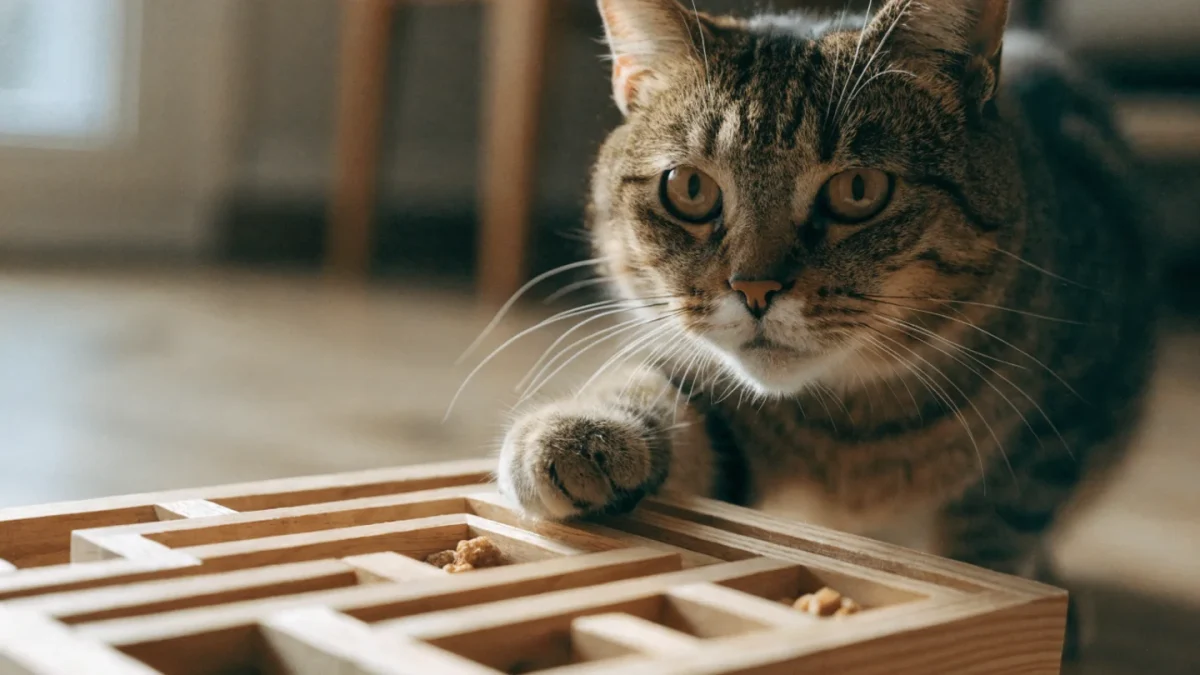
Here's what's actually going on when your cat wolfs down their food in thirty seconds and then immediately demands more: they're bored. Not just hungry — bored. A wild cat would spend several hours a day stalking, pouncing, and working for each meal. Your living room tabby has that same wiring, but their food appears in a bowl twice a day with zero effort required. Cat puzzle feeders fix this mismatch. If you haven't read cat enrichment yet, it'll give you the framework for understanding this.
The basic idea is simple: instead of eating from a flat bowl, your cat has to manipulate the feeder to get the food out. Slide a tile. Spin a disc. Bat pieces through a maze. Every time a kibble falls, it's a tiny successful hunt. For a lot of cats, this is genuinely more satisfying than a full bowl delivered for free.
Why Puzzle Feeders Are Worth the Effort
My cat Mochi was a stress-eater and a fast-eater. She'd inhale her food, vomit it back up twenty minutes later, and then sit next to the empty bowl looking betrayed. A vet ruled out medical causes. The culprit was just speed — she was eating too fast because there was nothing to slow her down.
Adding a puzzle feeder didn't just slow her down. It actually calmed her. She went from inhaling and bouncing off the walls after meals to finishing at a relaxed pace and then napping. That behavioral shift is pretty common. When cats use their brain and body to get food, they hit a kind of natural satisfaction that a free-fed bowl doesn't provide.
Beyond stress eating, puzzle feeders help with:
- Boredom and under-stimulation — especially for indoor-only cats who don't have access to outdoor hunting opportunities
- Weight management — slower eating and smaller portions per "hunt" naturally reduce calorie intake; a 2016 paper in the Journal of Feline Medicine and Surgery documented weight loss as one of the observed benefits in cats using food puzzles (Dantas et al., 2016)
- Anxiety — focused activity is a genuine outlet for nervous energy
- Redirecting destructive behavior — cats who scratch, bite, or over-groom sometimes improve with more daily mental engagement
Honestly, if your cat has any of these issues, it's worth trying a feeder before assuming there's a bigger behavioral problem.
Types of Cat Puzzle Feeders
Not all puzzle feeders work the same way, and cats have strong preferences. Understanding the main types helps you pick a starting point.
Maze and Peg Boards
These are flat trays or boards with channels, pegs, or walls that kibble sits in. Your cat has to nose or paw the pieces through the channels to get them out. They're usually the easiest starting point for beginners because the food is visible, which keeps cats motivated.
Look for versions where the channels are wide enough for your cat's paw — very narrow designs frustrate cats more than they engage them. Adjustable difficulty is a bonus, letting you add walls or sections as your cat gets good at it.
Spinning or Rolling Dispensers
Ball-shaped or cylindrical feeders that your cat bats and rolls to release kibble through small holes. These work great for playful cats who like chasing things. The movement triggers their prey-tracking instinct in a way a stationary feeder can't.
The tradeoff is that they can be loud (especially on hard floors at 3am) and kibble can scatter widely. If your cat is already anxious, the unpredictable rolling might frustrate rather than engage them.
Lick Mats
Technically in the puzzle feeder family, lick mats are flat textured silicone surfaces you spread wet food, plain pumpkin puree, or unseasoned meat paste onto. Your cat has to work their tongue into the grooves to get every bit.
These are particularly useful for cats who find other puzzle feeders intimidating, cats who eat wet food only, and as a calming activity during stressful events like grooming or travel days.
Stationary Puzzle Boxes
These are the more complex puzzle feeders — boxes or boards with multiple compartments, drawers, or lids that cats have to open, lift, or slide to access food. They're designed to be solved rather than just interacted with, and they come in difficulty levels. The same logic applies to play and hunting instincts, actually.
Multi-step puzzles are not for every cat. A cat who's never used a puzzle feeder before will often give up on a complex one and walk away. Starting too hard is one of the most common mistakes new puzzle feeder owners make.
DIY Options
Look, you don't need to spend money to test whether your cat takes to this. Some quick DIY feeders:
- Muffin tin + tennis balls: Put kibble in each cup, place tennis balls on top. Cat has to remove the balls to access food.
- Paper towel roll: Fold the ends closed and poke holes in it. Cat bats it around to release kibble.
- Egg carton: Lay it open, put small amounts of kibble in each cup.
- Ice cube tray: Same concept — kibble in each compartment, cat has to fish it out.
These are zero-cost ways to see whether your cat engages with the concept before you invest in purpose-built feeders.
How Puzzle Feeders Engage Hunting Instincts
Cats are obligate hunters. Even well-fed domestic cats show all the stages of predatory behavior — the stalk, the pounce, the catch, the kill bite — when they play. Mealtime, biologically speaking, is just the endpoint of that sequence.
The problem with a food bowl is that it skips the whole sequence and goes straight to eating. Puzzle feeders insert something between "hungry" and "eating" that resembles the cognitive and physical effort of the hunt. The cat has to figure out the puzzle (problem-solving, equivalent to tracking), manipulate it (physical effort, equivalent to pouncing), and then gets a small food reward each time (equivalent to a catch).
That sequence releases a cascade of brain chemistry that a bowl just doesn't trigger. It's why cats who get puzzle feeders often seem more settled and content — they've actually completed something, not just consumed something. I explore vertical space for cats on its own because there's a lot more going on than meets the eye.
Introducing Puzzle Feeders to a Reluctant Cat
Not every cat sees a puzzle feeder and immediately engages. Some sit next to it and stare at you accusingly. This is normal and very fixable.
Start absurdly easy. Scatter kibble on top of the feeder rather than inside it. Let your cat eat normally from the surface for a few meals. They get used to the object, learn that food is associated with it, and start exploring.
Make the food smell stronger. Mix in a small amount of something highly appealing — a tiny bit of wet food, or just rub some tuna juice on the surface. The stronger smell gives them more motivation to figure out where the food went.
Guide them through it once. Show your cat how to paw or nose the feeder to release food. Actually move their paw if they'll let you. Once they see kibble come out as a result of their action, most cats connect the dots quickly.
Don't leave them frustrated. If your cat has been at a feeder for more than a few minutes and is showing stress signals — ears back, tail lashing, walking away — make it easier immediately. Reduce the food to just the top compartments. A bad early experience can put them off puzzle feeders for a while.
Be patient with timid cats. My second cat, Oliver, took almost two weeks to warm up to the maze feeder that Mochi loved on day one. He's more anxious by nature. I left it out as a permanent fixture, added tiny treats to it occasionally, and didn't pressure him to use it. One day he just started using it. Cats do things on their timeline.
Choosing the Right Feeder
The real question isn't which feeder has the best reviews — it's which feeder matches your specific cat.
For fast eaters: A rolling ball dispenser or maze feeder with multiple channels slows the pace effectively. You want something that forces repeated small interactions rather than one big dump.
For anxious cats: Start with a lick mat or a very shallow maze. Low frustration threshold, high success rate. Build confidence before moving to complex puzzles.
For bored, high-energy cats: Rolling or spinning dispensers add movement. If your cat is tearing up your house, they probably need the physical component as much as the mental one.
For senior or mobility-limited cats: Flat feeders at floor level, or lick mats. No jumping or complex manipulation required.
For multiple cats: Look for feeders with multiple stations or use several simple feeders spread around the space so competitive cats aren't blocking each other.
Start with one feeder. See how your cat responds. If they love it, add variety — rotating two or three different types keeps it from going stale. If they hate it, try a different style before concluding your cat "just doesn't do puzzles."
Frequently Asked Questions
Can I use puzzle feeders for wet food?
Yes, though your options narrow. Lick mats are designed specifically for wet food and pastes. Some maze feeders work with chunky wet food, but check that the channels are wide enough and that the feeder is dishwasher safe — wet food in small crevices builds bacteria quickly.
How often should I use a puzzle feeder?
Most cats do well with puzzle feeders at every meal once they're comfortable. For cats who are new to them or tend toward anxiety, start with one meal per day and give them a straightforward bowl option if they seem frustrated.
My cat figured out the puzzle in two minutes. Now what?
That's a great sign — your cat is engaged and smart. Time to move up a difficulty level, add more compartments, or try a different feeder type. Some cats work through beginner and intermediate feeders fast and need something genuinely challenging to stay stimulated.
Are puzzle feeders suitable for kittens?
Absolutely, and starting young is ideal. Kittens are already in an intense play-and-explore phase, so a simple rolling feeder or shallow tray usually gets picked up very quickly. Just make sure the feeder openings aren't small enough to trap a tiny paw.