

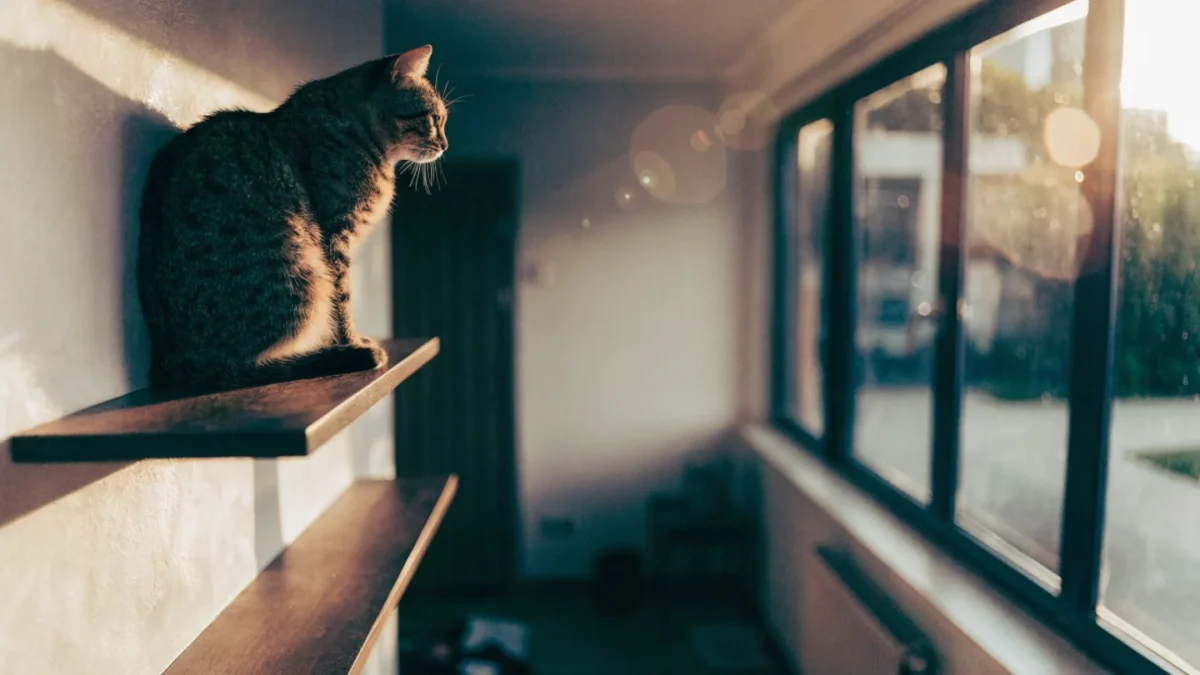
Here's what's actually going on when your cat sits on top of the refrigerator staring down at you like a disappointed landlord: they're doing exactly what their instincts tell them to do. High ground means safety. It means visibility. It means nobody can sneak up on you. And in a house full of floor-level furniture designed for humans, the refrigerator might honestly be the best perch available. The broader guide on cat enrichment is where I lay out the full framework.
Vertical space for cats isn't a luxury — it's environmental enrichment that changes how a cat experiences the whole home. Once you start adding real climbing options, you'll notice the shift. My cat Mochi went from restless and vocal to genuinely content within about a week of adding a decent shelf system. She had places to go.
Why Cats Need Vertical Territory
Cats are vertical animals. In the wild, height means predator avoidance and prey-spotting advantage. That drive doesn't disappear indoors — it just goes unsatisfied when the only options are a couch and a windowsill.
A cat with access to high perches can choose to be out of reach when they want space, can monitor the whole room without committing to a single location, and can move from zone to zone along elevated paths rather than always crossing the floor. Multi-cat households especially benefit here. Vertical territory effectively expands the usable space in a room — two cats can both be "up" without being in each other's faces.
The research on this is fairly consistent: cats with more enrichment, including vertical space, show fewer stress-related behaviors like over-grooming, hiding, and inter-cat aggression (studies published in Applied Animal Behaviour Science and the Journal of Feline Medicine and Surgery have documented this pattern repeatedly).
Low-enrichment environments are a significant driver of problem behaviors. Vertical space is one of the more impactful changes you can make.
What Counts as Vertical Space
Not everything tall qualifies. The goal is a connected, usable system — not just a high shelf your cat can only reach by parkour.
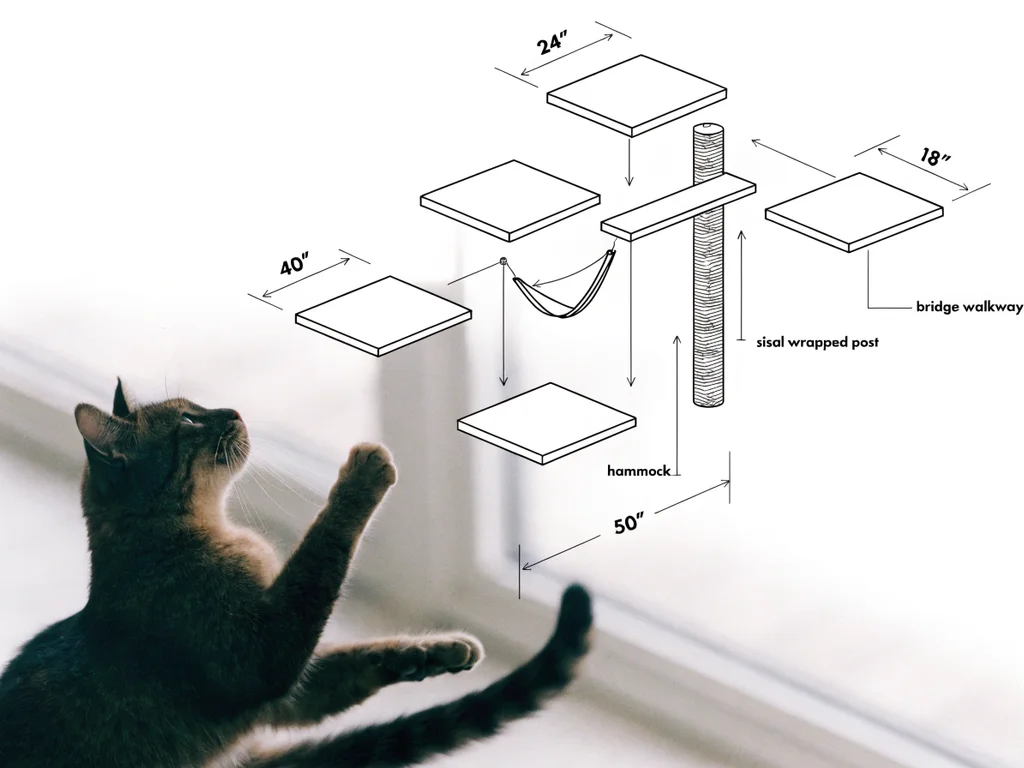
Cat trees are the entry point. A good one has multiple platforms at varying heights, a base that doesn't wobble when a 12-pound cat launches off the top, and some sisal scratching surface built in. The height matters: a tree that tops out at three feet gives a cat something, but a six-to-seven-foot tree places them genuinely above most furniture and gives them a real vantage point.
Wall-mounted shelves are where things get interesting. These are individual platforms, usually attached with heavy-duty brackets, that you arrange into a climbing route. Done well, they look intentional — part of the room design. You control the spacing, the height, the layout. They hold more weight than most freestanding furniture and can span an entire wall if you go all in.
Climbing walls are the full system: shelves plus bridges, tunnels, ramps, and sometimes a ceiling hammock. This is the end state a lot of cat people work toward. It sounds extreme until you see a cat actually use one — then it looks less like excessive cat parenting and more like good environmental design.
Window perches are supplementary. They don't give height across the room, but a window perch extends sill space and gives cats a dedicated observation station. Pair them with a shelf leading up to them and they become part of a larger system.
How to Plan a Cat Shelf Layout
This is where most people stall. The planning feels complicated, but it breaks down into a few decisions.
Step 1: Pick the wall. Look for walls near windows, along main corridors cats already travel, or in rooms where your cat spends the most time. A shelf system in a rarely-used guest room helps nobody. The living room wall your cat already patrols is ideal.
Step 2: Map the entry and exit points. Every vertical system needs a ground-level entry point — a cat tree, a tall scratching post, a low shelf at jumping height (roughly 18–24 inches for most cats), or a piece of furniture they can step onto. It also needs a way back down that doesn't require a leap of faith from five feet up. Build the descent into the plan. Cats will use a system more freely when they don't have to commit to a scary drop.
Step 3: Stagger the heights and spacing. Shelves should be spaced so an average cat can reach the next one in a comfortable jump — generally 12 to 18 inches apart vertically, never more than 24 inches horizontally without a bridge or intermediate shelf. Vary the heights rather than making a straight staircase. Cats prefer diagonal routes. Reading about puzzle feeders and food toys alongside this fills in a lot of gaps.
Step 4: Factor in your cat. A senior cat or one with joint issues needs closer spacing and gentler angles — ramps instead of big jumps. A kitten needs the same, for opposite reasons. A high-energy young adult cat will use everything you install and probably want more.
Step 5: Test the hardware. Wall-mounted shelves must be anchored into studs, not just drywall. A shelf holding a 12-pound cat in motion — mid-leap, weight shifted — is under significant force. Use a stud finder, use the right lag bolts, and check the manufacturer's weight ratings. This is not the place to estimate.
Cat Trees: What to Look For
The market for cat trees is enormous and the quality range is equally enormous. Here's what actually matters.
Base stability. The base should be wide and heavy. If the tree tips when you push the top platform with one hand, it will tip when your cat launches off it. That's how cats get scared off vertical furniture permanently.
Platform size. Platforms need to be big enough for your cat to comfortably curl up, not just balance. A 12-inch square is marginal for most adult cats. 16 to 20 inches gives them real room to settle.
Material on the platforms. Carpet holds up fine, but some cats prefer sisal-covered platforms or even bare wood. Look for removable, washable covers if you can find them — easier to maintain long-term.
Height. As mentioned: taller is generally better. If you're choosing between a 4-foot tree and a 6-foot tree and have the ceiling clearance, go taller.
Honestly, if you're deciding between something that's wobbly but cheap and something sturdy but costs more, get the sturdy one. A tree that tips or shakes even once will make some cats avoid it entirely.
Installing Wall Shelves: The Practical Steps
Wall-mounted cat shelves are a DIY project most people can handle with basic tools. Here's how to approach it.
What you need: a stud finder, a level, a drill, appropriate wall anchors or lag bolts (depending on what you hit), and the shelf brackets. Read the weight ratings on everything.
Finding studs: In most homes, studs are spaced 16 inches apart. Mark them with painter's tape before you drill anything. Both bracket points for a shelf should ideally hit studs. If the shelf width doesn't let you hit two studs, one stud and one good-quality toggle anchor (rated for the weight) can work — but confirm the rating.
Spacing the first shelf: Your lowest shelf sets the whole system. It should be reachable from the floor or from a piece of furniture nearby. Mark the height, use the level, and get the first one in solid before you place anything above it.
Working upward: Install from the bottom up. Each new shelf should be reachable from the one below. Stand back periodically and look at the layout from across the room — it's much easier to adjust before you've drilled all the holes.
Finishing touches: Add carpet tape, a small carpet square, or a slip-resistant pad to each shelf surface. Cats are less likely to use shelves that feel unstable underfoot. Some wall shelf systems come with felt or carpet already — if not, it's an easy addition.
Where to Place the System in Your Home
Placement determines whether your cat actually uses the space. A few things that matter more than most people expect:
Near windows. Cats will seek out perches with a view almost every time. A shelf system that terminates at a window, or even just runs parallel to one, gets used more than an identical system on an interior wall.
Away from startling zones. High-traffic doorways, places where doors slam, or spots near loud appliances will make a cat reluctant to settle in. You want the high space to feel safe, not exposed.
Connected to where they already spend time. Look at where your cat currently loiters. A shelf system that runs through that zone will integrate naturally into their daily routine. A system in a room they rarely enter is a harder sell.
Multiple rooms if possible. One good system is better than none. Two connected systems — say, shelves that run from the living room into a hallway — give a cat the ability to move through elevated space rather than having to drop down to floor level and cross through open ground.
The Real Question About Climbing Walls
Look, people ask me whether they should bother with a full climbing wall versus just getting a cat tree. The real question is: what's your cat's enrichment baseline right now?
If your cat has no vertical space, any improvement helps. A single decent cat tree will make a difference. But if you've already got a tree and you're noticing your cat still seems bored, restless, or socially tense in a multi-cat household, a more developed vertical system — shelves, routes, connected paths — will do more than adding another tree.
The cats who benefit most from full climbing walls are indoor-only cats with high energy, multi-cat households where space competition is a source of tension, and cats who display restless behaviors that improve when they're given interesting things to do.
Mochi, for the record, is indoor-only, opinionated about territory, and deeply motivated by having a higher perch than my other cat, Wren. The climbing wall didn't just give her a hobby — it genuinely reduced the low-level tension between them. Wren has her zone. Mochi has hers. Peace, mostly.
Frequently Asked Questions
How high should cat shelves be mounted?
The top shelf can go as high as your ceiling and your cat's confidence allow — most cats are comfortable at 5 to 7 feet up. The important thing is that each step in the route is reachable from the one below, with no single gap larger than about 18 to 24 inches vertically.
Can I add vertical space in a rental without drilling into walls?
Yes, with some limits. Freestanding cat trees are the obvious option. You can also look for tension-pole shelf systems that press between floor and ceiling without wall anchors. Some renters use furniture-top arrangements — a series of tall bookcases with shelves at the same height create an elevated path without any drilling. Talk to your landlord if you do want to install wall-mounted shelves — many are fine with it if you agree to patch holes before moving out.
My cat ignores the cat tree I already have — will more vertical space help?
Maybe, but first figure out why the tree is being ignored. Common reasons: it wobbles, it's placed somewhere the cat doesn't naturally spend time, it doesn't have a comfortable platform size, or the cat has never been shown it's okay to climb it. Try moving the tree to a more trafficked location first. Sprinkling dried catnip on the platforms can also encourage initial exploration. If the tree is genuinely flimsy, replacing it with a stable one is worth the cost.
How do I get an older or hesitant cat started with vertical space?
Don't put them on the shelf. Let them discover it on their own timeline, with the entry point right at their comfortable jumping height. Leave treats on the first platform for a few days. Sit near it yourself — cats are more likely to investigate something that's in your vicinity. Some cats take a week; some take a day. If they're still ignoring it after a couple of weeks, try a different location.