

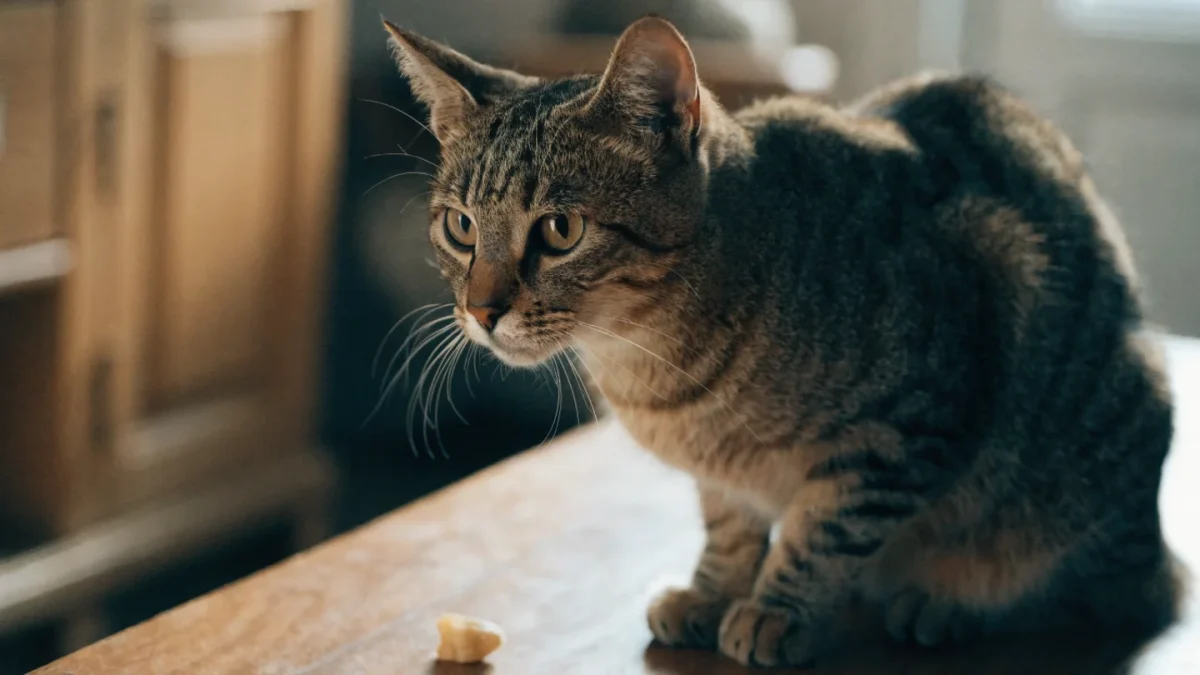
Here's what's actually going on when people say their cat is "untrainable": they're using the wrong playbook. Cats aren't stubborn — they're just not motivated by the same things dogs are, and they don't respond well to the same methods. Once you understand how a cat actually learns, the whole picture changes.
My cat Miso learned to sit on command within a week. Not because I'm some kind of cat whisperer, but because I stopped expecting her to work for approval and started working with what actually motivates her: food, curiosity, and a healthy respect for her own schedule. That shift in approach is what this cat training guide is really about.
Cats can be trained. They can learn tricks, follow cues, stop problem behaviors, and navigate household rules — but only if you train them on their terms.
Why Most People Give Up on Cat Training
The number one reason cat training fails is timing. People try to train when they feel like it, not when the cat is ready. A sleepy, overstimulated, or freshly-fed cat is not going to engage. Neither is a cat that's mid-zoomie or intensely focused on a bird outside.
The second reason is using the wrong reward. Praise and petting work great for dogs. For most cats, they're just… fine. Not motivating enough to override their natural "why bother?" instinct. Food — specifically high-value treats the cat doesn't get otherwise — is almost always the key.
The third reason? Sessions that run too long. Cats have a short engagement window. Five minutes is often the sweet spot. Ten minutes is pushing it. Fifteen minutes and you've probably lost them entirely, and you've also taught them that training is something to avoid.
Once you fix those three things, you'll be surprised how quickly cats engage.
How Cats Actually Learn: The Science Behind It
Cats learn primarily through operant conditioning — they repeat behaviors that lead to good outcomes and avoid behaviors that lead to neutral or unpleasant ones. This is the same basic mechanism dogs use, and the same one that drives most animal learning. The difference is in the details.
Cats are opportunity learners. They're hunters by nature, wired to notice patterns in their environment and act on them when conditions are right. They're not wired for sustained cooperative effort the way pack animals are. A dog might work hard to please you because social harmony matters to them. A cat will work hard because they've figured out that doing X reliably produces a piece of chicken.
This isn't a character flaw — it's just how they're built. Understanding your cat's play and hunting instincts helps explain a lot of this: cats are fundamentally goal-oriented in short bursts, not sustained-effort oriented.
Positive reinforcement is the only method worth using with cats. It means rewarding the behavior you want immediately after it happens, so the cat associates the action with the reward. Punishment — whether it's a stern "no," a spray bottle, or anything else aversive — doesn't teach cats what to do. It teaches them to be anxious around you, and it damages trust. Not worth it.
The timing of the reward is everything. The treat or click needs to happen within one to two seconds of the desired behavior, or the cat can't make the connection. This is why clicker training works so well — the click marks the exact moment of correct behavior, buying you a second or two to deliver the treat.
The Tools You Need (They're Minimal)
One of the things I genuinely love about cat training is how low-effort the setup is. You don't need much.
High-value treats. Small pieces — think the size of a pea — of something your cat finds genuinely exciting. Cooked chicken, small fish pieces, or commercial treats with a strong smell tend to work well. The key word is "high-value": these should be treats the cat only gets during training, not their regular food.
A clicker (optional but useful). A small handheld clicker that makes a sharp, consistent sound. The clicker becomes a "marker" — it tells the cat the exact moment they did the right thing. You can absolutely train without one (using a short word like "yes" instead), but clickers are more precise and easier to time consistently.
A quiet space. No other pets, no distractions, no loud sounds. Cats are easily pulled out of focus. A boring environment is a training environment.
Your cat's hunger. Train before a meal, not after. A cat that just ate has no reason to work for food. A cat that's slightly hungry is motivated.
That's genuinely it. No special equipment, no expensive gear.
What Cats Can Actually Learn
People often underestimate this. Cats can learn quite a lot — the range is wider than most owners realize.
Basic Commands and Cues
Sit. Most cats can learn this in a few days. It's usually the first thing to teach because the behavior happens naturally — you just need to capture and name it.
Come when called. This one is life-saving if your cat ever gets outside or gets into trouble. It takes more practice than sit, but it's absolutely achievable.
Stay. Harder for cats because it requires sustained stillness, which goes against their nature. Possible, but takes patience.
Paw/high-five. One of the easier tricks to teach because cats naturally reach for things. Very satisfying once it clicks.
Spin. A fun one. Cats learn to turn in a circle following a lure. Usually picks up quickly once the cat understands the game.
Practical Household Behaviors
Using a scratching post instead of furniture. This is training, not just hoping. You can actively teach a cat to prefer a post by rewarding them every time they use it. Combine with deterring furniture (covers, double-sided tape) and you've got a real solution.
Entering a carrier on cue. Hugely useful for vet visits. Cats that associate the carrier with treats instead of dread are dramatically easier to transport.
Getting off furniture on cue. Useful if you have certain surfaces that are off-limits. Teach "off" as a redirect, never as punishment.
Coming to a specific spot. Helpful for managing mealtimes, for keeping cats away from doorways, or for simply establishing a routine they find comforting.
What Cats Won't Learn
Honestly, there are limits. Cats won't reliably do something they find actively unpleasant just because you've trained them to. They won't perform on command when they're tired, disinterested, or focused on something else. They aren't going to follow commands in the middle of a stressful situation.
This isn't failure — it's just the honest reality of what cats are. Working within those limits, rather than fighting them, is what makes training feel rewarding instead of frustrating.
How to Teach the Sit Command: Step-by-Step
Sit is the best starting point for a few reasons. It happens naturally, it's easy to capture, and it gives you and your cat a shared language to build from.
Step 1: Get your cat's attention with a treat.
Hold a small treat close to your cat's nose. Let them sniff it so they know it's there. Don't give it yet.
Step 2: Lure upward and back.
Slowly move the treat up and slightly back, over your cat's head. Their nose will follow the treat, and as their head tilts back, their rear will naturally lower toward the floor. Don't rush this.
Step 3: Mark the sit.
The moment their rear touches down, click (or say "yes") immediately. Then deliver the treat.
Step 4: Add the cue word.
Once your cat is reliably sitting in response to the lure, start saying "sit" just before you move the treat. You're pairing the word with the action. After a few sessions, many cats will respond to the word alone.
Step 5: Fade the lure.
Gradually reduce how obviously you're luring. Start using just a small hand gesture, then try the word alone. Reward every success, especially in the early stages.
Keep each session to 5 minutes. Three to five repetitions per session is plenty at first — always end on a success.
How to Teach "Come When Called"
This one takes longer, but it's worth investing in early.
Step 1: Associate your call with great things.
Every time you say your cat's name followed by "come," immediately give them a treat — whether or not they came to you. You're just building the association first.
Step 2: Practice at short distances.
Start with your cat two or three feet away. Say their name, then "come," then immediately show the treat. Reward the moment they reach you.
Step 3: Gradually increase distance.
Once they're reliably coming from a few feet away, extend the distance slowly. Down the hallway, from another room, eventually from outside their line of sight.
Step 4: Make coming always worth it.
Never call your cat to you for something they dislike (nail trims, medicine, carrier loading). If you need to do something they find unpleasant, go to them instead. You want "come" to be permanently associated with good things.
Miso learned this one over about three weeks of consistent short sessions. Now she comes reliably when I call — which has been genuinely useful more than once.
Using a Clicker: The Basics
If you decide to use a clicker (and I'd recommend it, especially for teaching new behaviors), there's one thing you need to do first: "charge" it.
Charging the clicker just means teaching the cat that click = treat. Sit with your cat and do nothing but click and immediately hand them a treat, over and over. Fifteen to twenty reps across a couple of sessions is usually enough. After that, the click has meaning — it's a precise signal that says "yes, that exact thing right there."
Once the clicker is charged, use it to mark the exact moment of correct behavior. The treat follows within a second or two. Over time, you can use the clicker to shape more complex behaviors by clicking successive approximations — rewarding small steps toward the final behavior.
One common mistake: clicking too late. If you click after the cat has already moved away from the sit, you're rewarding them for moving, not for sitting. Timing is the whole skill in clicker training, and it gets easier with practice.
Training Kittens vs. Adult Cats
Kittens are typically easier to train in terms of energy and engagement — they're naturally curious and not yet set in their habits. The challenge is attention span, which is even shorter than adult cats. Sessions need to be very brief (two to three minutes), very rewarding, and repeated often.
Adult cats can absolutely be trained. The idea that you "can't teach an old cat new tricks" is genuinely not true — what's actually happening is that adult cats have established habits and preferences, so you're sometimes working against existing patterns rather than writing on a blank slate. That's a different challenge, not an impossible one.
Senior cats can also learn new behaviors. They tend to have better focus than kittens, which can actually be an advantage. The main consideration is physical — don't ask a senior cat to do anything physically demanding, and keep sessions gentle.
Common Training Mistakes
Starting when the cat isn't ready. If your cat is sleepy, agitated, or hyperfocused on something else, training will fail. Wait for a calm, alert moment.
Rewarding the wrong thing. If your cat sat and then immediately stood up, and you clicked while they were standing, you rewarded standing. Precision matters.
Moving too fast. Every step should be solid before you add the next one. If the cat is struggling, you've likely moved too fast — go back a step.
Using negative reinforcement or punishment. This is the biggest one. Anything that makes the cat feel threatened, anxious, or confused will backfire. Training should always feel good to the cat.
Expecting consistency across every context. A cat that sits reliably in the kitchen may not do it in the living room at first. New environments reset learning a bit. Practice in different locations to generalize the behavior.
Skipping sessions for weeks. Training requires consistency. A few short sessions per week is much better than a marathon session once a month.
The Real Question About Cat Training
Here's what I think people are actually asking when they wonder whether cats can be trained: Is it worth the effort?
And honestly — yes, but maybe not for the reasons you'd expect. The point of training isn't to make your cat perform on command. It's to build a communication channel. A cat that understands cues is easier to live with, easier to take to the vet, easier to manage in stressful situations. Training also gives your cat mental engagement, which is genuinely important for their wellbeing.
Understanding how to read your cat's body language makes you a much better trainer, too — you'll notice when your cat is actually engaged versus when they're checked out, stressed, or just humoring you. That feedback loop is how training becomes a conversation rather than a performance.
The cats I've seen thrive most with training are the ones whose owners approached it as a game rather than a lesson. Miso will do a sit-spin-paw sequence for about five minutes before she decides she's done with me. That's enough. That's actually a lot.
FAQ
Can all cats be trained, or are some just not trainable?
Almost all cats can learn basic behaviors with the right approach. Individual cats vary in how food-motivated they are, how quickly they engage, and how patient they are with new things. Some cats are naturally easier to train than others — but "untrainable" usually means the training approach wasn't the right fit, not that the cat can't learn.
How long does it take to train a cat?
It depends heavily on the behavior and the individual cat. Simple behaviors like sit often click within a week of consistent short sessions. More complex or counter-intuitive behaviors (like coming when called from another room) can take several weeks. Expect progress to be nonlinear — cats often seem to plateau and then suddenly improve.
Can you train a cat to stop doing something?
Sort of — but the most effective approach isn't "stop doing X," it's "do Y instead." You can redirect scratching from furniture to a post, redirect jumping on certain surfaces to acceptable ones, and redirect attention-seeking behaviors to specific cues. Pure punishment ("stop that") without redirecting to an alternative usually just creates anxiety without solving the problem.
Do I have to train every day?
Daily sessions are ideal in the early stages of learning a new behavior, but life doesn't always cooperate. Three to four short sessions a week is enough to make real progress. What matters more than frequency is consistency within each session — short, rewarding, and ending on success.
My cat loses interest halfway through a session. What am I doing wrong?
A few possibilities: the session is too long (try cutting it in half), the treats aren't exciting enough (try something higher-value), you're practicing after a meal (train before eating instead), or the environment has too many distractions. Cats also just have off days. If a session isn't clicking, stop, give your cat a treat for nothing, and try again tomorrow.