

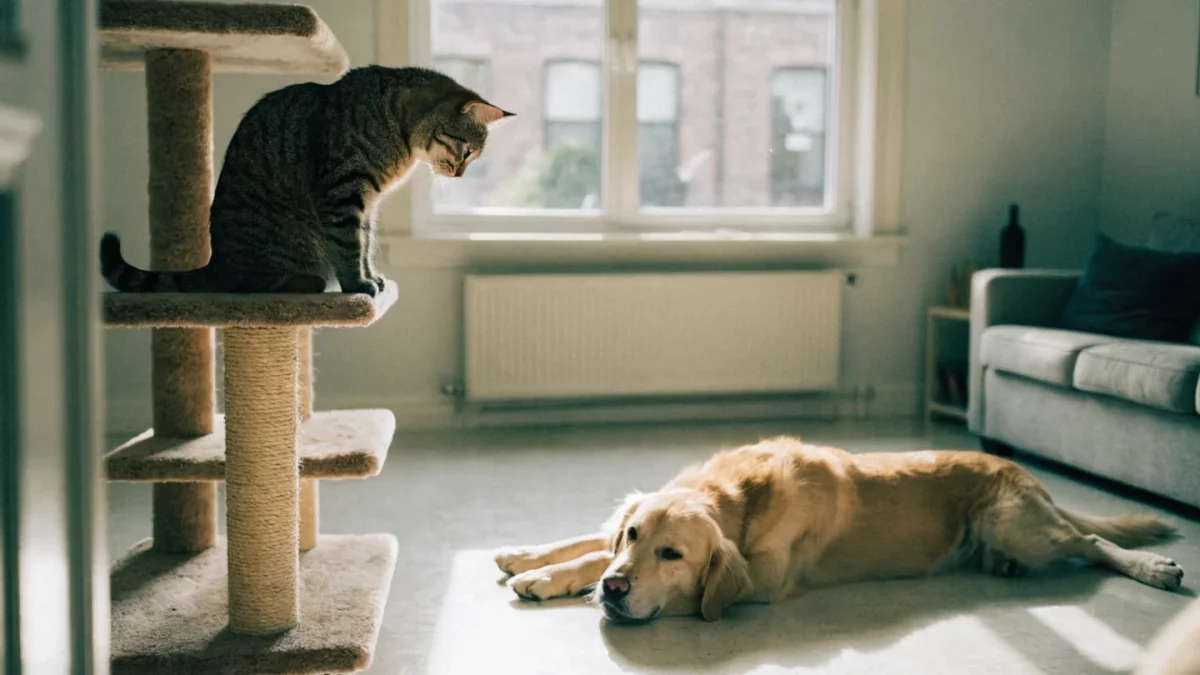
Here's what's actually going on when a cat first meets a dog: the cat is not overreacting. To a cat, a large, bouncy, barking animal with direct eye contact and zero concept of personal space is a legitimate threat. The fact that your dog is "friendly" and "just wants to play" means absolutely nothing to the cat in that moment. I break down introducing cats to other pets separately, and it really helps this make sense.
I learned this the hard way when I brought my terrier mix, Pickle, home to meet my two resident cats, Miso and Dumplings. I figured — they're nice cats, Pickle is a gentle dog, it'll be fine. Reader, it was not fine. Miso hissed so hard she spit. Dumplings hid under the bed for four days. We started over from scratch.
The good news: cat-dog introductions absolutely can work. They just take more time than people expect, and a structure that puts the cat's comfort first the entire way through.
Why the Cat Leads This Process
Most people focus on whether the dog is calm enough to meet the cat. That's only half of it. The cat needs to decide — on her own timeline — that the dog is not a threat worth fleeing.
Cats process stress differently than dogs. A dog bounces back from a startle and moves on. A cat files that experience away and treats the source of it as dangerous, potentially for weeks. A bad first meeting isn't just an awkward moment. It's data the cat will use to make decisions about that dog for months.
So the structure below prioritizes giving the cat information, control, and exit options at every step. The dog's job is to be boring enough that the cat loses interest in being afraid.
The Realistic Timeline: Week by Week
Week 1: Separate Completely — No Exceptions
Keep the dog and cat in entirely different spaces with a closed door between them. This is not optional, and it's not "being overly cautious." It's the foundation.
Set up the cat with everything she needs in her zone: food, water, litter, a bed, and vertical space if possible. Her life should feel completely normal except that there's a funny smell coming from under the door.
That smell is the point. Scent swapping starts here. Rub a cloth on the dog (his face, his bedding) and leave it in the cat's space — across the room at first, not near her food or sleeping area. Do the same in reverse with a cloth that smells like the cat, placed near the dog's bed.
Watch how each animal responds. The cat might sniff it and walk away (good), growl or hiss at it (normal — keep going), or completely ignore it (also fine). The dog might be obsessed and whiny (manage that — calm response is what you want). You're not looking for love yet. You're looking for the absence of panic.
Week 2: Scent + Sound Through the Door
By the second week, your cat has probably stopped treating the cloth like a crime scene. Now you can let them hear each other through the door more intentionally. slow introductions why rushing ruins everything covers the related side of this.
Feed them on opposite sides of the closed door — cat on one side, dog on the other. Start with their bowls several feet back from the door so neither animal is stressed about proximity. Over the course of several days, inch the bowls closer until both animals can eat calmly with only the door between them.
This is a big behavioral shift you're engineering: eating is a positive, relaxed activity. The smell and sound of the other animal starts to pair with something the cat actively enjoys. It's basic conditioning, and it works.
If the cat refuses to eat near the door or the dog is so fixated he won't eat either, you've moved too fast — back the bowls up and slow down.
Week 3: First Visual Contact (Controlled)
When both animals are eating calmly with the door between them, it's time for a crack. Literally — crack the door an inch or two, or use a baby gate with a barrier that the cat can jump over but the dog cannot.
Keep these sessions short: three to five minutes to start. The cat should have a clear path to leave the area if she wants. The dog should be on a leash or in a sit-stay, not allowed to rush the cat or even stare intensely.
What you're watching for: Is the dog ignoring the cat or glancing at her calmly? Good. Is he locked in, hackles up, pulling toward her? Session ends immediately, no drama, back to basics.
Miso — the spitting champion from our first disaster — took eleven days before she'd sit within eyeline of Pickle without her tail puffed up. Eleven days of three-minute sessions. When she finally sat down and started grooming herself while looking at him, I almost cried.
Week 4: Shared Space With an Exit Plan
This is where you move into the same room. The dog stays leashed or behind a barrier initially. The cat enters on her own terms — don't carry her in.
Set this up before the cat enters: her escape routes are clear (a tall cat tree, a shelf, a room she can retreat to). The dog cannot access these spots. This is non-negotiable. Cats need vertical options when they feel cornered, and a cat who is cornered by a dog is going to respond in a way that sets everyone back.
Let the cat investigate from a distance. She may sit far across the room and stare. She may come close to sniff and then bolt. She may go straight to the cat tree and watch from above. All of these are fine. What you do not want is chasing — from either direction.
If the dog lunges, barks, or fixates in a way you can't redirect, end the session. If the cat swipes and runs, that's normal cat communication — watch whether the dog respects it (backs off) or ignores it (that's a dog management problem you need to address separately).
Weeks 5–6: Supervised Freedom
By week five, most dogs and cats who are going to work out have settled into an uneasy truce. The cat has confirmed the dog isn't going to eat her. The dog has accepted that the cat is not an invitation to play.
You can start letting them share space with less intervention — you in the room, but not managing every second. Leash on the dog but dragging, so you can step on it if needed. The cat has full access to her high spots.
Signs this is going well: cat walks past the dog without changing her posture. Dog glances at the cat and looks away. Both animals sleep in the same room without incident.
Signs to slow down: dog fixates on the cat whenever she moves. Cat refuses to eat or use her litter box (stress signals worth taking seriously). Repeated chasing even when redirected.
The Real Question: What If It's Not Working?
Some dogs simply have a prey drive that makes them incompatible with cats. Some cats are so stressed by dogs that life quality suffers permanently. These outcomes aren't failures of the introduction process — they're information about whether this pairing actually works.
Honestly, the best predictor isn't breed (though breed tendencies matter). It's the individual dog's response to the cat's body language. A dog who backs off when the cat hisses is a dog who can probably learn to coexist. A dog who escalates when the cat hisses — ignores it, stiffens, fixates harder — is a dog who needs intensive training work before this introduction should proceed.
If you're doing multi-pet introductions for the first time, you might find it useful to read up on introducing cats to each other as well — many of the same patience-first principles apply, and the scent-swapping protocol is nearly identical.
What "Success" Actually Looks Like
I want to reset expectations here, because a lot of people expect their cat and dog to become best friends who curl up together. That happens — genuinely — but it's not the goal. The goal is peaceful coexistence.
Miso and Pickle will never cuddle. She tolerates him. He has learned she is not interesting. They exist in the same house, eat in the same kitchen, and sleep on the same bed (at opposite ends). Four years in, this is an unqualified success.
Dumplings, the one who hid for four days, turned out to be the one who surprised me. About two months after the introduction, I found her grooming Pickle's ear while he sat perfectly still. She is inexplicably the more tolerant one. Cats.
Setting Up for Long-Term Peace
Once the introduction phase is over, the infrastructure matters as much as anything. The cat needs spaces the dog genuinely cannot access — not just spaces she can escape to temporarily, but feeding stations, litter boxes, and resting spots that are permanently dog-free.
Feeding the cat on a raised surface keeps her from having to guard her food bowl from a curious dog. Placing litter boxes in rooms with cat-door access (or raised entries the dog can't navigate) means she's never cornered during a vulnerable moment.
The dog needs consistent boundaries — clear rules about chasing, about approaching the cat uninvited, about what happens when the cat signals she's done with the interaction. These don't come from the introduction process. They come from ongoing training and management, every day.
Frequently Asked Questions
How long does it take to introduce a cat to a dog?
Most introductions take three to six weeks before both animals can share space without active management. Some pairs move faster, some slower — follow their actual behavior rather than a fixed schedule. Rushing past visible stress signals is what causes setbacks.
Should the cat or the dog come home first?
If you're adding a dog to a cat household, the cat being the established resident is actually ideal — she knows the territory, which gives her a confidence advantage. If you're adding a cat to a dog's home, spend extra time creating high cat-only zones before the cat arrives, so she has safe spaces mapped out from the start.
What if my dog is obsessed with the cat?
A dog who cannot break his fixation on the cat — even with training cues, even between sessions — needs separate behavioral work on impulse control before the introduction continues. The obsession isn't usually about aggression; it's about arousal level. A dog that wound up is dangerous to a cat even without intent to harm.
Can kittens and puppies be introduced more easily?
Often yes — younger animals haven't yet developed the ingrained territorial or prey-drive responses that complicate adult introductions. But a puppy can still injure a kitten through play, so supervised contact is still essential. And a kitten around a larger dog needs vertical escape routes just as much as an adult cat does.