

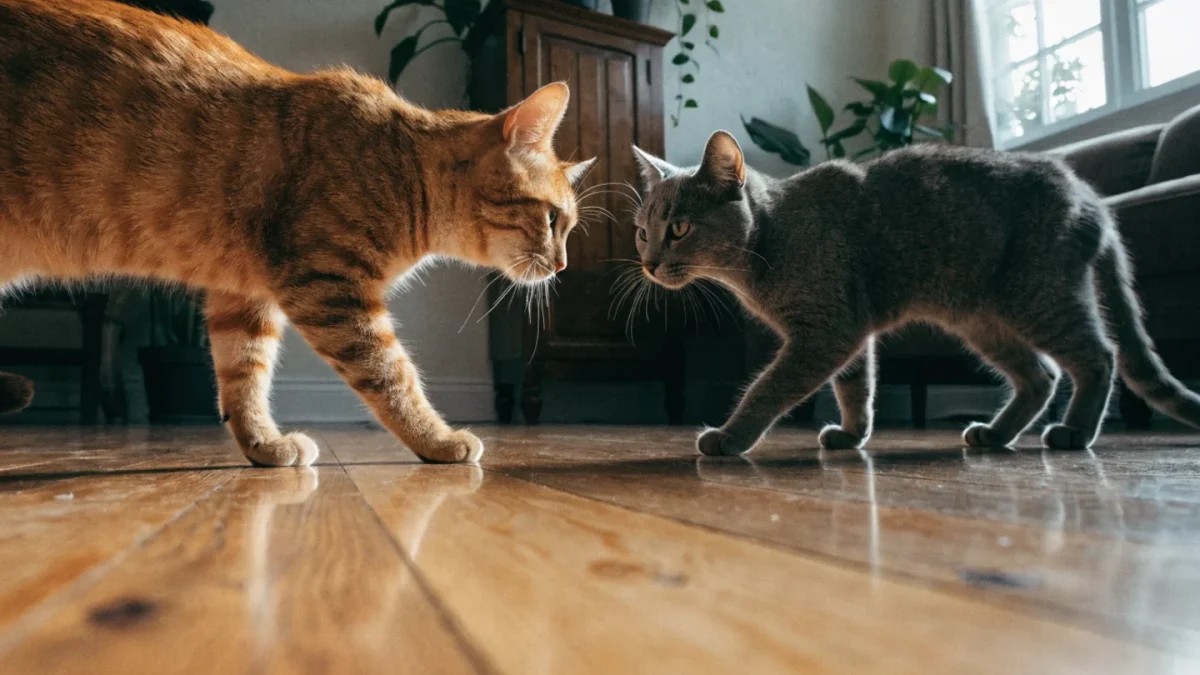
Here's what's actually going on when your resident cat hisses at a newcomer the second they walk in the door: it's not meanness, and it's not a bad sign about how this is going to go. Your resident cat just had their entire world — their territory, their scent map, their sense of security — upended in one moment. The new cat is panicking too, dropped into an unfamiliar place that already smells like someone else's home turf. The guide to living with multiple cats puts all of these signals in one place.
The good news is that cats can and do learn to coexist, and many become genuinely bonded. The key is understanding that this process is measured in weeks, not hours. When you introduce a new cat to your resident cat the right way — scent first, visual contact second, physical meeting last — you dramatically improve the odds of a peaceful household. I've done this introduction twice now with my own cats, Miso (my senior tortoiseshell) and later Pickle (the chaos gremlin I adopted during a weak moment at the shelter). What follows is exactly what worked.
Step 1: Separate Rooms — And Mean It
The new cat goes into a dedicated room with everything they need: food, water, a litter box, a hiding spot, and ideally some of your used clothing to help them acclimate to your scent. Close the door completely. This room is their safe space for the foreseeable future.
Your resident cat keeps access to the rest of the home. Let them sniff around the closed door on their own terms — most cats will investigate obsessively for a day or two, then start to settle.
How long does this phase last? Two weeks minimum. I know that sounds long. It felt long when I was doing it with Pickle, who spent the first four days crying pitifully from the other side of the door. But skipping or shortening this phase is the number one reason cat introductions go badly. You're giving both cats time to process the other's existence without the pressure of sharing space.
During this time, watch your resident cat's behavior. Some cats barely react. Others stop eating, spray, or become clingy. Both responses are normal. The goal is to let things settle before you add any more stimulation.
Step 2: Scent Swapping (The Most Important Step Nobody Does Enough)
Scent swapping is the real work of a cat introduction, and most people underdo it.
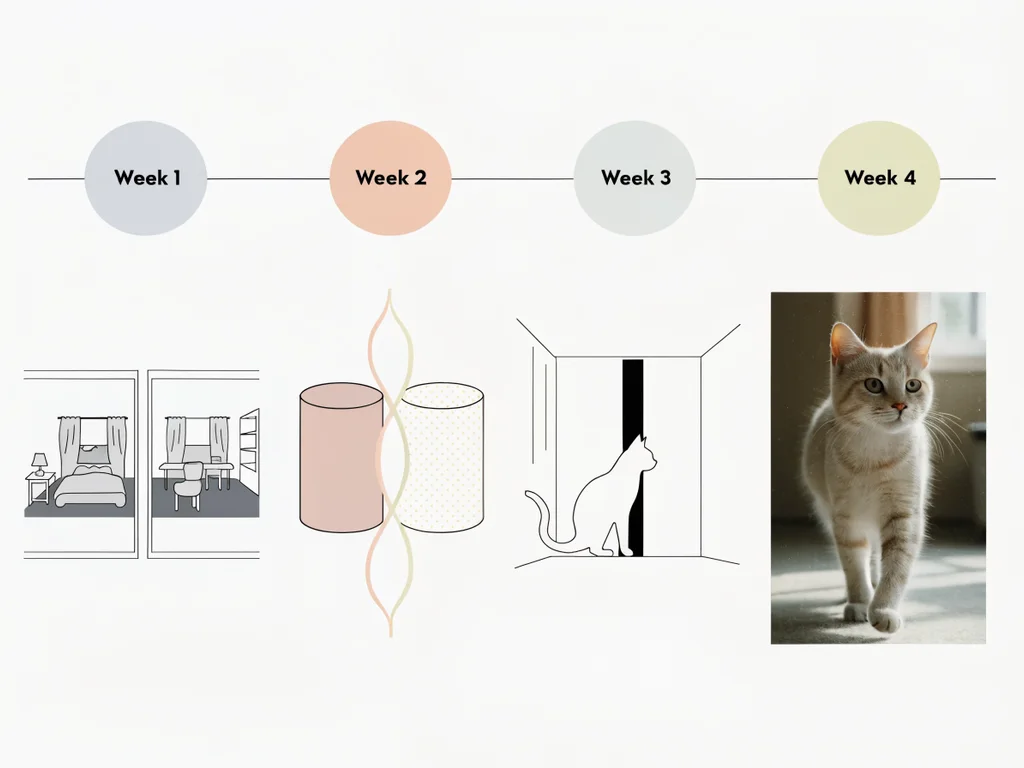
Here's the basic method: take a clean sock or small towel and gently rub it on one cat's cheeks and chin — the areas where scent glands are concentrated. Then place that cloth in the other cat's space. Do this for both cats, switching back and forth every day or two.
Some cats sniff the cloth once and walk away unbothered. Some cats hiss at it, bat it across the room, and then come back to sniff it again. Both reactions are fine. The point is that each cat is processing the other's scent in a low-stakes context, without the visual trigger of seeing another animal.
You can extend scent swapping by switching their food bowls before meals — feeding each cat from a dish that briefly lived in the other's space. You can also swap bedding. The goal is to get both cats to a point where the other's scent doesn't cause alarm. When your resident cat can walk past the cloth without reacting, you're ready to move forward.
Honestly, I did this phase for almost three weeks with Miso before she stopped showing any stress response to Pickle's scent. It's worth the wait.
Step 3: Visual Introduction Through a Barrier
Before any face-to-face meeting, let the cats see each other without being able to access each other. There are a few ways to do this:
- Crack the door of the new cat's room open a few inches and prop it with a door stopper
- Use a tall baby gate (double-stacked if you have athletic cats)
- Feed both cats on opposite sides of the closed door, then gradually move the bowls closer to the gap over several sessions Cat territory and hierarchy is worth reading next — the two topics complement each other.
The feeding-at-the-door trick is particularly effective because it creates a positive association with the other cat's presence. If both cats will eat calmly when they can smell (and eventually see) each other through a crack, that's a genuinely good sign.
Watch body language carefully during these sessions. Hissing and retreating is not the same as lunging and growling — the first is discomfort, the second is escalation. If either cat is refusing to eat, flattening their ears, or fixating in a way that looks like predatory staring, end the session and go back to scent swapping for a few more days.
The real question here isn't "will they be friends?" — it's "can they be in proximity without either one panicking?" That's all you need for the next step.
Step 4: The First Supervised Meeting
When both cats are consistently calm during barrier sessions — eating normally, maybe even curious rather than alarmed — it's time for supervised time in the same room.
Set up the space with multiple exits. Cats feel safer when they can retreat, and a cat with no escape route is a cat that will fight. Move furniture away from corners if needed. Put food or treats at opposite ends of the room to give each cat a focal point.
Let them move at their own pace. Don't force proximity. Don't carry one cat toward the other — that removes the cat's sense of agency and almost always triggers a reaction.
The first session should be short: five to ten minutes, then separate them again. Even if it goes well. Especially if it goes well. You want to end on a calm note, not push until someone gets overstimulated.
Gradually increase session length over the following days. Expect some hissing, some posturing, some tense standoffs where neither cat moves. These are not failures — they're cats negotiating. Redirect tension with a toy or by tossing a treat to interrupt fixated staring. For anyone who wants to go deeper, introducing cats to other pets is the deep dive.
When I did this with Miso and Pickle, the first three sessions ended with Miso on top of the cat tree looking deeply offended and Pickle completely ignoring her. By session six, Pickle was flopped out on the couch three feet from Miso and both were asleep. Progress doesn't always look dramatic.
Handling Setbacks
Setbacks happen. If you have a fight — actual contact with hissing, swatting, and chasing — separate them immediately and go back a step. You can even go all the way back to separate rooms and start over. This is not a failure. It just means the timeline needs more time.
Signs that you may have moved too fast: either cat stops eating, hides constantly, starts missing the litter box, or shows redirected aggression toward you. These are stress responses, and stress doesn't get better by pushing forward — it gets better by reducing the trigger.
A setback also doesn't mean these cats can't live together. It means they need a longer runway. Some cats take two months. Some take four. The process is the same, just stretched out.
What doesn't help: punishing hissing or growling. Those are communication — a cat telling the other cat (and you) that they need more space. Punishing it doesn't make the cats feel safer around each other; it just teaches them not to warn before they react.
Common Mistakes That Derail Introductions
Skipping straight to a meeting. The "just toss them together and let them sort it out" approach does occasionally work, but it's genuinely stressful for both cats and far more likely to create a lasting negative association.
Moving too fast on a good day. A good day is not permission to skip steps. The introduction needs to be predictable and gradual even when things look promising.
Hovering and anxious monitoring. Cats read human energy, and if you're visibly tense every time they're near each other, they register that tension as a cue that something is wrong. Stay calm, act boring, let them figure each other out.
Giving the resident cat less attention. This is a common mistake driven by guilt about the new cat's adjustment. Your resident cat needs reassurance that their bond with you hasn't changed. Prioritize time with them, especially in the early weeks.
Expecting friendship. Some cats become best friends who sleep in a pile. Others maintain a polite coexistence that looks a lot like mutual indifference. Both are fine outcomes. The goal is a household where neither cat is chronically stressed — not a cat friendship for social media.
Signs the Introduction Is Going Well
You're on the right track when:
- Both cats are eating and using the litter box normally
- Your resident cat shows interest rather than alarm when the new cat is in view
- The new cat is comfortable exploring their space and approaching you
- Hissing and posturing are decreasing session by session
- Either cat initiates proximity rather than just tolerating it
The first time Miso groomed Pickle — unprompted, while Pickle was asleep — I genuinely teared up a little. It took about six weeks from the day I brought Pickle home. Not every introduction ends like that, but most of them end with something workable, even if it's just two cats who have agreed to share a home on their own terms.
Frequently Asked Questions
How long does it take to introduce two cats?
Most introductions take two to four weeks if everything goes smoothly. Some cats, especially seniors or cats with no prior feline experience, need six to eight weeks. The timeline depends on both cats' personalities, not how well you're doing the process — so don't compare your timeline to someone else's.
My cats keep fighting through the door — is this normal?
Door-batting and some hissing through a closed door is normal. If it's escalating to either cat refusing to eat near the door, or you're seeing urine spraying or significant behavior changes, slow down the scent swapping phase and make sure both cats have plenty of enrichment and attention during the separation period.
Do I need to keep them permanently separated if the first meeting went badly?
No. A bad first meeting is common and doesn't predict the long-term outcome. Separate them, go back to scent swapping, and rebuild at a slower pace. Many cats who had disastrous first meetings end up coexisting comfortably — it just takes more patience and time.
Should I get a kitten or an adult cat to introduce to my resident cat?
There's no universal answer. Kittens are often less threatening to resident cats because they're clearly not competition for territory in the same way. But some senior cats find kitten energy genuinely exhausting. Adult cats can match each other's energy better. Honestly, temperament matters more than age — a calm adult cat is usually easier to introduce than an extremely active kitten, regardless of your resident cat's age.