


Here's what's actually going on when a cat reacts badly to a new pet: they're not being dramatic. They're responding to a genuine territorial threat in the only language evolution gave them. That hiss, that puffed tail, that retreat under the bed — those aren't personality defects. They're a cat doing exactly what a cat is supposed to do.
The good news is that introducing cats to other pets is one of the most coachable skills in the multi-pet world. You don't need special training or any particular luck. You need a plan, a realistic timeline, and the patience not to skip steps when things look like they're going fine.
My first real introduction was a disaster. I brought home a rescue dog when my cat Miso was three years old, assumed a shared-species sniff was enough of an intro, and then watched the next two weeks collapse into territorial chaos. The second time — when I added a second cat named Juniper — I did it properly. Same house, completely different outcome.
Why the Introduction Process Matters So Much
Cats are territorial in a way that most other domestic animals simply aren't. A dog can generally walk into a new home, read a few noses, and figure out the social order within a day. Cats don't work like that. Their sense of security is built on familiarity with scent, spatial ownership, and predictable routines. A new animal doesn't just threaten their spot on the couch — it threatens every one of those anchors at once.
A botched introduction doesn't just mean a stressful first week. It can set the emotional tone for the entire relationship. Cats that are forced together too fast sometimes never fully relax around each other — they tolerate rather than coexist, spending years doing careful spatial math to avoid sharing rooms. That's liveable, but it's not what most of us picture when we imagine a multi-pet household.
The introduction process creates a different first chapter. Instead of "stranger appeared in my territory," the story becomes "new smell, then a shape, then an animal — and nothing bad happened at any step." That's the emotional foundation you're building.
For a deeper look at what life looks like once introductions are complete, the guide to living with multiple cats covers long-term cohabitation strategies, resource setup, and how to manage relationships that shift over time.
Before You Start: What You Need in Place
Before the new pet even comes through the door, do a quick check on your setup.
A dedicated safe room. The new arrival goes here first — door closed, every resource they need inside. This isn't a punishment. It's where they decompress from the stress of a new environment before adding the additional complexity of another animal. A spare bedroom, bathroom, or office works. It just needs food, water, a litter box (for cats), a bed, and something with familiar scents if possible.
Separate feeding stations. Never share bowls during introductions. You want every feeding experience to feel safe and uncomplicated.
Baby gate or x-pen (optional but useful). A barrier that allows visual contact without physical access is one of the most useful tools in the process. More on that later.
A realistic timeline. Two to four weeks is typical for a cat-to-cat introduction. Cat-to-dog and cat-to-small-animal introductions vary more by individual personality and species. If someone tells you it'll take a few days, treat that as a floor, not an average.
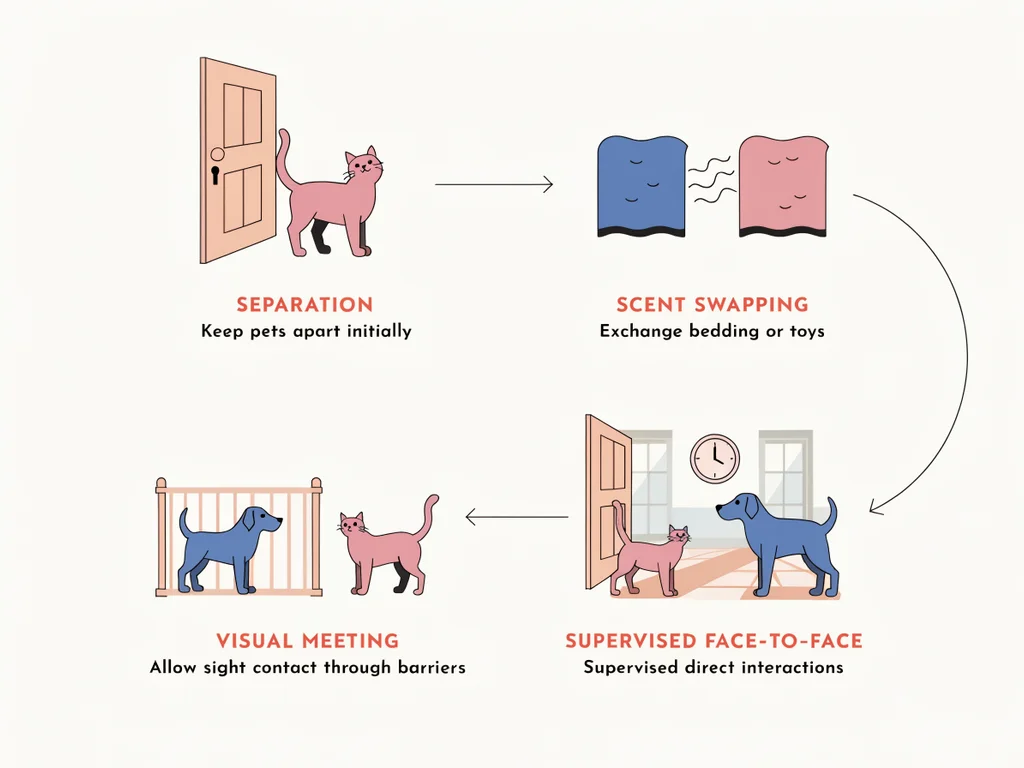
Stage 1: Total Separation (Days 1–7)
Keep the new pet in the safe room with the door closed. Your resident cat knows something is on the other side of that door — the scent gets through immediately — but can't see or confront the newcomer directly.
This stage does two things. It gives the new animal time to settle and start smelling like the house. And it lets your resident cat process the new scent at a comfortable distance, without feeling cornered or ambushed.
During this week, pay extra attention to your resident cat. Maintain their feeding schedule, play sessions, and lap time without change. Any disruption to routine right now will get mentally filed under "the new animal caused this."
Don't force interaction through the door. If your cat sniffs at the gap and walks away calmly, that's good. If they hiss at the door and leave, that's fine too. Both are normal.
Stage 2: Scent Swapping (Days 3–10, Overlapping Stage 1)
A few days in, start exchanging bedding or toys between the animals — something that smells strongly of each one. Put the new pet's blanket near your cat's feeding area (not directly under the bowl; just nearby). Put something of your cat's in the safe room.
The goal is for each animal to encounter the other's scent in a neutral, non-threatening context. When the new smell is associated with food, comfort, and calm — rather than a physical confrontation — it lands differently.
You can also do a room swap: let the new pet explore the main house while your resident cat has access to the safe room. This gives both animals a chance to investigate each other's territory without a face-to-face meeting. Watch your resident cat's body language when they enter the room the newcomer has been using. Intense sniffing is normal. Prolonged growling or distress is a sign you may need to slow down.
Stage 3: Visual Contact Through a Barrier (Days 7–14)
Once both animals seem relatively settled — meaning your resident cat isn't in a constant state of agitation, and the new pet has calmed down from the move — it's time for visual contact.
Crack the safe room door an inch, or set up a baby gate, so they can see each other without physical access. Do this during something positive: a feeding session is ideal. Put both animals' food near the barrier, far enough apart that neither feels threatened, and let them eat while seeing each other.
Watch what happens. Eating in proximity while the other animal is visible is a significant behavioral step. If either animal stops eating, moves away, or shows signs of stress, the distance is too short. Move the bowls back, give it another day or two, and try again a little farther apart.
Gradually move the bowls closer over multiple sessions until both animals can eat with the barrier between them without visible stress. This might take three days or ten — both are within normal range.
Stage 4: Supervised Face-to-Face Meetings
This is the stage people are most tempted to rush. Don't.
Open the barrier only when you've seen both animals eat comfortably near each other multiple times. Choose a large, neutral-ish space — not the new pet's safe room, and ideally not a spot your resident cat has claimed as a high-value territory.
Keep the first few meetings very short. Five to ten minutes. Stay calm yourself — animals read human anxiety easily, and if you're tense, the room feels tense.
What you want to see: Curious sniffing. One animal approaching and then retreating normally. Parallel existence, both going about their business without fixating on each other. These are all good signs.
What you want to watch for: Hard staring (especially from a dog toward a cat), stalking posture, a cat that freezes and can't leave, or any animal that can't relax at all during the session. These aren't failures — they're just signals that more barrier time is needed.
End every session on a neutral or positive note before either animal reaches their threshold. You're building a bank of "nothing bad happened" experiences.
How This Works for Different Combinations
Cat Introducing to Resident Cat
This is the most common multi-pet introduction and the one where the territorial response tends to be most intense — because you're adding a direct competitor for the same species niche.
The resident cat almost always has the social advantage, even if they're smaller or younger. That dynamic needs to play out naturally; don't try to enforce an artificial hierarchy. What you can do is make sure the resident cat never feels like they've lost access to resources. Feeding stations, litter boxes, sleeping spots, and your attention should all be maintained or expanded, not redistributed.
Hissing and swatting during early face-to-face meetings is normal. What you're watching for is escalation into sustained chasing or one cat being unable to access food, water, or the litter box. That's when you take a step back.
Cat Introducing to Dog
The dynamics here depend enormously on the dog. A dog with a high prey drive and minimal impulse control is a genuinely harder case — not impossible, but harder. A calm, older dog who ignores the cat's presence is often the easiest introduction of all.
The key rule: the cat must always have an escape route. A cat who can't get away from a dog will eventually stop trying to flee and switch to offense — which makes things worse. Tall cat trees, elevated shelving, and baby gates the cat can pass through but the dog can't are all useful tools here.
During visual barrier stages, watch the dog more than the cat. If the dog is fixated, whining, or doing a stalking crouch, they need more impulse control work before you move forward. A cat who hisses and retreats behind the gate is setting a healthy boundary; a dog who won't take their eyes off the cat for ten minutes is telling you they're not ready.
Cat Introducing to Rabbits, Guinea Pigs, or Small Animals
This is where people sometimes assume prey-animal = automatic target. That's not always true, but it's true enough that you need to take it seriously.
The small animal should always have a fully enclosed, secure enclosure — not just during introductions, but always. The introduction is about acclimating your cat to the presence of the smaller animal so that the cat's baseline curiosity reduces over time. You're not working toward free-roaming cohabitation; you're working toward a cat who can be in the same room as an enclosed small animal without fixating on it.
Watch for predatory focus: a cat who crouches low, tail tip twitching, entirely still while watching the small animal. That's not casual interest. Controlled exposure paired with redirection (a toy, a treat, your voice) can help desensitize over time, but some cats never fully switch this off, and that's something to be honest with yourself about.
Reading the Room: Signs Things Are Going Well
Knowing what success looks like helps you avoid over-interpreting normal friction as failure.
Positive signals:
- Animals in the same room without one fleeing immediately
- Parallel play or rest — both relaxed, not fixating on each other
- Curiosity sniffs without aggressive follow-through
- Slow blinking or looking away (cats)
- One animal approaching and the other redirecting to something else, without conflict
Neutral but normal:
- Hissing when personal space is invaded during early meetings
- One animal spending more time in a certain room to avoid the other
- Occasional swatting with claws retracted
- Your resident cat being grumpy with you for a few weeks
Signals to take seriously:
- One animal can't access food, water, or the litter box because they're afraid of the other
- Sustained, intense chasing that doesn't stop when the chased animal retreats
- Either animal is losing weight or showing behavioral changes from chronic stress
If you're seeing prolonged stress responses in your cat — not just initial adjustment grumpiness, but ongoing hiding, changes in eating, or excessive grooming — it's worth looking more carefully at signs your cat is stressed to understand what's a normal adjustment phase and what might need intervention.
The Real Question: How Long Does This Actually Take?
Honestly, the timeline question is where most people get frustrated, because the answer is "it depends" and that feels unhelpful. But here's the more honest version.
Most cat-to-cat introductions hit their stride somewhere between three and eight weeks. Cat-to-dog introductions can be faster if the dog has good impulse control, or significantly longer if they don't. Cat-to-small-animal cohabitation is often indefinite management rather than a point of completion.
The thing that extends timelines more than anything else is rushing a stage and having to backtrack. A stressed reset — where you have to go back to full separation after a failed face-to-face — costs you more time than moving slowly would have. So when you're at stage 3 thinking "they seem fine, let's just open the door" — give it one more day of barrier feeding. The day isn't wasted.
What you can control is the quality of each stage, not the total clock. Animals that associate every stage with neutral-to-positive experiences move through faster than animals that spend half their time in a stress response.
When to Ask for Help
Most introductions, even messy ones, resolve without professional help. But there are situations where getting a certified animal behaviorist involved is genuinely the smarter call.
A dog with very high prey drive toward cats. A cat with a history of trauma who isn't making progress after six weeks. Animals who have had a serious altercation with injury. Multi-species combinations with genuinely complex dynamics. These aren't failures — they're cases where professional support shortens the timeline and gets you to a better outcome.
Look for someone with credentials in animal behavior specifically, and be cautious of anyone who promises a fast fix. The underlying behavioral work doesn't compress.
Frequently Asked Questions
How long does it take to introduce a cat to another pet?
Cat-to-cat introductions typically take two to eight weeks, with the wide range reflecting individual personality differences and whether the process goes smoothly or requires backtracking. Cat-to-dog introductions can be faster with a calm dog, or considerably longer with a reactive one. There's no universal timeline — watch the animals, not the calendar.
Can you introduce a cat to a dog without a barrier?
You can, but it's rarely a good idea in the early stages. The barrier stage isn't just about preventing fights — it's about giving both animals a way to observe each other without the pressure of a direct encounter. Skipping it puts both animals in a situation where they can't opt out, which tends to create negative associations rather than neutral ones. The barrier stage is usually the fastest part of the process when you actually do it.
My resident cat is still hissing at the new pet after a month. Is this normal?
It can be, depending on the situation. Some cats — particularly those with smaller social tolerances — take longer to accept a newcomer, and intermittent hissing during close contact may persist for several months. What matters more than the presence of hissing is whether both animals can access their resources without fear and whether the overall trend is moving toward more peaceful coexistence, even slowly. If there's been no improvement at all after six to eight weeks, revisit the introduction stages from scratch or consider behavioral support.
Do I need to keep them separated at night during introductions?
Yes, during the early stages. Unsupervised access at night removes your ability to intervene if things escalate, and most cats do a lot of their territorial asserting in the dark. Many households keep the animals separated for sleeping even after daytime coexistence is going well, especially in the first few months. Some keep sleeping separation permanently, and that's a perfectly fine long-term arrangement.
What if my cat absolutely refuses to accept the new pet?
True, permanent rejection is less common than people fear — most cats do eventually reach some level of tolerance, even if it's not warm coexistence. But some cats, particularly those with strong territorial personalities or prior trauma, have a much harder ceiling. If you're months in with no progress and the quality of life for either animal is being genuinely affected, it's worth having an honest conversation with an animal behaviorist about realistic expectations and whether the current setup is sustainable.