

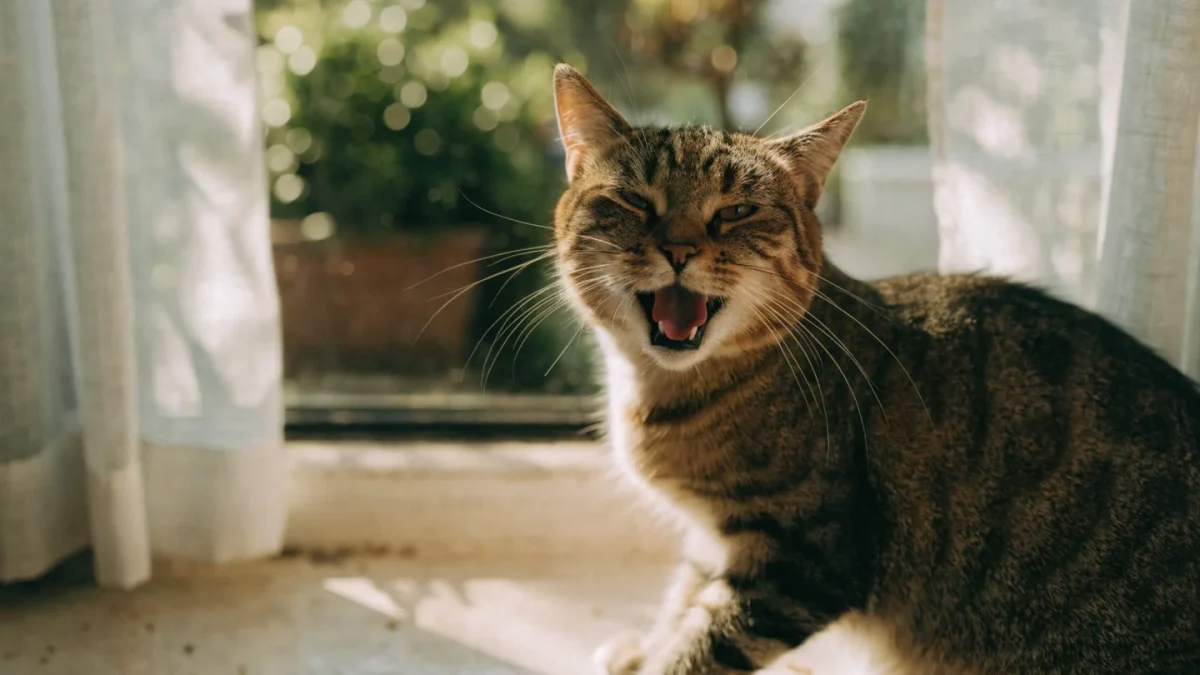
Here's what's actually going on when your cat opens their mouth: they're talking to you. Specifically to you. Because cats evolved to communicate with humans in a way they largely don't bother with each other.
That realization hit me differently after I'd lived with cats for years. My cat Mochi could go an entire afternoon in a room with my friend's cat without a single meow exchanged between them — then the moment I walked in, she launched into a full monologue. Cats are selective communicators, and we are their primary audience.
The cat vocalizations meaning behind each sound is more nuanced than most people assume. A meow can mean "I'm hungry," "I'm bored," "I'm annoyed you closed the bathroom door," or "I see you and I acknowledge your existence." Learning to tell the difference isn't mystical — it's pattern recognition, and it gets easier the more you pay attention.
The Meow: Your Cat's Most Customized Sound
Adult cats almost never meow at other adult cats. This is one of those facts that sounds too specific to be true, but researchers finally confirmed what cat owners already knew — studies by animal behaviorist Nicholas Nicastro, published in the Journal of Comparative Psychology, found that domestic cats have evolved their meow specifically to communicate with humans, not with each other. Kittens meow at their mothers. Adults who live with humans? They meow at us, and they adapt that meow over time based on what gets a response.
Honestly, it's a little flattering if you think about it.
Short, High-Pitched Meow
This is the greeting meow — the "oh, it's you" acknowledgment when you walk through the door or enter the room. Mochi does this every single time I come home, even if I was gone for twenty minutes. It's quick, it's light, and it doesn't carry any urgency. You don't need to do much in response beyond saying hello back.
Mid-Pitch Sustained Meow
This is the request meow. Longer than a greeting, insistent but not distressed. It usually comes in a sequence — meow… meow… meow — with pauses that feel like your cat is waiting to see if you're going to do something about it. Food, water, an inaccessible toy, a door they want opened. Look around; the context is usually obvious within about ten seconds.
Low, Growling Meow
Something is wrong and your cat is unhappy. This sound is longer, rougher, and sits lower in the throat than a normal meow. It shows up when a cat is territorial, overstimulated, or in pain. If your cat makes this sound while you're petting them, stop immediately — they're telling you they've hit their limit. If it comes out of nowhere, something in the environment has triggered them.
Repeated, Urgent Meowing
High frequency, short gaps between sounds — this signals real distress. It's different from the request meow in that there's no patient waiting quality to it. If your cat is doing this and you can't identify an obvious cause, it's worth paying close attention. Cats in pain can vocalize this way.
The Silent Meow
The mouth opens, the shape is exactly right, and nothing comes out — or almost nothing. This one gets people. The sound is likely there at a very high frequency — cats can vocalize and hear well beyond the range of human hearing — though the exact mechanism isn't fully documented. What's consistent is the context: cats use this toward people they feel very comfortable with. My previous cat, Oliver, reserved the silent meow exclusively for times he wanted to sit on my laptop. Impeccable timing.
Purring: More Complex Than It Sounds
The purr is probably the most misread cat vocalization. Most people interpret it as happiness-only, but cats also purr when they're anxious, injured, or giving birth. The current thinking — supported by veterinary behavioral research — is that purring functions as a self-soothing mechanism (like humming when you're nervous) as well as a social bonding signal.
The frequency range of a cat's purr — roughly 25 to 150 Hz — overlaps with frequencies that have been studied for promoting bone density and tissue healing. A 2001 paper by Elizabeth von Muggenthaler in the Journal of the Acoustical Society of America found that every felid species tested generated strong purr frequencies in this range, which correspond to frequencies used therapeutically for bone and tissue repair. This has led to the popular idea that cats purr to heal themselves, though the research here is interesting rather than definitive.
What you can reliably read from purring:
Relaxed, rhythmic purring while your cat is in a comfortable position, eyes half-closed: contentment. This is the good one.
Purring combined with tense posture, flat ears, or dilated pupils: stress or pain. The sound is the same, but the body is telling a different story. This is why understanding cat body language alongside vocalizations gives you a much more complete picture.
Solicitation purring is a specific type that some cats use when they want something — usually food. It has a higher-pitched, slightly more urgent quality embedded in it. Research by Dr. Karen McComb at the University of Sussex, published in Current Biology in 2009, found that humans rated solicitation purrs as more urgent and less pleasant than resting purrs — the embedded high-frequency cry element apparently taps into the same instincts that make human baby cries hard to ignore — which explains why it works so well.
Trilling and Chirruping: The Social Sounds
Trilling is one of those cat sounds that takes people by surprise because it's so cheerful. It's a rolling, vibrating sound — somewhere between a meow and a purr — made with the mouth closed. Cats trill at people they like, and mother cats use it to encourage kittens to follow them.
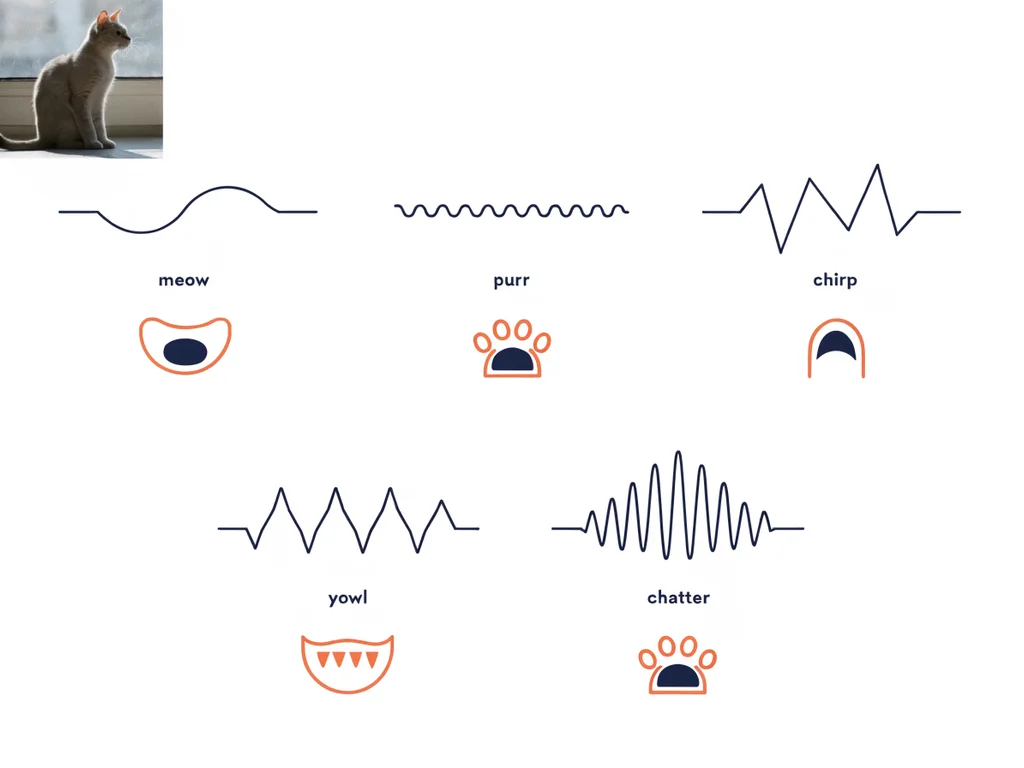
When Mochi trills at me, it usually means she wants me to follow her somewhere. She's showing me a toy. She's showing me her food bowl. She wants to sit near me in another room. The trill is an invitation rather than a demand.
Chirruping is similar in quality but shorter and more staccato. Some cats use it as an excited greeting sound, especially when you've been away for a while. It has an energetic, happy-to-see-you quality that's hard to mistake for anything negative.
Both of these sounds are social and positive. If your cat trills at you and you trill back — yes, some people do this, and yes, cats often respond to it — they'll usually look at you with an expression that falls somewhere between amused and delighted.
The Chatter and the Chirp: Birds, Windows, and Frustration
If you've ever watched a cat watching birds through a window, you've probably heard this: a rapid, staccato clicking or chattering sound made with the jaw, sometimes accompanied by a high-pitched chirp. It's one of the stranger sounds cats make, and no one has fully nailed down what's driving it.
The leading theories are that it's either:
- Predatory excitement — the visual trigger of prey activating hunting instincts creates a kind of involuntary vocalization
- Frustration at not being able to reach the prey
- A mimicry behavior — researchers from the Wildlife Conservation Society documented a margay in the Amazon imitating the calls of a pied tamarin monkey to lure it closer, and similar behavior has been reported anecdotally for jaguars and pumas
The truth is probably some combination of the first two. What's clear is that the chatter/chirp combo is almost exclusively triggered by prey-like visual stimuli — birds, squirrels, fast-moving insects. It's not a sound directed at you. Your cat is in a full prey-brain moment and you're just witnessing it.
Yowling and Caterwauling: When Things Get Loud
These are the sounds that wake you up at 3 a.m.
Yowling is a long, drawn-out, mournful vocalization. It's louder and more sustained than any normal meow, with a wailing quality that cats in TV shows are often dubbed with. In unfixed cats, yowling is a major component of mating behavior — female cats in heat yowl to attract males, males yowl when they sense a female in heat nearby. If your cat is unfixed and suddenly starts yowling, this is almost certainly what's happening.
In fixed cats, persistent yowling can signal:
- Cognitive dysfunction in older cats — Cornell University's College of Veterinary Medicine notes that nighttime disorientation and seemingly unprompted loud vocalizing are recognized signs of feline cognitive dysfunction syndrome, which typically becomes noticeable in cats 10 years and older
- Pain or medical distress — any sudden onset of yowling in a cat who didn't previously do this warrants attention
- Territorial disputes — if there's a cat outside the window or a new cat in the household
Caterwauling is the ugliest version — the full-volume, almost-howling sound that cats produce during serious territorial confrontations or when genuinely terrified. If you've ever had the misfortune of two unfixed males encountering each other at close range, you know this sound. It's meant to intimidate and it does the job.
Hissing and Spitting: The Unambiguous Ones
Hissing needs no interpretation manual. A cat that is hissing is a cat saying "I feel threatened and I will escalate if pushed." The sound is produced with the mouth open, air forced rapidly over the tongue, and it's a near-universal warning sign across cat species.
Spitting — a sharp, explosive sound that sometimes accompanies hissing — is a step up from hissing in urgency. Some cats spit as a reflex when startled, even without any ongoing threat.
The real question with hissing isn't what it means (you know what it means) — it's why it's happening. A cat that hisses at people regularly is a stressed cat. A cat that suddenly starts hissing at a person or animal they were previously fine with has had something shift in their comfort level, and that's worth figuring out.
Growling: Different From the Growling Meow
A genuine growl is lower and more continuous than the growling meow mentioned earlier. Cats growl when actively threatened, defending territory, or warning something away from their food or space. It often accompanies hissing and happens right before physical escalation.
Some cats growl while playing with toys — a low, satisfied rumble while wrestling with a kicking toy. Context makes it obvious which one you're dealing with.
Why Your Cat Is More (or Less) Vocal Than Average
Cats vary enormously in how much they talk. Some of this is individual personality, some of it is breed-related (Siamese and other Oriental breeds are notoriously chatty; Norwegian Forest Cats tend to be quieter), and some of it is environment.
Cats who have learned that vocalizing gets results tend to vocalize more. If you've ever gotten up to feed your cat because they wouldn't stop meowing at 5 a.m., congratulations — you've trained your cat to meow at 5 a.m. This isn't a character flaw on anyone's part; it's just operant conditioning doing its thing.
Cats who are rarely responded to may vocalize less. Cats under chronic stress may vocalize more or change their usual patterns. If a previously quiet cat suddenly becomes vocal, or a previously vocal cat goes quiet, a check-in with a vet is a reasonable step — especially to rule out pain or illness before assuming behavioral causes.
Reading the Whole Cat
Sound is one channel. Posture, ear position, tail movement, eye contact — these all run alongside the vocalizations and often tell you more. A meow with an upright tail and forward ears reads completely differently than a meow with a puffed tail and flat ears, even if the sounds are similar.
The more time you spend paying attention to the whole picture, the better you get at reading your specific cat — because individual cats develop their own dialects over time. Mochi has a specific meow she uses only when she wants to go into the bedroom and the door is closed. I know that meow. I didn't teach myself it — I just noticed it enough times that it became obvious.
That's really what understanding cat vocalizations comes down to: noticing. Your cat is telling you things constantly. You just have to pay attention long enough to learn the patterns.
Frequently Asked Questions
Why does my cat meow so much at night?
Nighttime vocalizing has a few possible causes. In unfixed cats, it's often mating behavior. In older cats, cognitive changes can cause disorientation that leads to nighttime yowling. Some cats are simply more active at night — cats are crepuscular, meaning naturally more alert around dawn and dusk — and vocalizing is part of that energy. If the nighttime meowing is new behavior in an older cat, a vet visit is worth it to rule out any underlying issues.
Do cats meow differently to different people?
Yes, and this is one of the more charming aspects of cat communication. Cats adapt their vocalization patterns based on what works with specific people over time. Your cat may have a completely different meow "vocabulary" for you versus other household members — shaped by years of learning which sounds get which responses from each person.
What does it mean when a cat meows with their mouth closed?
A closed-mouth vocalization is usually either a trill or a chirrup — both of which are positive, social sounds. The "silent meow" where the mouth moves but no audible sound comes out likely involves a very high-pitched vocalization — cats can hear and vocalize well beyond the range most humans can detect — though the exact mechanism isn't fully documented. Both indicate a comfortable, non-distressed cat.
Is excessive meowing always a problem?
Not necessarily. Some cats are just talkers. What matters is whether the vocalization pattern has changed. A cat who has always been chatty and is still chatty isn't concerning. A cat who was quiet and suddenly becomes very vocal — or a vocal cat who suddenly goes quiet — is worth paying attention to, as it can signal stress, pain, or illness.
Why do cats chirp or chatter at birds?
The exact mechanism isn't fully understood, but it appears to be linked to predatory excitement. The rapid jaw movement and clicking sound happen when cats see prey they can't reach — birds, squirrels, fast insects. Some researchers think it may also involve mimicry of prey sounds, though this isn't confirmed. It's essentially your cat's hunting brain firing up without an outlet.
Can you train a cat to be less vocal?
To some extent, yes — by not reinforcing the vocalizations you want to reduce. If your cat meows for food and you feed them every time they do it, you've reinforced that behavior. Waiting for a quiet moment before providing what they want can gradually shift the pattern, though this requires consistency and patience. Trying to reduce vocalizations that are stress-driven won't work without addressing the underlying cause.