

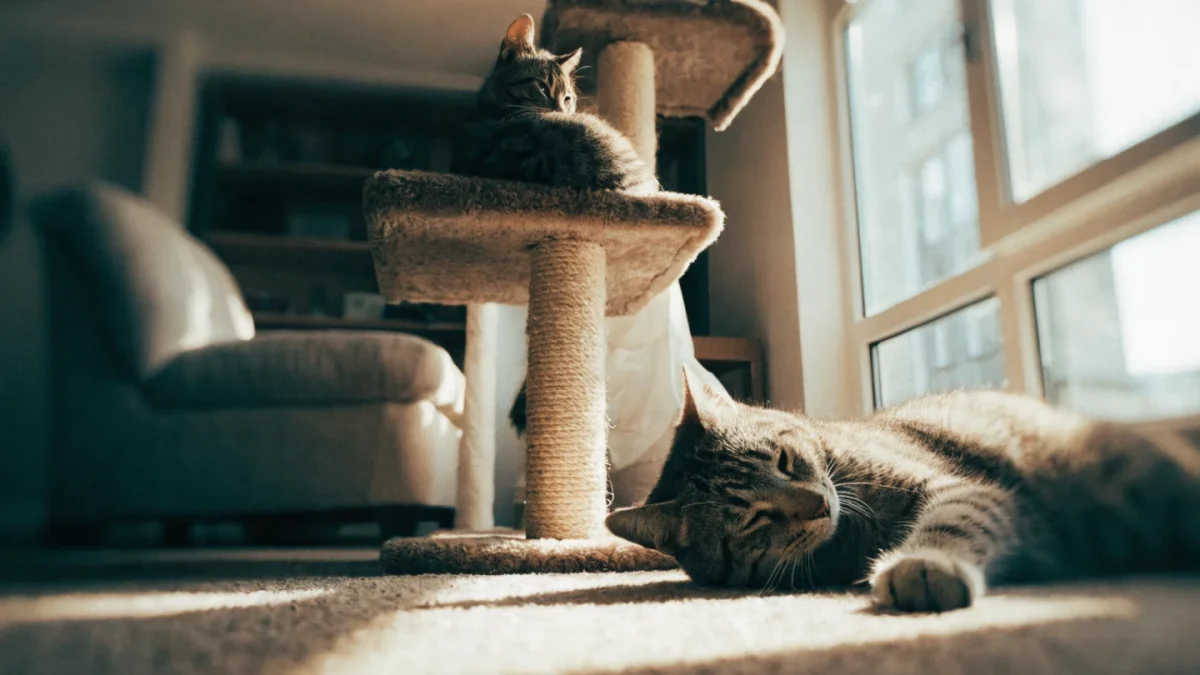
Here's what's actually going on when your cats seem to be waging a cold war over the couch: it has almost nothing to do with dominance, and everything to do with geography. For anyone wanting the full picture, living with multiple cats is where I'd start.
Cat territory hierarchy isn't a pecking order the way most people picture it. Cats don't have a CEO and an intern. What they have is a sophisticated, constantly renegotiated system of spatial ownership — one that involves time, scent, resources, and the ability to get vertical when things get tense. Once you understand the actual mechanics, a lot of multi-cat household drama starts to make a lot more sense.
The "Alpha Cat" Myth (and Why It Keeps Spreading)
Honestly, I blame the dog world for this one. The alpha model got popularized for dog behavior, then people transplanted it onto cats, and now half the internet thinks one cat is "in charge" of the others.
Cats are not pack animals. They evolved as solitary hunters. The social structures they form — even in feral colonies — are loose, fluid, and built around resource access rather than rank. There's no cat equivalent of a pack leader enforcing rules through posture and intimidation. What you actually see in multi-cat homes is something closer to uneasy neighbors negotiating shared space than a military command structure.
Some cats do seem more confident or assertive than others. My cat Mochi will absolutely stare down my other cat, Biscuit, when Biscuit wanders too close to the window seat. But that's not Mochi being the alpha — that's Mochi having claimed a specific resource and defending it. Biscuit has his own spots he's equally territorial about. Neither of them "runs" the household; they've just divided it.
How Cats Actually Map Territory
A cat's territory isn't a single space — it's a mental map of zones, each with different weight depending on how the cat uses it.
The core territory (what behaviorists sometimes call the "home base") is the spot a cat sleeps, grooms, and feels safest in. This is the area a cat will defend most aggressively. Surrounding that is a broader "home range" — the areas a cat moves through regularly but doesn't feel the same ownership over. And then there's a wider hunting or exploration zone beyond that.
In a multi-cat household, these zones overlap constantly. Cats manage the overlap in two main ways: spatial separation and time-sharing.
Spatial separation is exactly what it sounds like — one cat takes the bedroom, another takes the living room. When you notice your cats rarely occupy the same room at the same time, that's not coincidence. They've mapped the space and divided it.
Time-sharing is subtler and genuinely fascinating. Cats will use the same spot but at different times. The radiator perch might belong to Biscuit in the morning and Mochi in the afternoon. If you've ever wondered why your cats rotate through spots without incident, this is why. They're not sharing — they're scheduling.
Scent Marking as Territory Management
Scent is how cats post their "I was here" notices — and it's a lot more nuanced than most people realize.
When a cat rubs its face on furniture, doorframes, or you, that's called bunting or allomarking. It deposits scent from glands on their cheeks and forehead. This is social, affiliative scent marking — the cat equivalent of leaving a friendly note. Cats will often rub the same spots in sequence, layering their scents together in a multi-cat home. That communal scent profile actually signals group membership and can reduce tension. There's a related dynamic happening with introduce a new cat to your resident cat that's worth knowing about.
Scratching does double duty: it deposits scent from glands in the paws while also leaving a visual mark. A cat scratching a prominent piece of furniture near a contested area is essentially putting up a billboard. The height of the scratch matters — cats scratch as high as they can reach to make the mark as visible (and impressive) as possible.
Urine spraying is the escalated version, and it usually indicates a cat that feels genuinely insecure about its territory. Spraying is different from litter box elimination — it's targeted at vertical surfaces, done in small amounts, and specifically communicates territorial anxiety. When a cat starts spraying in a multi-cat home, that's a signal something has destabilized the spatial arrangement, not a sign of a "dominant" cat asserting control.
Resource Placement and Perceived Territory
Here's the real question most cat owners don't think about: how much of the conflict in your home is actually about the cats themselves, versus how the resources are arranged?
Cats are intensely aware of resource distribution. Food, water, litter boxes, resting spots, and high perches aren't just things — they're territory anchors. When all the good spots are clustered in one area, every cat has to compete for the same zone. When resources are spread throughout the home, each cat can develop its own territory cluster without constant confrontation.
The classic guidance of one litter box per cat plus one extra isn't arbitrary. It's a direct application of territory logic: multiple resource points mean multiple viable territories. The same thinking applies to feeding stations (ideally separated enough that cats can't make eye contact while eating) and resting spots.
Look, I've rearranged my apartment more than once because the cats had decided a particular hallway was a conflict zone. Moving a second water bowl to the bedroom ended a three-week standoff that no amount of intervention had resolved. Sometimes the fix is spatial, not behavioral.
Vertical Space: More Territory Without More Floor
One of the most underused tools in multi-cat households is height.
Cats don't just live in horizontal space — they think in vertical layers. The cat on the top platform of a cat tree occupies genuinely different territory than the cat on the floor, even if they're two feet apart. Height communicates confidence and provides visual access to the room. Cats that feel anxious often feel much calmer when they have an elevated option.
Adding vertical space — cat trees, wall-mounted shelves, cleared-off bookcases — effectively increases the square footage of perceived territory without changing the floor plan. I've seen two cats that couldn't share a small apartment suddenly coexist peacefully after adding a floor-to-ceiling cat tree in the living room. The confident cat took the top; the more cautious cat claimed a mid-level platform. They had what they needed.
Vertical territory also matters for conflict resolution in the moment. A cat that can get high and watch from safety is a cat that doesn't need to escalate a confrontation on the ground.
When the System Breaks Down
Multi-cat territory arrangements can destabilize. New cats, moves, changes in routine, or even a piece of furniture rearranged can scramble the established map and force cats to renegotiate.
The signs that the system is under stress: increased staring or blocking, more frequent chasing, spraying, or cats suddenly refusing to use areas they previously occupied comfortably. This isn't character failure — it's cats reacting to a genuinely disrupted territorial arrangement.
The response is almost always: add resources, add vertical space, and let them renegotiate on their own timeline. Forcing contact or punishing avoidance behavior makes things worse, not better. The cats aren't being dramatic. They're doing exactly what their instincts are designed to do — mapping and defending the space they need to feel safe.
Frequently Asked Questions
Do cats have a clear dominant cat in a multi-cat household?
Not in the way most people think. Cats don't maintain strict linear hierarchies. What looks like dominance is usually one cat having priority access to specific resources in specific locations. That "priority" can shift depending on context — a cat that holds the preferred sleeping spot may defer completely to another cat at the food bowl.
Why does my cat stare at my other cat across the room without doing anything?
Sustained eye contact is a territorial communication signal. The cat doing the staring is essentially marking the space between them as contested. The stared-at cat's response (look away and groom = backing down; hold the stare back = escalation) determines whether it becomes a confrontation. If it happens frequently, it's a sign those cats don't feel they have enough spatial separation.
Can cats learn to truly share space, or do they always need their own zones?
Cats that are bonded (raised together, or successfully introduced as kittens) will often genuinely share space — sleeping together, grooming each other, choosing proximity. Cats introduced as adults usually manage coexistence rather than companionship: they tolerate each other and develop workable spatial arrangements without becoming close. Both outcomes are normal. The goal isn't to make them best friends; it's to make the shared space feel safe for both of them.
How long does it take for cats to establish a territorial arrangement?
When a new cat is introduced, it usually takes somewhere between a few weeks and several months for a stable arrangement to emerge — the ASPCA notes it can take 8 to 12 months for cats to develop a real friendship, and some pairs take even longer. Some pairs settle quickly; others renegotiate for much longer. The process goes faster when resources are plentiful and spatial options are abundant — which is another reason to set the environment up thoughtfully before introductions begin.