

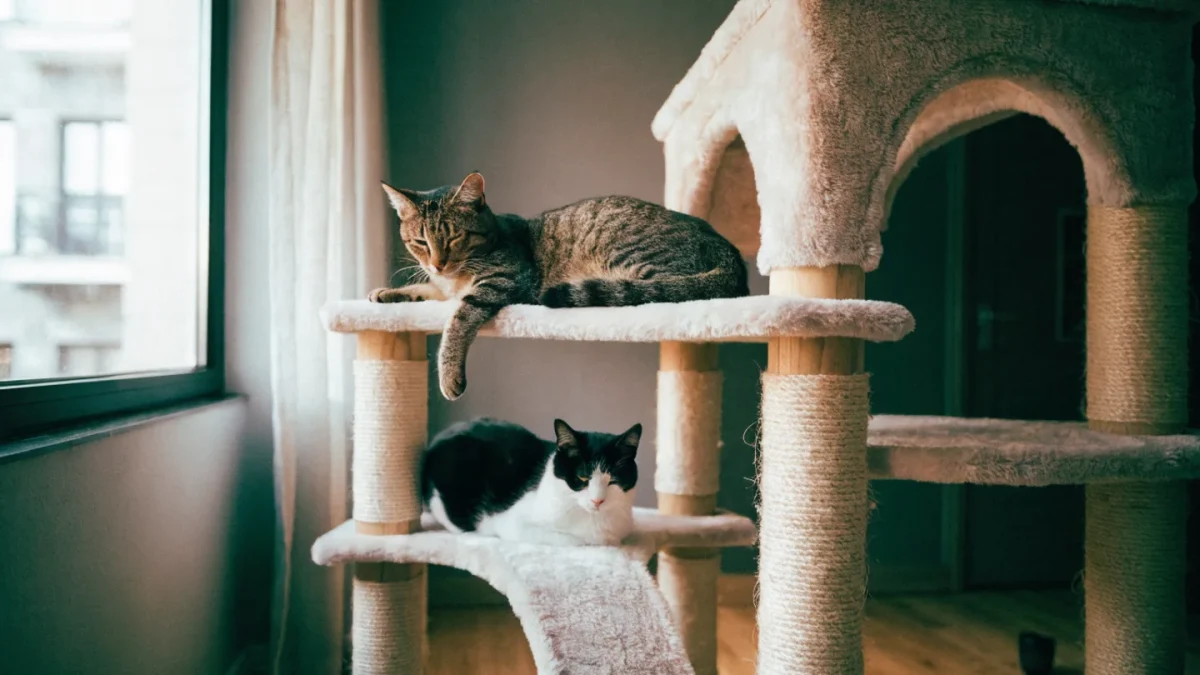
Here's what's actually going on when you bring a second (or third, or fourth) cat home and everything falls apart: your resident cat isn't being mean. They're not "bad with other cats." They're reacting exactly the way millions of years of evolution designed them to react when a stranger walks into their territory.
Cats are solitary hunters. Unlike dogs, who evolved in cooperative social groups and genuinely need companionship, cats developed as animals who hunted alone, defended their own patch, and had no biological reason to share resources with another cat. That doesn't mean they can't live together — plenty of multi-cat households are genuinely harmonious — but it does mean they need a lot more help from us to get there than most people expect.
This is the complete guide to making it work. Whether you're planning your first introduction, trying to fix ongoing conflict, or just wondering why your cats still won't sleep in the same room after two years, here's what you need to know.
Why Cats Struggle to Share Space
The solitary hunter thing isn't just theoretical — it shapes everything about how cats perceive their environment. A cat's territory isn't just the physical space. It includes the scent profile of that space, the established pathways through it, the specific resources within it (food, water, elevated resting spots, exit routes), and the temporal rhythm of who uses what and when.
When a new cat arrives, every single element of that carefully mapped world gets disrupted. The scent is wrong. The pathways feel unsafe. The resources might suddenly have a competitor. And there's no reliable signal telling the resident cat whether the stranger is a threat or not.
Honestly, the remarkable thing isn't that introductions so often go badly. It's that they ever go well.
The other piece that trips people up: cats communicate mostly in ways we can't easily see. A slow blink across the room, a tail held at a particular angle, a body posture that's 10% more tense than it was yesterday — these are meaningful signals that your cats are exchanging constantly. When humans miss them, we also miss the early warning signs that tension is building before it turns into outright conflict.
How to Introduce Cats the Right Way
This is the single most important factor in whether a multi-cat household succeeds. A rushed introduction can set up a dynamic that's genuinely hard to undo — cats form strong impressions fast, and a first meeting that goes badly becomes a template.
The Scent Introduction Phase
Before your cats ever see each other, they should know each other's smell. Keep the new cat in a separate room with the door closed for at least a week — ideally two. Slide a blanket or towel that the new cat has been sleeping on under the door. Do the same in the other direction. Feed both cats near the door so they associate the other cat's scent with something good.
When scent exchange has been going on for a few days and neither cat is actively hissing at the door or refusing to eat, you can progress.
Visual Introduction
A cracked door, a baby gate with a blanket draped partway over it, or a screen door are all good options. You want them to be able to see each other without being able to make physical contact. Keep these sessions short — five to ten minutes — and always have food or play available to keep the association positive.
Look for signs of escalating stress: dilated pupils, a tail that's puffed or thumping, ears flattening back, a crouched or rigid posture. If you see these, the session ends. No forcing it. You're not losing progress — you're just not rushing ahead faster than the cats can handle.
Free Roaming
The first full-room meeting should happen when both cats are demonstrably calm and curious rather than stressed near the door. Pick a neutral space if possible — a room neither cat "owns" — and let them do their thing without interference. Don't hold cats or force closeness. Just stay nearby, keep the energy calm, and let them set the pace.
Hissing at first contact is normal. A short, contained confrontation that ends with both cats walking away is actually fine — that's cats establishing a boundary, not declaring war. It becomes a problem if the chasing is prolonged, if one cat pins another, or if either cat becomes too scared to eat, use the litter box, or move through the house.
Territory and Resources: The Math Matters
Here's the rule that veteran multi-cat households live by: N+1. Whatever the resource is — litter boxes, food stations, water sources, beds, perches — you need at least one more than you have cats. Two cats need three litter boxes. Three cats need four food stations. This isn't overcautious. It's the structural reason most resource conflicts never happen in the first place.
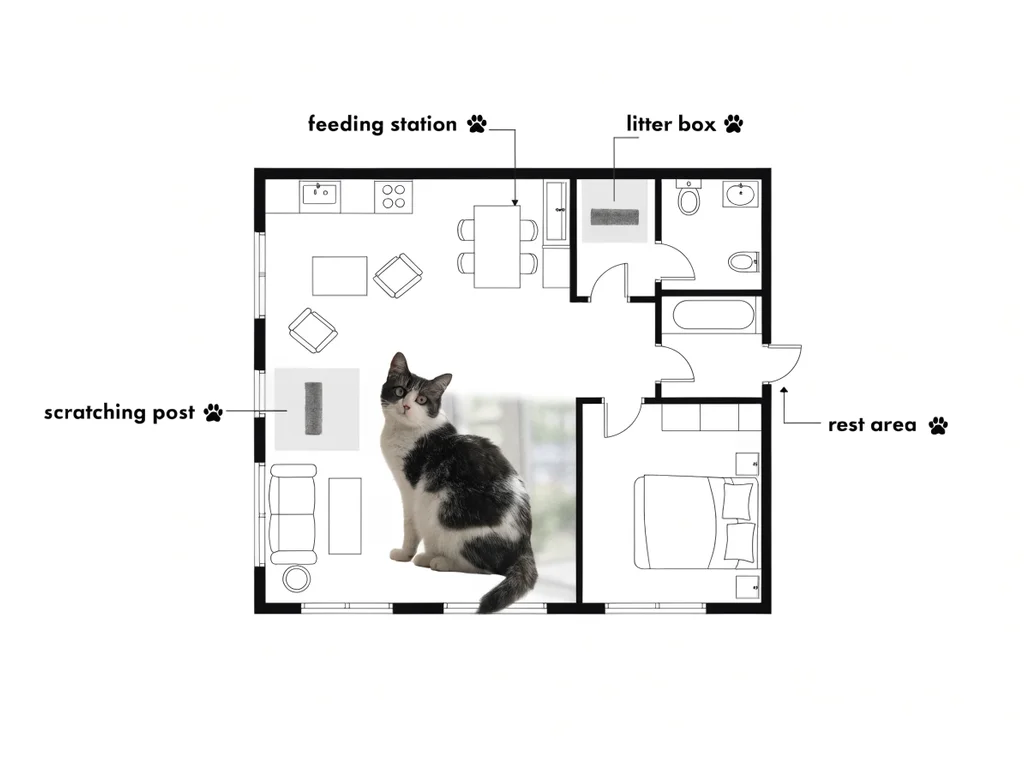
When resources are scarce, even cats who generally get along will guard them. It's not personal. It's instinct. The cat sitting in front of the water bowl and staring down the other cat isn't being a bully — they're managing a perceived scarcity. Add another water bowl across the room and the behavior often vanishes within days.
Vertical space matters just as much as square footage. A 600-square-foot apartment with good vertical real estate — tall cat trees, wall-mounted shelves at different heights, clear perching spots by windows — can comfortably house more cats than a large home with nothing but floor-level space. Elevation is safety and status for cats. The ability to get above a threatening situation, to observe from height, is genuinely calming for many cats.
Also think carefully about exit routes. A cat who can't escape an interaction — who's cornered in a hallway with another cat between them and the door — is a cat who's about to either panic or fight. Furniture placement that creates dead ends is one of those things that's easy to fix once you know to look for it.
Reading Play vs. Fighting
This is where even experienced cat owners get confused, because some of the physical moves are nearly identical. Rough wrestling, chasing, pouncing — these can be play or they can be real conflict, and the behavioral cues that distinguish them are subtle.
Signs it's play:
- Both cats take turns being "it" — chasing happens in both directions
- Claws are mostly retracted
- No vocalizations, or only soft chirping/trilling
- Either cat can disengage and the other doesn't pursue
- After it ends, both cats groom themselves calmly or resume normal activity
Signs it's real fighting:
- One cat is consistently the aggressor; the other is always trying to escape
- Claws out, biting at the neck or back of the head
- Hissing, growling, screaming
- One cat is hiding more than usual, refusing food, or seems afraid to move through the house
- Either cat has scratches or bite wounds
The ambiguous middle ground — one cat who's a little too intense, play that the other cat seems to tolerate but not enjoy — is worth paying attention to. Cats rarely signal distress loudly. A cat who's quietly miserable in your home might just look like a cat who "prefers to be alone." Regularly check whether each cat in the household has private access to food, water, and a litter box without having to run a gauntlet.
Understanding reading your cats' body language in depth is genuinely one of the most useful skills you can develop in a multi-cat home — small postural signals tell you a lot about how each cat is really doing.
Feeding Without Conflict
Food is one of the most reliable flashpoints in multi-cat households, and it's almost always entirely preventable.
Feed cats in separate locations. Not just separate bowls side by side — actual physical separation, different rooms if possible, or at minimum opposite corners of a large room where they can't see each other while eating. This matters even in households where the cats generally get along. Eating is a vulnerable moment, and the presence of another cat can create low-level stress that accumulates over time.
Timed feeders can help enormously, especially if you have cats with different paces. The slow eater who's being hovered over by a faster one — or the cat who grazes through the day and leaves food out for the food-protective one to guard — benefits from having their own station that opens and closes independently.
If you free-feed dry food, know that the dominant cat in the household often controls access to the food station in ways that are hard to see. The cat who always seems less interested in eating might actually be getting pushed out. Moving to scheduled meals makes this visible and fixable.
Water bowls and the food bowl should never be right next to each other. Cats instinctively avoid water that's near their food — this is a holdover from the wild, where a dead prey animal would contaminate nearby water. Multiple water sources around the house, away from food, gets everyone drinking more and removes another potential conflict point.
Setting Up Separate Zones
The goal isn't to have cats who share every space — it's to have cats who can share a home without constant stress. Those are very different targets.
My three cats (Miso, Pebble, and the newest addition, Remy) each have what I'd call a "home base" — a room or area that's more theirs than anyone else's. Miso has the bedroom. Pebble has claimed the living room couch. Remy, still somewhat new, has the spare room and the window seat in the hallway. They overlap constantly — Pebble absolutely walks through the bedroom whenever she wants — but they each have somewhere to decompress that feels like theirs.
You can create this intentionally by placing a preferred bed, a cat tree, or a particularly good bird-watching window in each cat's preferred area. Scent matters here too: cats who have rubbed their faces on surfaces in an area — who have literally marked it with their scent glands — feel more secure there. Don't aggressively clean those marks away.
Litter box placement should prioritize privacy and multiple routes in/out. A litter box in a corner where another cat can sit in the entrance and essentially block access is a setup for avoidance issues. Covered boxes sound like they'd give more privacy, but if a cat can be ambushed while exiting, the cover actually makes things worse. Open boxes in locations where a cat can see someone approaching give a better escape option.
How you design and enrich your home — the placement of vertical space, hiding spots, and activity zones — has a measurable effect on stress and conflict levels in multi-cat households. It's worth thinking about this as deliberately as you would think about the introduction process.
Bonded Pairs: When Cats Actually Choose Each Other
Here's the thing that surprises people new to multi-cat households: some cats genuinely become close. Not just tolerant of each other — actually bonded, in the way we usually think of with dogs.
Bonded pairs groom each other without being prompted. They sleep touching. They follow each other around. They get anxious when separated. Miso and Pebble became this way after about a year, and I did nothing special to make it happen — I just managed the environment well enough that they had time and space to decide they liked each other.
Kittens socialized together from an early age are more likely to bond. Adult cats who are introduced when young (under two years) have a better chance than older adults. Two cats with complementary temperaments — one mellow, one playful — often do better than two high-energy cats competing for the same play resources.
Look, you can't force bonding. What you can do is reduce the stressors that prevent it. When cats aren't competing for resources, aren't afraid of ambushes, and feel secure in their environment, they have the mental bandwidth to explore each other with curiosity instead of defensiveness. Bonding, when it happens, usually emerges naturally from that foundation.
Signs Your Cats Are Getting Along
These are the positive signals that multi-cat households — especially new ones — should be watching for:
Allogrooming (mutual grooming): One cat grooming another, especially on the head and face. This is one of the clearest signs of affiliation between cats.
Allorubbing: Cats rubbing their faces or bodies against each other. This deposits scent and signals trust.
Sleeping in proximity: Cats who nap near each other, even if not touching, are comfortable sharing space. Cats who are in actual contact are expressing something closer to affection.
Parallel play: Chasing and wrestling where both cats are having fun, with turn-taking and no one hiding afterward.
Relaxed body language in shared spaces: Loose posture, soft eyes, tail held neutrally — cats who aren't stressed in each other's presence just look relaxed in a way that's recognizable once you know what you're looking for.
The absence of these signals doesn't mean your cats are miserable. Some cats just coexist quietly and professionally — they're not bonded but they're not stressed. That's a perfectly fine outcome. The red flags are the ones I mentioned earlier: hiding, food avoidance, litter box avoidance, one cat consistently blocking another.
When to Seek Help
Most multi-cat tension is manageable with environmental adjustments and patience. But some situations warrant professional input.
A cat behaviorist (look for someone with accreditation from a reputable certifying body) can help when conflict escalates despite a thorough introduction process, when one cat is consistently being victimized, or when you're seeing signs of redirected aggression — a cat lashing out at you or other pets after becoming aroused by something outside (like a strange cat visible through the window).
Your vet is the right first call if the conflict involves a sudden change in behavior from a cat who was previously social. Pain, illness, and hormonal changes can all make cats more reactive. A cat who suddenly becomes aggressive toward a housemate they've lived with peacefully for years should be seen medically before you assume it's a behavioral problem.
Honestly, some cats genuinely cannot live together without chronic stress, no matter how well-managed the environment is. That's hard to accept when you love all of them. But a cat living in constant low-level fear or anxiety — even in a "managed" situation — has a quality of life problem, and it's worth taking that seriously rather than indefinitely hoping things will improve.
The good news is that the vast majority of multi-cat households can work. Cats are more adaptable than their solitary-hunter reputation suggests. They just need us to do the setup work rather than assuming they'll figure it out on their own.
FAQ
How long does it take cats to get used to each other?
It varies a lot — anywhere from a few weeks to six months or more. A careful introduction that moves at the cats' pace tends to produce better long-term relationships than rushed introductions, even if the patient approach takes longer. Most cats reach a stable coexistence (if not full bonding) within two to three months when the environment is set up well.
Can cats who started out fighting eventually become friends?
Sometimes, yes. Early fighting that stemmed from a rushed introduction can often be improved by going back to basics — separating and reintroducing through scent exchange before visual contact. Cats who have had months of negative association are harder to reset, but it's not impossible with time and environmental management.
Is it better to get two kittens at the same time than to add a cat later?
Getting two kittens together is often easier than adding an adult to a resident cat, because neither has established territory yet and they tend to be socialized together naturally. The downside is that two kittens are genuinely chaotic, and some single adult cats do fine with a kitten added later if the introduction is careful.
Should I let my cats "work it out" on their own?
For low-level hissing and posturing? Usually fine to observe. For active chasing, cornering, or fighting that leaves injuries? No — intervening (by separating and slowing down the introduction) is kinder than waiting it out. Cats don't typically "work out" serious conflict the way some other animals do.
How do I know if my multi-cat household is actually stressful for my cats?
Watch for the subtle signs: changes in litter box habits, a cat eating less than usual, a cat spending more time hidden, or a cat who seems to be constantly monitoring where another cat is. Happy cats in multi-cat households look loose and easy in shared spaces, not tense and watchful.
Do cats need to be friends, or is tolerating each other enough?
Tolerating each other, in a home with enough resources and space that no one is chronically stressed, is genuinely enough. Plenty of multi-cat households run smoothly on polite coexistence rather than affection. What matters is that all cats can meet their basic needs — food, water, litter, rest — without constant competition or anxiety.