

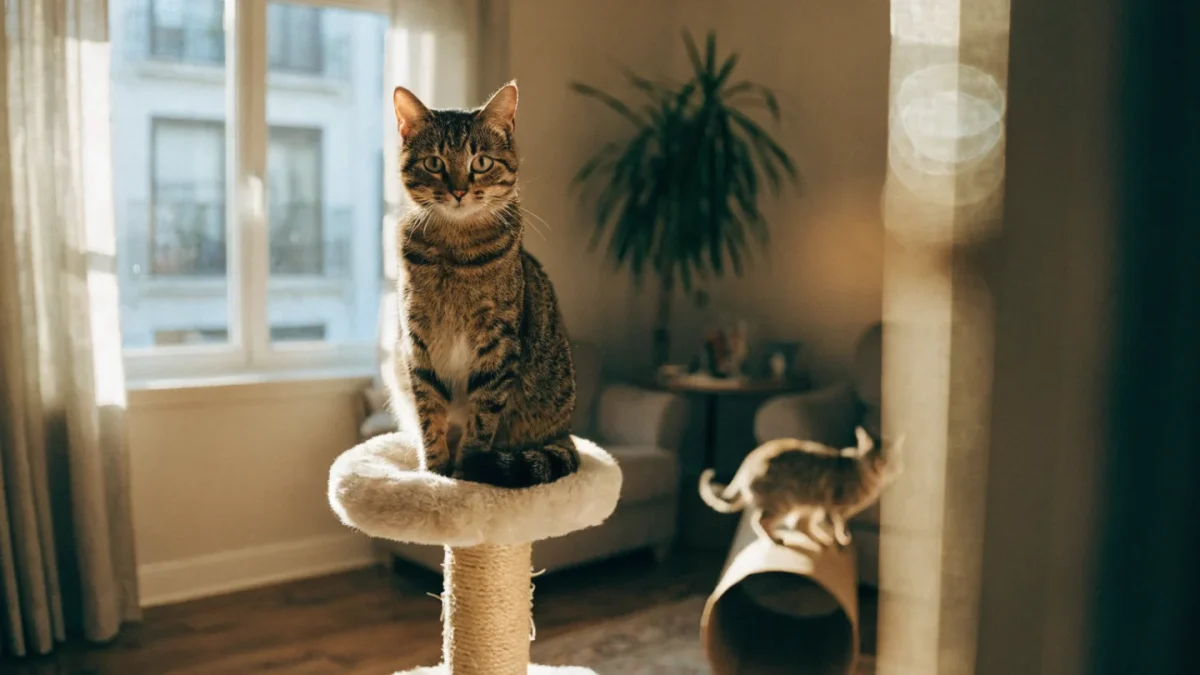
Here's what's actually going on when your cat knocks things off shelves at 2am, ignores the expensive toy you bought, or stares at the wall like there's something only she can see: she's bored. Not in a lazy, nothing-to-do way. In a deeply frustrated, my-brain-has-nothing-to-work-on way.
Indoor cats live in an environment that's safe but often — let's be honest — pretty unstimulating. No territory to patrol. No prey to track. No new smells rolling in on the breeze. Their nervous systems are wired for a life that involves a lot of sensory input and physical problem-solving, and most homes don't deliver that by default.
The best cat enrichment ideas give indoor cats outlets for their natural instincts: climbing, hunting, hiding, and exploring. A well-enriched home includes vertical space, puzzle feeders, window access, hiding spots, and regular interactive play — all adapted to your cat's personality and your living space. You don't need a huge house or a lot of money. You need to think like a cat.
My two cats, Miso and Fig, have been my real-world test subjects for years. What works for Miso (anxious, food-motivated, loves high perches) often bores Fig completely (confident, play-obsessed, prefers ground-level hunting games). A good enrichment setup accounts for individual cat personality — which is why this guide covers the full range, not just a checklist.
Why Cat Enrichment Matters More Than You Think
A bored cat doesn't just get restless. Over time, chronic under-stimulation contributes to real behavioral problems: litter box avoidance, aggression, over-grooming, stress-related illness, and weight gain — a finding backed by research published in the Journal of Feline Medicine and Surgery, which identified lack of environmental enrichment as a primary driver of stress-related behavioral disorders in indoor cats.
That's not a guilt trip — it's context. Understanding why enrichment matters makes it easier to prioritize the right things instead of buying a pile of toys your cat ignores for the rest of their life.
Cats are obligate hunters. Their brains are built around a predatory sequence: search → stalk → chase → catch → kill → eat. In the wild, a cat might go through this cycle a dozen times a day. Inside your apartment, that sequence gets interrupted at every step unless you deliberately create opportunities for it. A puzzle feeder that makes them work for kibble? That's the "hunt" part. A wand toy session before dinner? The chase. A window perch with bird activity outside? The search.
Enrichment isn't about entertaining your cat. It's about giving their brain and body the inputs they're biologically expecting.
Vertical Space: The Single Biggest Change You Can Make
If you only do one thing, do this. Cats are vertical creatures. Height equals safety, confidence, and territory in their world. A cat with access to elevated positions is a cat who can survey their domain, escape stressful situations, and feel genuinely secure.
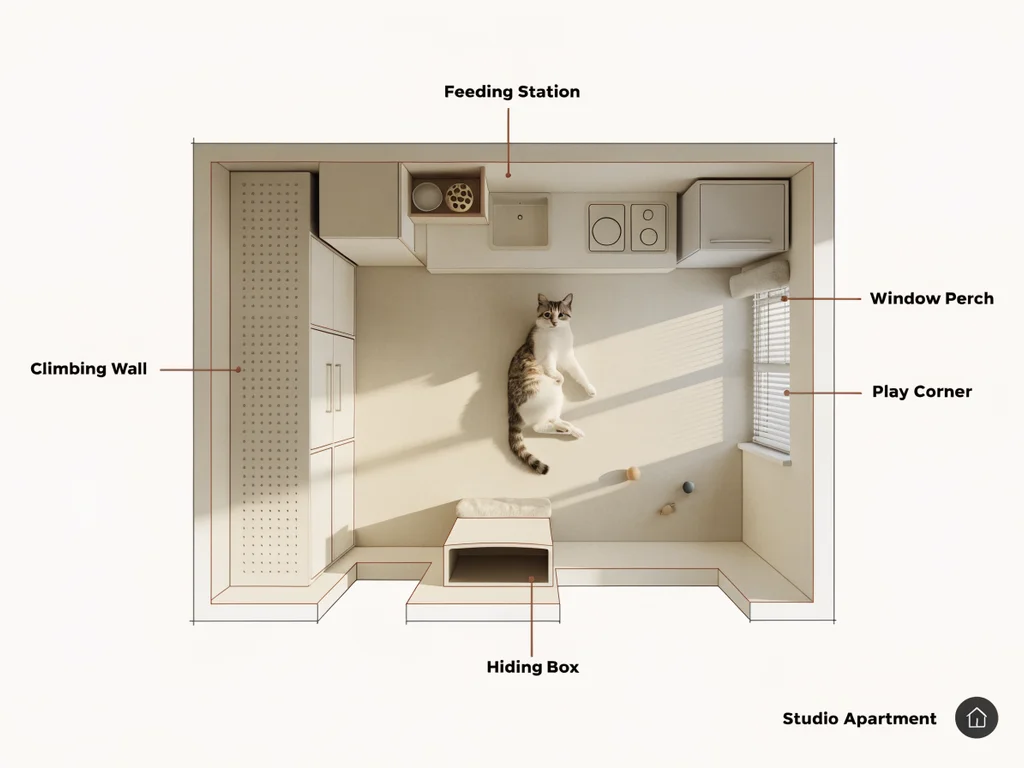
Most homes are set up entirely for humans — furniture at human height, walls full of stuff at human eye level, floor space only. From a cat's perspective, that's a flat, one-dimensional world with nowhere to go when things get overwhelming.
Cat Trees and Climbing Structures
A good cat tree isn't just a scratching post with a platform bolted on top. Look for:
- Stability. A wobbly cat tree that shifts when a cat jumps will never be used. Heavy base, wide footprint, ideally wall-anchored.
- Height. Ceiling-height or close to it. A tall cat tree positioned near a window is one of the best enrichment investments you can make.
- Multiple levels with varied surfaces. Flat platforms, enclosed cubbies, angled perches — variety matters.
- Location. Next to a window, in a room where the family spends time, not shoved in a corner of the spare bedroom.
If your cat isn't using the cat tree you already own, check those four factors before assuming they don't want vertical space. Miso ignored our first tree for six months before I moved it next to the living room window. She spent the entire next afternoon up there.
Cat Shelves and Wall-Mounted Walkways
Cat shelves — wall-mounted perches that form a pathway around the room — are brilliant for cats who want to move between spaces without touching the ground. They're also genuinely cool looking, and they use wall space that's otherwise just… wall.
You can buy purpose-made cat shelves in modular systems, or repurpose sturdy wooden shelves with non-slip surfaces. Space them so your cat can step comfortably between them — roughly 12–18 inches of vertical spacing between shelves for most cats, up to 24 inches for younger, more athletic cats. Wider gaps create hesitation; cats need each jump to feel manageable.
Start simple: two or three shelves in one room, positioned near furniture so your cat can get on and off without a big leap. Once they're using them, expand.
Puzzle Feeders and Food-Based Enrichment
The predatory sequence ends with eating. When cats get all their food in a bowl twice a day with zero effort, they miss out on most of what makes mealtime meaningful.
Puzzle feeders — any container that requires the cat to work to get food out — tap into the hunt-and-earn instinct. Most cats take to them quickly once they understand there's food involved. Start with something easy (a flat snuffle mat or a simple ball feeder) and only increase difficulty when your cat seems bored with the current challenge.
Types to Try
Scatter feeding: The simplest option. Instead of a bowl, scatter dry kibble on a litter mat, snuffle mat, or even a towel. The cat has to sniff and forage. Zero cost, immediate impact.
Rolling ball feeders: Cats bat or push a ball, kibble falls out through holes. Great for food-motivated cats who haven't encountered puzzles before.
Multi-chamber puzzles: Trays with sliding covers, hidden compartments, and varying difficulty levels. These are best for cats who've already mastered simpler feeders.
Licki mats: Flat mats with textured surfaces where you spread wet food, pâté, or pureed treats. The licking action is calming as well as stimulating. Miso is obsessed with hers.
Slow feeders: Bowls with raised patterns that force cats to eat around obstacles. Good if you have a cat who wolfs food too fast.
Honestly, you don't need to buy anything to start. A muffin tin with kibble pressed under tennis balls is a perfectly legitimate puzzle feeder.
One note: if your cat has been free-fed their whole life, transitioning to puzzle feeders requires a gradual adjustment. Don't suddenly make food hard to access for a cat who isn't used to working for it.
Hiding Spots and Private Space
Cats need to hide. Not because they're antisocial — because feeling able to disappear is the foundation of feline emotional security. A cat who has no hiding option in a stressful moment is a cat stuck in high alert.
Hiding spots are not the same as sleeping spots, though they can overlap. A hiding spot is specifically a place where a cat can be enclosed, invisible or nearly so, and uninterrupted. Enclosed box, paper bag with the handles removed, covered cat bed, space under a bed — all qualify.
Every room your cat spends time in should have at least one viable hiding option. This matters especially in multi-cat households, where social pressure between cats can build invisibly until someone explodes.
Fig has claimed the space under our coffee table as her primary hideout. It's three inches of clearance. She fits. She goes there when the doorbell rings or when Miso is having a territorial moment. It does its job perfectly.
What Makes a Good Hiding Spot
- Enclosed on at least three sides — cats prefer to have their back protected
- Sized appropriately — snug enough to feel secure, not so tight it's stressful
- Elevated options too — some cats prefer to hide up high, combining vertical safety with concealment
- Positioned away from high-traffic paths — a hiding spot next to the front door isn't restful
- Multiple locations — so a cat can retreat without having to cross another cat's territory to get there
You can buy purpose-made cat caves, or just leave a cardboard box on its side. Cardboard boxes are genuinely one of the best cat enrichment tools in existence, and they cost nothing.
Window Perches and the Outside World
A window is a television, a newspaper, and a nature documentary all in one for an indoor cat. Bird feeders, squirrels, leaves blowing across the yard, rain, neighborhood activity — all of it provides the kind of visual and auditory stimulation a cat's brain was designed to process.
Window perches need to be secure and comfortable. A perch that wobbles or sits too low to actually see out of will go unused. Look for:
- Height that positions the cat at window level — they should be able to look out, not just at the window
- Solid suction cups or a bracket mount — lightweight suction cup perches are fine for small cats; larger cats need something more substantial
- Comfortable surface — fleece, carpet, or padded surfaces work; slippery surfaces do not
If your windows don't have much going on outside, you can add interest: a bird feeder, a small water feature, or even a window box with herbs can dramatically increase the entertainment value.
For apartments with no outdoor access, a window perch might be the closest your cat gets to outside. Make it count. Miso spends a minimum of two hours every morning at the living room window. Some days I think she's more informed about what's happening on our street than I am.
Scratching as Enrichment
Scratching is one of the most important forms of feline enrichment — not just nail maintenance, not just property destruction, but a core behavioral need that covers territorial marking, stress relief, and full-body stretching. Why cats scratch and how to redirect it covers this in full.
The enrichment angle on scratching is often missed. When cats scratch in visible, high-traffic locations (the corner of your couch, the doorframe), they're doing territorial work — leaving visual and scent marks where they'll be noticed. That's not random rudeness. That's communication.
For scratching to genuinely enrich your cat's life, you need:
- The right surfaces — most cats have a material preference (sisal, carpet, cardboard, wood — they vary)
- The right orientation — some cats scratch vertically (tall posts), some horizontally (flat pads); observe your cat
- The right locations — near sleeping areas, near entrances, in rooms where the cat spends time; not hidden in corners
- Adequate height for vertical scratchers — a post that doesn't let your cat fully stretch isn't meeting the need
This is one area where location matters as much as the object itself. A great scratching post shoved in an unused hallway will be ignored. A mediocre cardboard pad placed next to the couch gets used constantly because it's in the right territory.
Interactive Play: You Are Part of the Enrichment Setup
No passive enrichment fully replaces interactive play with a human. The social, unpredictable, alive quality of a wand toy session is something a puzzle feeder or window perch can't replicate. Cats who get daily interactive play tend to be calmer, more social, and less prone to attention-seeking behaviors.
The key word is interactive. You're not dangling a toy while scrolling your phone. You're simulating prey behavior — moving the toy like something alive, pausing to let the cat stalk, dragging it along the floor, making it disappear and reappear. There's a whole article on play and hunting instincts that gets into the weeds on this.
How to Run a Good Play Session
Length: 10-15 minutes is usually enough for most adult cats, once or twice a day. Kittens need more. Senior cats may want shorter, gentler sessions.
Timing: Before meals is ideal — it mirrors the hunt → eat sequence. A cat who plays hard before dinner tends to be more relaxed afterward.
Ending the session: Let the cat catch the toy several times and "kill" it. This completes the predatory sequence. A play session that ends with the cat never catching anything can leave them frustrated and revved up instead of satisfied. End with a small treat or meal to signal success.
Toy variety: Wand toys, crinkle balls, mice, tunnels — different toys target different prey instincts. Rotate them so novelty stays high. Toys that have been out for weeks lose their interest value.
Fig's favorite is a simple feather wand. Miso couldn't care less about feathers — she's a crinkle ball cat. Knowing this saves a lot of money on toys they'll never touch.
Scent Enrichment: The Underrated Category
Cats process the world largely through smell. Their olfactory system is dramatically more sophisticated than ours, and scent enrichment — giving them new smells to investigate — is one of the easiest, cheapest enrichment tools that most people never think about.
Practical scent enrichment ideas
Herb exploration: Catnip (research published in BMC Veterinary Research found that roughly 50–70% of domestic cats show a behavioral response — it's genetic, so if your cat doesn't react, they're just not wired for it), silver vine, valerian root, and certain mints produce strong responses in some cats. Grow a small pot of cat grass or catnip near a sunny window.
Novel materials: A pine cone, a stick from outside, a handful of dried leaves in a paper bag, a worn piece of clothing from a friend who has pets — all of these introduce complex scent profiles your cat has never encountered. Watch how thoroughly they investigate them.
Rotation of sleeping spots: Moving a favorite blanket to a new location creates a new scent exploration opportunity.
Hiding food by smell: Slightly warming wet food or treats increases scent intensity, prompting more active hunting behavior.
The real question with scent enrichment isn't whether it works — it obviously does, watch any cat investigate a bag brought in from outside — but whether you're providing enough variety. Most indoor cats live in a very scent-stable environment. Everything smells exactly the same every day. Adding even one novel scent per week makes a measurable difference.
Enrichment in Small Apartments
Look, not everyone has a sprawling house with room for floor-to-ceiling cat trees and a dedicated cat room. Most people live in apartments, and a lot of cat enrichment advice assumes infinite space and no rental restrictions. Here's what actually works in small spaces.
Go vertical aggressively. Small floor space makes vertical space more important, not less. A tall cat tree in the corner, cat shelves along one wall, the top of the refrigerator made accessible — height is free real estate when floor space is limited.
Multi-function furniture. Cat furniture that doubles as a side table or TV stand takes up the same footprint as regular furniture but adds cat functionality. There are some genuinely well-designed options that look good in small apartments.
Rotate toys aggressively. In a small space, novelty wears off faster. Keep most toys in a box and rotate three or four at a time. Something that's been "away" for three weeks feels new again.
Window access is non-negotiable. In a small apartment, the window is often the primary source of environmental variety. A good window perch positioned at an active window is worth more square footage than most other enrichment additions.
Use vertical height for hiding too. High perches with enclosed backs function as both climbing territory and hiding space — a two-for-one in tight quarters.
I spent three years in a 550-square-foot apartment with both cats. The things that made the biggest difference: two tall cat trees by windows, a rotating toy basket, daily play sessions, and a cardboard box that I replaced every few weeks. That's it.
Signs Your Cat Isn't Getting Enough Enrichment
Cats don't tell you directly. But they do show you, if you know what to look for.
Attention-seeking that escalates. Yowling, pawing at you, knocking things over repeatedly. These are often frustration behaviors from a cat whose needs aren't being met.
Aggression that seems to come from nowhere. Redirected aggression — attacking your feet, ambushing other pets — often spikes when a cat is understimulated and revved up.
Over-grooming. Excessive licking or barbering (pulling out fur) can be a stress response — veterinary behaviorists recognize this as psychogenic alopecia, a compulsive disorder triggered by anxiety, under-stimulation, or environmental change. Enrichment is part of the standard treatment protocol because it gives cats something other than their own coat to engage with.
Weight gain and lethargy. An under-enriched indoor cat often becomes sedentary. This feeds into health problems that compound over time.
Inappropriate elimination. A cat who suddenly starts going outside the litter box, particularly in unusual locations, may be expressing stress — researchers found in a 2011 study that even routine disruptions triggered elimination outside the box in otherwise healthy cats. Once medical causes are ruled out, environmental stress (including under-enrichment) is the first place to look.
Obsessive or repetitive behaviors. Pacing the same path, fixating on windows or doors, excessive vocalization at night. These are all signs of a cat whose brain is looking for stimulation and not finding it.
If you're seeing several of these, don't panic — and don't assume it's a personality or health issue before you've evaluated the enrichment environment. A lot of "behavioral problems" resolve substantially once cats have appropriate outlets.
Building an Enrichment Routine
The most effective enrichment setups aren't just about stuff — they're about structure. A consistent daily rhythm gives cats a sense of predictability and control, which itself reduces stress.
A simple enrichment routine looks like this:
- Morning: Puzzle feeder for breakfast (or scatter feeding). Check the bird feeder outside the window perch.
- Midday: Rotate a toy or add a novel scent item. Leave a new cardboard box out if you have one.
- Evening: Interactive play session (10-15 minutes) before dinner. Wet food reward to close the predatory sequence.
- Ongoing: Fresh hiding spots available, vertical access maintained, scratching posts in active locations.
You don't have to do all of this every single day. Some of it — the environmental setup — just needs to exist. The parts that require you are the interactive play (daily is ideal) and the novelty rotation (a few times a week is plenty).
Honestly, the biggest shift is just starting to think about your home from your cat's perspective. Not what's convenient for you, but what the environment is offering your cat to do, explore, climb, hunt, and hide. Once you see it that way, you'll notice gaps you didn't before — and filling them is usually simpler than it looks.
FAQ
How many cat trees does one cat need?
One well-positioned cat tree near an active window covers most cats' vertical space needs. If you have multiple cats or a large home, two trees in different rooms helps prevent resource competition. The quality and placement matter more than the number — a tall, stable tree in a good location beats three flimsy ones in the wrong spots.
My cat ignores all the enrichment I've bought. What am I doing wrong?
Usually it's placement or timing, not the objects themselves. Cats need enrichment items to be in places they already spend time, not tucked away. They also need introduction — a new puzzle feeder dropped on the floor cold gets ignored; the same feeder introduced with a treat inside gets investigated immediately. Try moving existing items to higher-traffic areas before buying anything new.
Is enrichment different for senior cats?
Yes. Senior cats often have reduced mobility and energy, so the emphasis shifts toward lower-effort enrichment: window perches they can access without big jumps, puzzle feeders with easy difficulty levels, scent enrichment, and shorter play sessions with less intense movement. Mental stimulation stays important even as physical activity decreases.
Can I enrich my cat's environment if I'm away from home all day?
Absolutely. Passive enrichment — puzzle feeders, window perches, hiding spots, cat trees, rotated toys — works without your involvement. The one thing you can't replace passively is interactive play, but a good 15-minute session in the morning and another in the evening goes a long way. If you're gone for very long hours regularly, a second cat can provide significant social enrichment, though introductions need to be done carefully.
How do I know which enrichment my specific cat will respond to?
Watch what your cat does with their time right now. A cat who gravitates toward high spots wants vertical space. A cat who bats at things wants hunting games. A cat who hides wants more enclosed retreats. Their current behavior tells you exactly which instincts are active and unsatisfied — enrichment just gives those instincts a proper outlet.