

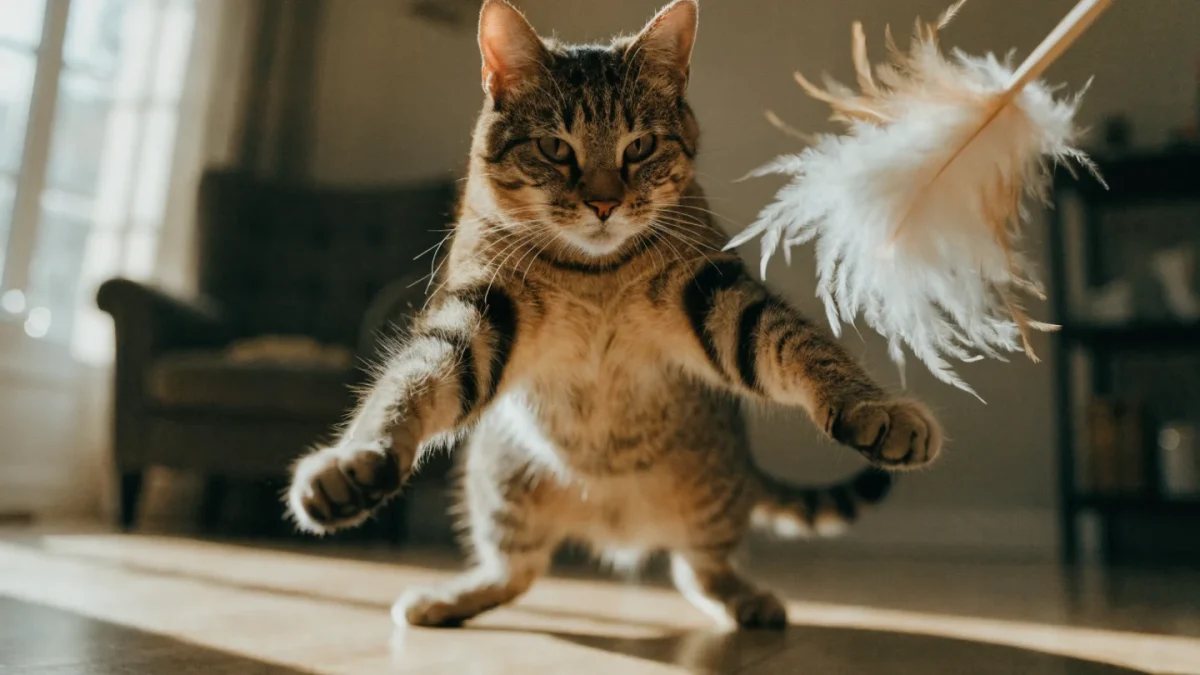
Here's what's actually going on when your cat crouches behind the couch leg, tail twitching, pupils blown wide, laser-focused on a dust bunny: they're hunting. Or rather, they're doing the closest thing their indoor life offers to it. That slow, deliberate stalk followed by an explosive pounce isn't random silliness — it's a hard-wired behavioral sequence that evolution spent millions of years perfecting.
Cat play and hunting instincts aren't two separate things. They're the same thing. Play is how cats keep that sequence sharp, burn off the arousal that accumulates when their environment doesn't give them enough real stimulation, and quite honestly — stay sane.
My cat Miso used to do this thing where he'd stare at a spot on the wall for twenty solid minutes before launching himself at it. I spent a while thinking something was wrong with him before I understood the reality: he was doing exactly what cats do. He was hunting.
Why Cats Never Stopped Being Hunters
Domestic cats have been living alongside humans for somewhere around 10,000 years, but that's a blink in evolutionary terms. Their predatory wiring hasn't meaningfully changed. A barn cat and your apartment cat sitting on a heated blanket share identical neurobiology when it comes to prey drive.
Cats are obligate carnivores and solitary hunters. Unlike dogs, which evolved to hunt cooperatively in packs, cats hunted alone. That means every skill in the hunting sequence had to be self-sufficient — no backup, no second chances, no teammates to compensate for a missed strike. The precision required is extraordinary, and the brain had to develop accordingly.
What this means practically: the urge to stalk, chase, grab, and bite isn't something cats can just choose not to feel. It's a physiological drive with real neurochemical underpinnings — dopamine, in particular, plays a central role. Neuroscientist Jaak Panksepp's research on the mammalian SEEKING system showed that dopamine-driven circuits activate the appetitive, hunting-oriented phase of predatory behavior, and these circuits are conserved across mammals including cats. When a cat spots prey-like movement, a cascade of arousal fires up automatically. That arousal needs somewhere to go.
An indoor cat with nothing to hunt doesn't lose that drive. They just have nowhere to put it.
The Hunt Sequence: What Your Cat Is Actually Doing
Understanding the hunting sequence is genuinely one of the most useful things you can learn about cat behavior, because it explains so much about how and why to play with them. The sequence has six distinct phases, and cats — unlike dogs playing fetch — want to run through most or all of them.
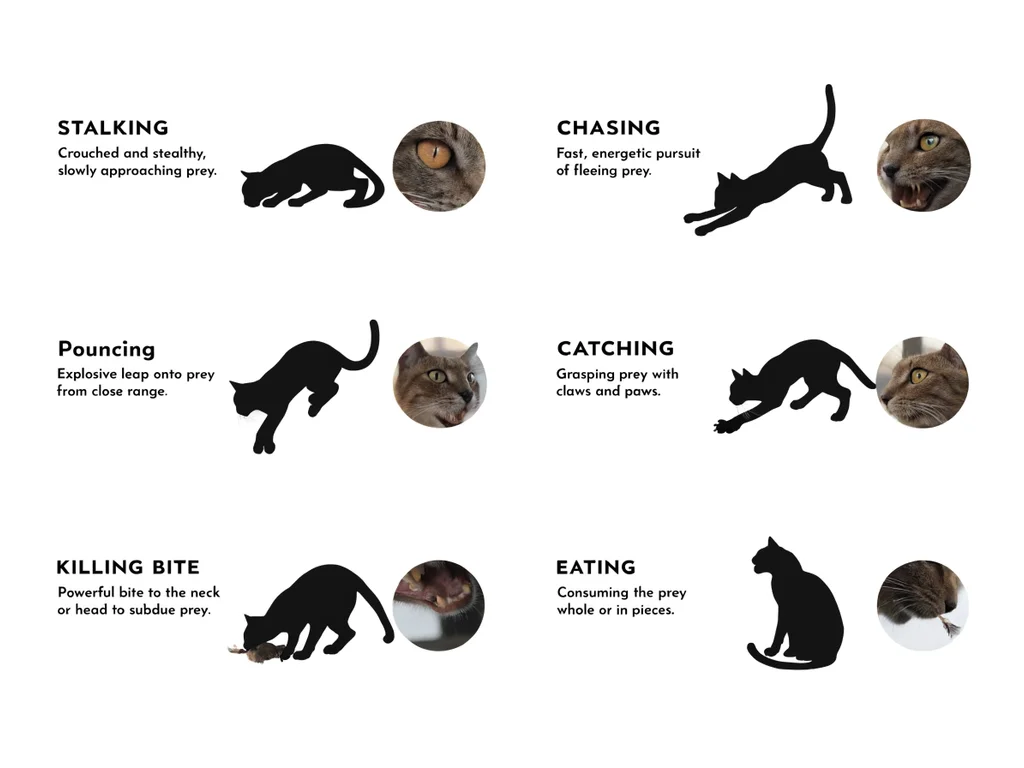
Stalk. The cat freezes, crouches low, and fixes on the target. Pupils dilate. Weight shifts to hindquarters. This phase can last a surprisingly long time — cats are patient hunters who will wait for the optimal moment rather than rush in. If you notice your cat doing that slow-motion crawl across the floor toward a toy, you're watching the stalk.
Chase. The pursuit. Short, explosive bursts of speed, usually with direction changes. Cats aren't endurance runners — they're sprinters. A chase that goes on too long without a catch becomes frustrating, not fun.
Pounce. The commitment strike. Both front paws leave the ground, often with the body fully extended. This is one of the most athletic moments in a cat's repertoire, and it's genuinely impressive to watch when they really get into it.
Catch. Front paws grab the prey and pull it in. Claws extend, sometimes followed by the classic "rabbit kick" — hind legs pumping rapidly against the held object. This is not aggression toward you, even if it's your hand. It's a specific motor pattern that's as automatic as a knee-jerk reflex.
Kill bite. A quick, precise bite to the back of the neck or head. Cats doing this to toys will often bite down and hold briefly. It's instinct — you'll notice a cat pause mid-play to do this before resuming.
Eat. Or in the case of play, often just a moment of stillness. This post-hunt calm is neurologically significant. It's the completion of the circuit, and cats who never get to "finish" — who play without ever catching anything — can stay in a state of low-grade frustration.
This last point is worth sitting with. A lot of indoor cats have plenty of opportunity to stalk and chase (laser pointers, flicking toys), but never get to complete the sequence with a catch and a kill bite. Over time, that incomplete loop contributes to chronic frustration and overstimulation. More on this later.
Types of Play — and Why They're Not All Equal
Not all play satisfies the prey drive equally, and cats generally need a mix of types to stay genuinely enriched.
Interactive play is the gold standard. This is you with a wand toy, moving something in prey-like patterns for your cat to hunt. The unpredictability — the thing moving in ways they can't fully predict — engages the full predatory sequence in a way that static toys simply can't. Miso goes completely feral for a good wand session in a way he never does with anything he can bat around on his own. There's something about the target moving like it's trying to escape that trips the full hunt response.
The key to good interactive play is mimicking real prey behavior: move the toy away from the cat, not toward them (prey doesn't run at predators). Let it hide behind objects and peek out. Let it "freeze" occasionally. Give your cat a chance to stalk before you start moving it. And crucially — let them catch it regularly, do the kill bite, and hold it. Ending a session by letting the cat "win" matters for that circuit completion we talked about.
Solo play with toys has value, but most cats lose interest in static toys quickly because those toys don't behave like prey. Puzzle feeders and toys that move unpredictably on their own (battery-powered options, crinkle balls that roll unexpectedly) sustain engagement better. Rotating toys helps too — "new" triggers more interest than familiar.
Social play — cats playing with each other — tends to be more wrestling and ambush-based than prey-hunt based, though young cats will absolutely chase each other. It serves a different function: it builds physical coordination, establishes social dynamics, and burns energy. Two-cat households often get the benefit of cats entertaining each other, but this doesn't replace interactive play sessions with you if you want a genuinely bonded cat.
Self-directed hunting behaviors — chasing shadows, staring at and batting at flying insects, following moving lights on the wall — are opportunistic outlets your cat will use when nothing else is available. These are better than nothing, but alone they're not sufficient enrichment.
Understanding how play fits into a cat's broader enrichment needs — including territory, vertical space, and mental stimulation beyond just hunting games — is worth exploring if you want to build a genuinely enriched indoor environment for them. The hunting drive connects to almost every other behavioral need cats have.
Zoomies: What They Are and Why They Happen
The "zoomies" — those sudden explosive sprints around the house, often at 2am — have a pretty specific explanation. Technically called frenetic random activity periods, they're a pressure-release valve for accumulated predatory energy.
A cat who hasn't had adequate play during the day builds up a reservoir of arousal that has to go somewhere. Often it discharges in these sudden sprint bursts. Some cats do it after using the litter box (there's a theory this is a vestigial response to getting away from where predators might smell them — the instinct to flee the kill site; some vets also point to vagus nerve stimulation during defecation as a contributing trigger). Others just seem to hit a threshold and need to move.
Honestly, zoomies are usually a sign your cat needs more active play sessions, not less. If Miso goes absolutely bananas at midnight, a solid 15-minute wand session before bed generally handles it. The energy needs to go somewhere — might as well be directed.
Play Aggression: When Play Isn't Fun Anymore
Play aggression is one of the most common cat behavior issues people ask about, and it almost always traces back to the same root: the cat has too much unreleased predatory energy, and not enough appropriate outlets for it.
Signs of play aggression: your cat ambushes your feet, bites your ankles when you walk by, grabs your hand and kicks it with their hind legs, or escalates from playing to biting hard enough to break skin. The behavior often develops gradually and gets progressively more intense.
Look — a lot of people accidentally train play aggression by using their hands and feet as toys when the cat is a kitten. It's cute when they're tiny. It becomes a problem when they're 5kg and their biting force has tripled. But even cats who weren't hand-play-trained can develop it when their environment doesn't give them enough appropriate outlets.
The fix is almost always: more interactive play sessions with appropriate toys (not your body parts), and never responding to ambush attacks with attention of any kind — not even "ow," not even pushing them away, both of which are engagement from the cat's perspective. Redirect to a toy immediately, or disengage entirely and leave the room.
For reading your cat's physical signals during play — the difference between "I'm enjoying this and escalating" versus "I've tipped into overstimulation and I'm about to bite for real" — understanding reading your cat's physical signals during play gives you the specific cues to watch for. Tail position, ear angle, and skin rippling each tell you something different.
A cat who is regularly hitting their prey drive threshold through structured play is dramatically less likely to take it out on you.
How Much Playtime Does a Cat Actually Need?
This varies by age and individual temperament, but the general guidance is more than most people are giving.
Kittens (under 1 year) need multiple shorter play sessions per day — they have enormous amounts of energy and their motor skills are still developing through practice. Think three to five 10-15 minute sessions spread across the day.
Adult cats (1-7 years) generally do well with two sessions per day, around 15-20 minutes each, at consistent times. Cats are creatures of habit — if you play with them at the same times each day, they'll start anticipating it, which itself provides enrichment.
Senior cats slow down, but they don't stop needing play. They may prefer shorter sessions with less intense movement, but the mental stimulation of going through the hunt sequence matters into old age. Adjust intensity, not frequency.
The quality of play matters more than the raw minutes. A genuinely engaged 10-minute session where your cat is running the full hunt sequence beats 30 minutes of half-hearted dangling that the cat ignores after two minutes.
A session that ends with the cat catching the toy, doing a kill bite, and then settling down to groom themselves is a successful session. Grooming after play is often a sign of decompression — they're calming themselves down after the arousal of the hunt. It's a good sign.
Toy Types and What Actually Engages Prey Drive
The toy market for cats is enormous and varying quality. Thinking about it in terms of what it mimics — and where in the hunt sequence it activates — cuts through most of the noise.
Wand toys with attachments are the most versatile and effective interactive play tools available. The wand lets you control movement patterns, the attachment mimics prey behavior, and the distance keeps your hands out of the equation. Look for attachments that move fluidly and unpredictably — feathers, fabric strips, and lightweight ribbon-like materials tend to work better than stiff or heavy attachments that don't move like prey.
Small, light toys for batting and solo hunting — crinkle balls, small stuffed mice, lightweight plastic rings — engage the catch and kill-bite phases. Cats will often carry these around, which is the "bring prey back to base" instinct. The lightweight matters; heavy toys don't move like prey.
Puzzle feeders engage a different facet of the hunting drive — the food-seeking behavior that would, in the wild, involve significant problem-solving and effort. Making cats work for at least some of their food through puzzle feeders addresses the "hunt before eating" expectation their brains have.
Laser pointers are a controversial one. Cats go absolutely wild for them, which makes them tempting. The problem is completion — a cat can never catch a laser dot, which means they never get the catch or kill-bite phase. Used exclusively, laser play can leave cats chronically frustrated. If you use a laser, always end the session by transitioning to a physical toy they can actually catch.
Avoid toys with: detachable small parts that can be swallowed, strings long enough to cause entanglement, anything that breaks apart easily into sharp pieces. This is basic safety, not paranoia.
Prey Drive vs. Real Aggression: Knowing the Difference
One thing that trips people up is distinguishing play drive from genuine aggression. They look similar from a distance — crouching, intense staring, quick striking movements — but they're different motivational states with different causes and different interventions.
Play-motivated behavior (prey drive) is directed at something that moves like prey: toys, insects, fast-moving feet. The cat is aroused but not stressed. Eyes may be wide but ears are usually forward or slightly to the side, not pinned flat. The tail may lash but the cat's body isn't puffed. Vocalizations are minimal — hunting cats go quiet. After the event, they typically relax.
Fear-based aggression is defensive. The cat feels trapped or threatened. Ears flat, body low or puffed, pupils dilated in a defensive way, often with hissing or growling before striking. This is a stressed cat trying to create distance.
Redirected aggression happens when a cat is aroused by something they can't reach — often another cat outside a window — and redirects that energy onto whoever is nearby. This can look like unprovoked attack and genuinely can be intense. The cat isn't angry at you; they're just overflowing.
The behavioral history and context usually clarify which you're dealing with. A cat who suddenly attacks you after watching a bird outside? Redirected arousal. A cat who has been stalking your feet every time you walk past? Prey drive, probably combined with insufficient play. A cat who hisses and strikes when cornered or handled? Fear-based, and the solution is completely different.
Building a Play Routine That Actually Works
The cats that are best-adjusted, in my experience, are the ones whose owners have made play a genuine priority rather than an afterthought. It doesn't require huge amounts of time — but it does require consistency and presence.
A few things that make a real difference:
Play before meals when possible. This mirrors the hunt-eat sequence that cats are neurologically wired for. Hunt, catch, eat, groom, sleep. Playing before feeding taps into that sequence and often results in a cat who eats more calmly and settles more easily afterward.
Be present, not distracted. A cat can absolutely tell when you're going through the motions while looking at your phone. Engaged play — where you're watching them, responding to their movements, making the toy behave like prey — is qualitatively different from absent dangling. The cat's engagement follows yours.
End sessions thoughtfully. Slow the toy down, let the cat catch it, let them do their kill bite, and then set the toy down and let them walk away on their own terms. Don't abruptly end play while the cat is still highly aroused — that incomplete circuit is part of what contributes to overstimulation and post-play aggression.
Rotate toys. Cats habituate to familiar objects. Something they've had access to for weeks becomes furniture. Rotating toys in and out keeps things novel. You don't need more toys — you need managed access to the ones you have.
Honestly, once you understand that your cat is a hunter living in an environment that mostly doesn't let them hunt, everything about play starts to make more sense — and the investment in doing it well starts to feel less like indulgence and more like what they actually need.
Frequently Asked Questions
Why does my cat bite me after I've been playing nicely with them?
This usually happens for one of two reasons: either the cat's arousal level crossed a threshold and tipped from "play" to "overstimulated," or the play session ended abruptly without completing the hunt sequence. Watch for pre-bite signals — a lashing tail, skin rippling along the back, ears that start rotating backward, or a sudden stillness — and end the session before you hit that point. Letting the cat catch the toy and settle before putting it away also helps.
How do I know if my cat is getting enough play?
A well-played cat is calmer between sessions, less likely to ambush you unpredictably, and generally more relaxed in their body. Cats who are chronically under-stimulated tend to be more restless, may vocalize more, have more extreme zoomies, or exhibit destructive behavior like knocking things off shelves. If your cat seems perpetually "buzzy" or wound up, more structured play is usually the first thing to try.
Do older cats still need to play?
Yes, though their style changes. Senior cats often prefer shorter sessions with slower-moving prey-like objects. The mental engagement of going through the hunt sequence still matters for their wellbeing even when they're physically less explosive about it. A cat who has been played with consistently throughout life often stays more active and engaged into older age than one whose play stopped being prioritized.
My cat seems uninterested in toys. What's wrong?
A few possibilities: the toys move wrong (too fast, too slow, toward them instead of away), the cat is full (try playing before meals), the toys are too familiar (try rotating them or introducing something novel), or the cat has learned that play means hands and is confused by objects. Some cats also need a warm-up period — start slow and build the intensity. If a cat has genuinely never been played with interactively, it can take a few sessions before they click into it.
Is it okay to use a laser pointer with my cat?
Laser pointers can be fine as one tool among several, but shouldn't be the primary play method. Because the cat can never actually catch the dot, laser-only play leaves them without the catch and kill-bite completion phases. If you use a laser, transition to a physical toy they can grab at the end of every session so they get to finish the sequence. Some cats become more frustrated than satisfied by laser play — watch your individual cat and adjust accordingly.