

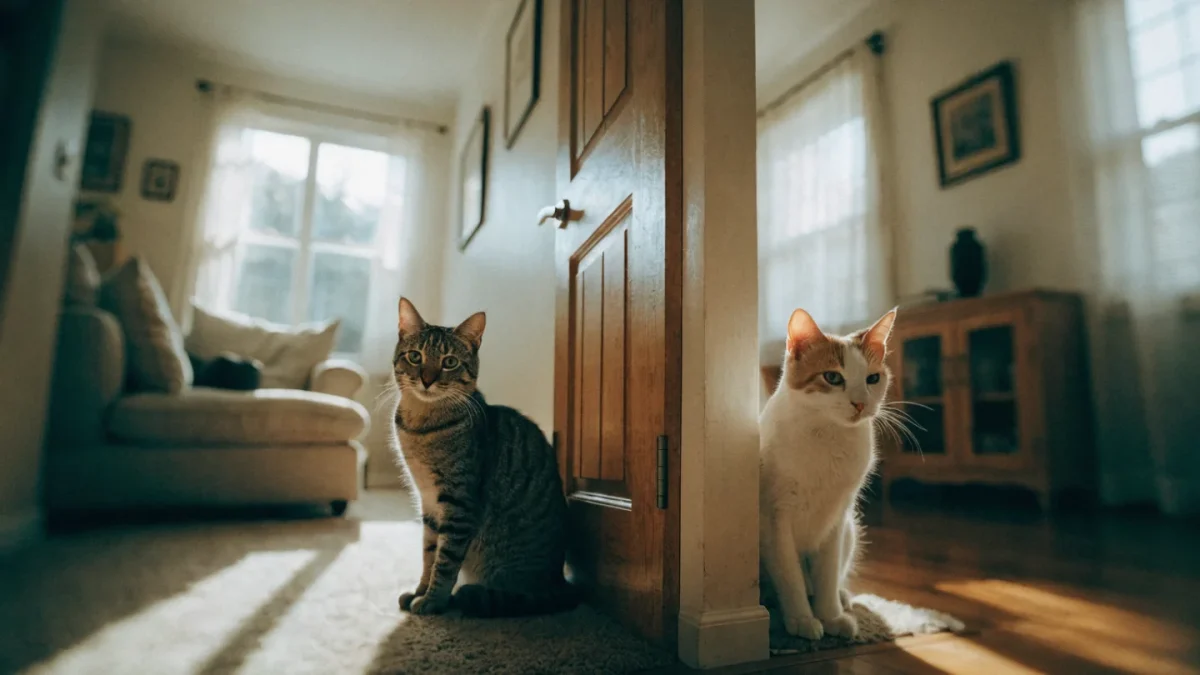
Here's what's actually going on when a cat introduction falls apart: it didn't fail at the moment the cats first saw each other. It failed two weeks earlier, when someone decided the timeline was moving too slowly and opened the door early. There's a whole layer to this I cover in introducing cats to other pets.
The slow pet introduction method isn't popular because it's fun. It's popular because it's the only thing that reliably works. And once you understand why it works, the timeline stops feeling arbitrary and starts feeling like common sense.
Your Cat's Brain Doesn't Do "Fine, Whatever"
Cats are territorial in a way that's easy to underestimate when you're looking at a fluffy animal napping in a sunbeam. Their territory isn't just space — it's scent. Every room, every piece of furniture, every sleeping spot carries a chemical signature that tells your resident cat "this is mine, this is safe, this is home." A new animal's smell doesn't just register as unfamiliar. To a cat, it registers as intrusion.
That's not a personality flaw. That's millions of years of hardwiring telling them that an unknown animal entering their marked territory is a threat until proven otherwise.
The slow introduction method works by giving your resident cat (and the newcomer, who's equally stressed) a chance to revise that threat assessment gradually, through information they actually trust: scent, then sound, then limited visual, then supervised contact. By the time the first real meeting happens, both cats have already been processing each other's existence for days or weeks. The novelty shock is mostly gone.
Skip those stages and you're throwing two strangers into a room and expecting them to shake hands.
The Stages and Why Each One Matters
Stage One: Separate Spaces, Shared Air
The new cat gets a room of their own — ideally with a door that has a small gap at the bottom. This is not just about giving the new cat time to settle, though that matters too. It's about beginning the scent exchange passively.
Both cats can smell each other under the door without any pressure to react. There's no visual stimulus triggering defensive posturing. Just: there's something new in the air. Over days, that new scent becomes baseline. Normal. Not alarming.
Honestly, this phase feels like nothing is happening. That's the point.
Stage Two: Active Scent Swapping
Once both cats are eating normally and behaving calmly in their respective spaces — usually after several days to a week — you start actively swapping scent. This means rubbing a soft cloth on one cat's face and cheeks (where the friendly scent glands are) and leaving it near the other cat's food bowl or favorite resting spot.
The food association is intentional. Cats pair scent with experience. If the new cat's smell keeps appearing near something pleasant — food, a treat, a comfortable bed — the resident cat starts forming a different emotional category for it. Not threat. Just… neighbor.
This is the stage most people either rush through or skip entirely. Don't.
Stage Three: Visual Contact Without Physical Access
After successful scent swapping — both cats eating near the door, no hissing, no hiding — you move to visual introductions. A baby gate, a cracked door, a screen door if you have one. They can see each other. They cannot reach each other.
Watch what happens. Some cats will be immediately curious. Some will posture. Some will just walk away like the whole thing is beneath them. All of those are workable. What you're watching for is sustained escalation — sustained hissing, growling, or either cat refusing to eat or use their litter box. That's a sign you moved too fast and need to back up a stage.
A brief hiss and then both cats going about their day? That's fine. That's basically a cat saying "noted" and moving on.
Stage Four: Supervised Face-to-Face
This is the one people rush to. It should only happen after stage three has gone well for several days minimum — and for cats with big personalities or a history of aggression, potentially weeks.
The first meeting should be short. Fifteen minutes. Distracted with play or treats. Positive associations layered on top of the visual familiarity they've already built. If it goes badly, separate and go back a stage. If it goes well, slowly extend the sessions.
Understanding how to introduce a new cat to your resident cat as a full process — not a single event — is the shift that makes everything else make sense.
The Real Question Is Why People Rush
Look, I get it. You brought home a new cat and you want them to be friends. You want your resident cat to love this small creature you've already fallen for. You want to believe that if you just let them figure it out, they'll be fine.
Sometimes they are fine. Occasionally two cats meet and immediately start grooming each other and you look like a genius. But that's not a method. That's luck, and it's rarer than the success stories on the internet make it seem.
The real question isn't whether the slow method will work. It almost always does. The real question is whether you can tolerate feeling like nothing is happening when something important actually is. The full breakdown of introduce a cat to a dog is worth your time if this caught your attention.
My own cats — Biscuit and the newer addition, Miso — took four and a half weeks before their first supervised meeting. Four and a half weeks of scent cloths and baby gate sessions and me second-guessing every single stage. The first face-to-face was completely anticlimactic. Biscuit sniffed Miso's face, Miso sat very still like a polite houseguest, and then they both went to opposite sides of the room and took naps.
Was it worth it? Obviously. Do I wish I'd known going in that "anticlimactic" was the goal? Yes.
Signs You're Moving Too Fast
A few things to watch for that tell you to slow down before you end up having to start over:
Either cat stops eating. Stress suppresses appetite. If your resident cat is skipping meals or your new cat has stopped eating in their room, that's a sign the introduction is moving faster than they can process.
Prolonged hiding. A day of hiding when a new cat arrives is normal. Two weeks of hiding is the new cat telling you the environment feels unsafe.
Redirected aggression. Your resident cat starts scratching furniture, attacking your ankles, or picking fights with other pets. This is overflow stress looking for an outlet.
The hissing isn't decreasing. Hissing on first visual contact is expected. If it's just as intense a week later with no improvement, something about the pace isn't working.
Any of those signals means pause and re-evaluate, not push through.
How Long Does This Actually Take?
The honest answer: longer than you want and shorter than you fear.
For two cats with no history of aggression or trauma, the full process — from arrival to comfortable cohabitation — typically takes several weeks. For cats with prior negative experiences with other animals, it can take several months.
The timeline isn't a failure if it's long. It's information about what those specific cats need. Some cats are immediately curious about newcomers. Some cats are territorial in a way that takes real time to soften. Both are normal. Both are manageable with patience.
The mistake isn't taking too long. The mistake is deciding that the cats should be over it by now, and making decisions based on your timeline instead of theirs.
FAQ
How do I know when it's safe to move to the next introduction stage?
Move forward when both cats are consistently calm at the current stage — eating normally, not hiding, and showing curiosity rather than sustained defensive behavior. There's no fixed day number because cats vary so much. The behavioral cues are more reliable than any calendar.
What if my resident cat is still hissing weeks into the introduction?
Back up a stage and slow down. Sustained hissing after weeks of scent exposure often means the cats need more neutral positive experiences associated with each other's scent before moving to visual contact. Try feeding them on opposite sides of a closed door so the other's smell is consistently paired with something good.
Can I do a slow introduction with a dog and a cat?
Yes, and many of the same principles apply — scent before sight, sight before contact. The key difference is that dogs are generally easier to manage spatially (leash, crate) during supervised meetings, which gives you more control over how visual introductions unfold. The cat usually drives the pace: when the cat approaches voluntarily, things are going well.
Is it possible to redo an introduction if the first meeting went badly?
Absolutely. A bad first meeting isn't permanent damage. Separate, go back to scent swapping, give both cats time to de-stress, and start the visual stage again from scratch. Cats that had a terrible first encounter can still become tolerant housemates — and occasionally friends — with a proper reset and more time.