

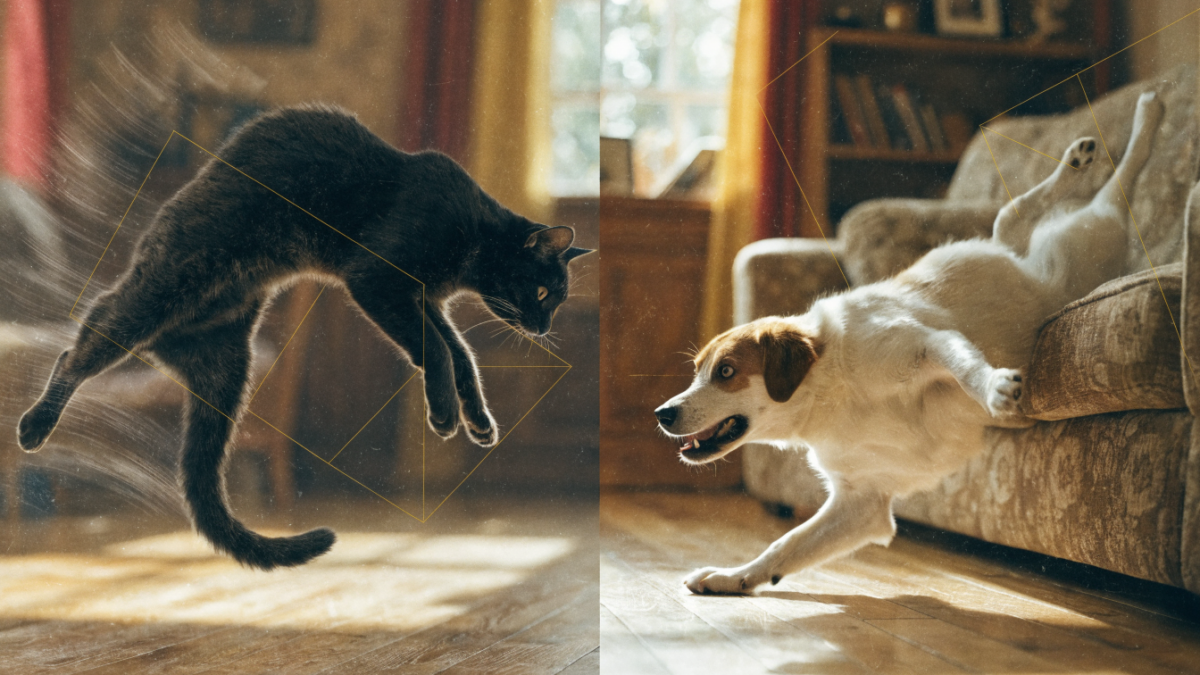
Suki, my senior rescue tabby, has a flair for the dramatic. Last week, she decided to sleep on the highest shelf in my living room, lost her footing, and tumbled a solid five feet to the floor. She landed perfectly on all four paws, gave me a look that clearly said, “I meant to do that,” and trotted off to yell at her empty food bowl. A few days later, my dog, Barnaby—a lovable mutt with zero spatial awareness—tried to leap onto a low ottoman, misjudged the distance entirely, and landed on his side with a spectacular thud. He was fine, albeit deeply embarrassed, but the contrast was wild.
It’s a tale as old as time: cats fall with the grace of Olympic gymnasts, and dogs fall like a sack of potatoes. But this difference isn’t just about feline superiority or canine clumsiness. It’s a fascinating mix of anatomy, evolutionary history, and some truly mind-bending physics.
The Anatomy of an Acrobat
To understand why cats pull off these mid-air acrobatics, we have to look under the hood. Suki isn’t just flexible; she is essentially built like a furry noodle.
Cats possess an exceptionally flexible spine, boasting up to 53 vertebrae compared to a human’s 33. Throw in a lack of a rigid, functional collarbone—basically, their clavicles are just tiny, free-floating bones buried in muscle—and you have an animal with a shockingly loose, fluid skeletal structure. This anatomy is exactly what allows Suki to squeeze into impossibly small boxes and, more importantly, twist herself into a pretzel in mid-air.
The Built-In Gyroscope
The trigger for this acrobatics show happens before the cat even realizes it’s falling. Deep inside a cat’s ear is the vestibular system, a tiny, highly sensitive apparatus that acts like an internal gyroscope.
The millimeter Suki’s paws slip off that shelf, her vestibular system instantly detects which way is up. It works so fast that her eyes barely have time to process the information. This reflex is wired into their biology incredibly early. By the time a kitten is 3 to 4 weeks old, the righting reflex starts to kick in, and it is fully perfected by 6 to 7 weeks.
Defying Physics (Or Just Bending the Rules)
Here is where things get controversial. Back in the 1890s, French scientists looked at falling cats and were legitimately spooked. According to the strict laws of physics—specifically the conservation of angular momentum—a rigid object dropped without any rotational force should not be able to spin in mid-air. If a cat starts falling feet-up, it should stay feet-up. Period.
These scientists literally argued that cats were defying the laws of physics. This mystery [1] like James Clerk Maxwell and George Gabriel Stokes, who were known to drop cats onto beds and tables just to see what would happen. (Nineteenth-century scientists had a lot of time on their hands, apparently.)
It took decades and the invention of high-speed photography to prove that cats are sneaky rule-benders, not rule-breakers. They don’t act as a single rigid object. Instead, they [2] and execute a move physicists lovingly call the “bend and twist.”
First, they tuck their front legs in super tight, making their front half narrow, while extending their back legs straight out. Then, they twist their front half to face the ground. Because the front is tucked in (reducing the moment of inertia) and the back is extended (increasing it), the front half spins fast while the back half barely moves. Then, they reverse it: they shoot their front legs out, tuck their back legs in, and twist the back half to catch up.
They do this incredibly fast, completely legally under the laws of physics, by constantly changing their body shape. It’s brilliant.
Why Dogs Just Go Thud
So, why couldn’t Barnaby execute a similar maneuver when he face-planted off the ottoman? I’ll leave the complex dog training to the experts, but the physics of a falling dog is pretty straightforward.
Dogs just don’t have the hardware for the bend-and-twist. Their spines are stiffer, their center of gravity is higher, and they have actual, rigid collarbones connecting their shoulders to their skeleton. While some exceptionally athletic [3] in a fall, their heavier frames prevent them from pulling off that rapid, split-body rotation.
When a dog falls, they generally stay in whatever orientation they started in. They can’t create the extreme physical contrast between their front and back halves to twist around. They fall like normal, gravity-bound mammals.
Terminal Velocity and the High-Rise Paradox
Now, you might have heard a terrifying but fascinating statistic about something called “High-Rise Syndrome.” A famous 1987 study by the Animal Medical Center in New York found that cats falling from higher floors (above seven stories) sometimes suffered fewer injuries than cats falling from lower floors (two to seven stories).
The physics behind this come down to terminal velocity. Because cats are lightweight and wonderfully fluffy, they create a lot of drag. Their terminal velocity—the maximum speed they can fall—is only about 60 mph. Humans, by contrast, fall at a brutal 120 mph.
When a cat passes the seventh floor, they hit that 60 mph maximum. Once they stop accelerating, their inner ear senses the lack of acceleration, and the cat stops panicking. They literally relax, spread their limbs out like a flying squirrel to maximize drag, and brace for impact. This relaxed, spread-out posture distributes the force of the impact and reduces internal injuries.
However, before you start thinking cats have cheat codes for gravity, modern researchers point out the survivorship bias of that 1987 study. Cats that tragically died instantly from extreme falls were never taken to the vet, meaning they weren’t counted in the statistics. Even with a flying-squirrel pose, extreme falls can completely shatter a cat’s legs and jaw.
Every summer, veterinary associations everywhere issue warnings about this. Cats are not invincible. If you live above the ground floor—anywhere in the world—please install proper window screens. Suki might be a physics genius, but I’m not trusting her life to her reflexes.
From Leopards to Lunar Landers
This incredible righting ability isn’t just a quirky domestic cat trick. It’s a shared superpower across the feline family. Wild big cats, like leopards and lions, use the exact same bend-and-twist mechanism. It’s an evolutionary adaptation developed for navigating steep, rocky terrains and tumbling out of tall trees while escaping predators or chasing down dinner.
Incredibly, humans are now learning from them. Modern roboticists and physicists are currently studying the cat’s air-righting reflex to design better self-righting robots, stabilize tumbling drones, and develop safer spacecraft landing mechanisms. We are literally building machines modeled on Suki’s living room mishaps.
Ultimately, the way our pets interact with gravity is a beautiful reminder of how perfectly tuned they are to their environments. Barnaby was bred to run, track, and fetch, so it makes sense that his heavy, powerful frame isn’t meant for mid-air pirouettes. Suki was built to climb, pounce, and survive the occasional miscalculated leap. Understanding the wild physics happening right in our living rooms makes me appreciate both of them—even when one of them is thudding ungracefully onto the rug.
Sources
- baffled brilliant minds — petbook-magazine.com
- split their body into two halves — youtube.com
- dogs might partially right themselves — quora.com