

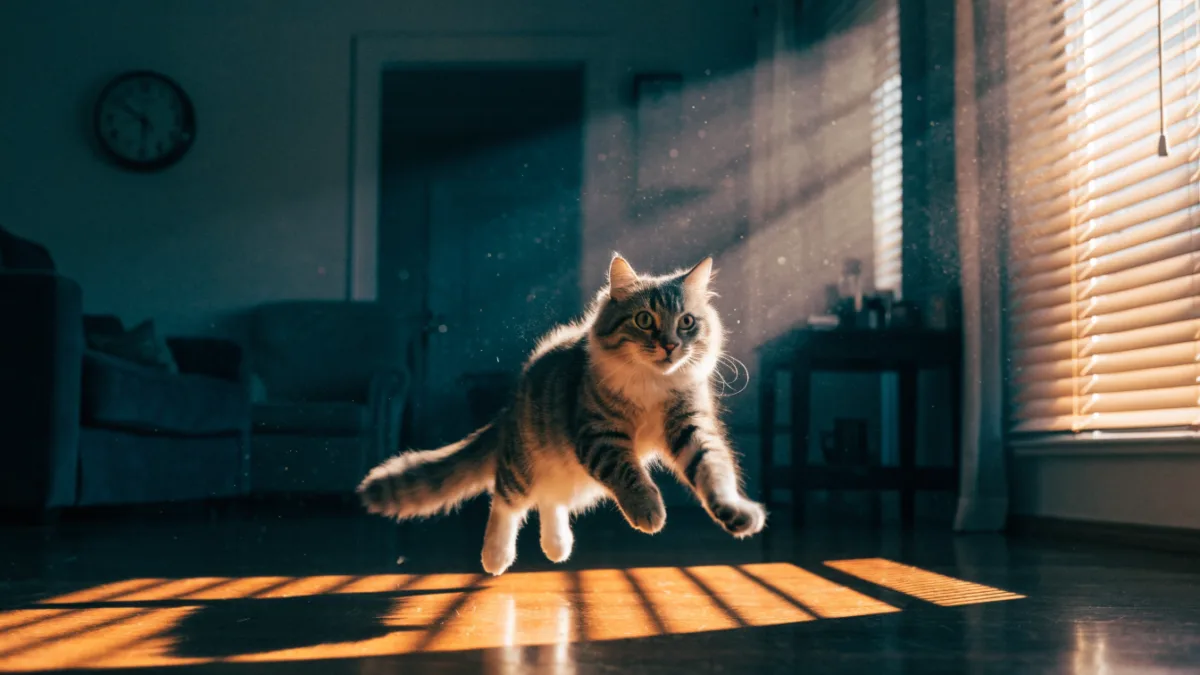
It is 5:00 AM. You are dead asleep, enjoying the best rest of your life, when suddenly a nine-pound fur missile launches directly onto your sternum. Or maybe it is 7:00 PM, you just sat down on the couch to relax, and your cat suddenly decides the living room is an Olympic track. They are bouncing off the sofa, chasing invisible ghosts, and acting like they’ve lost their minds.
If you are like most people, you probably mumble something about your pet being nocturnal. I used to think the exact same thing. I spent years assuming that cats were simply creatures of the night, hardwired to wake us up at the crack of dawn because they were basically tiny vampires. I was completely wrong. Your cat is not nocturnal. Dogs don’t operate this way either. The behavior you are seeing is driven by a fascinating, deeply ingrained biological rhythm. It is time to learn the crepuscular truth.
The Crepuscular Truth: Busting the Nocturnal Myth
Here is the deal: cats are neither nocturnal (awake at night) nor diurnal (awake during the day). They are crepuscular. In zoology, a crepuscular animal is one that is primarily active during the twilight hours. That means their internal engines naturally rev up right around dawn and again right at dusk.
This biological reality is a hardwired legacy from their wildcat ancestors. Millions of years of evolution didn’t program domestic cats to hunt at high noon when the sun is blindingly hot, nor in the pitch black of midnight. It programmed them to move when the light is low, the temperatures are moderate, and the hunting is absolute prime time.
Within the scientific world, crepuscular behavior actually breaks down into two highly specific sub-categories. Depending on the individual animal, their environment, or the specific prey they are hardwired to hunt, they might lean heavily into one of these two windows:
- Matutinal: Animals that are active specifically around the early morning dawn hours.
- Vespertine (or Vespertinal): Animals that are active specifically around the evening dusk hours.
When you understand this timeline, your pet’s behavior suddenly makes perfect sense. They are not trying to ruin your morning sleep or your evening wind-down. They are simply answering an ancient, biological call to the hunt that happens to perfectly align with the worst possible times for your modern human schedule.
The Hunter’s Advantage: Why Evolution Chose Twilight
To really understand why your cat gets the zoomies at dusk, you have to look at what their ancestors had to do to survive. Dawn and dusk are dangerous times in the wild. It is the transition period. Diurnal animals—like many birds and rodents—are frantically trying to find a safe place to sleep for the night or groggily waking up in the morning. Nocturnal animals, like mice and certain insects, are just starting to stir.
This massive overlap of waking and sleeping creatures creates a perfect hunting buffet for a predator. But there is a catch. To catch this prey, a wildcat needs an evolutionary advantage in low-light conditions.
Think about the physical makeup of a cat. Their eyes are absolute marvels of natural engineering. Felines possess a specialized layer of tissue in the back of their eyes called the tapetum lucidum. This layer acts like a mirror, reflecting visible light back through the retina. This is exactly why a cat’s eyes seem to glow eerily when you hit them with a flashlight or car headlights in the dark. It is also why they need only a fraction of the light humans do to see clearly.
In the dim light of dawn and dusk, a cat’s vision drastically outperforms their prey. They become the ultimate ambush predators. So, when your domestic housecat starts intensely staring at the wall or chirping at a bird outside your window at 6:00 AM, it is not random. Their pupils are dilating, their muscles are tensing, and their instincts are screaming at them to stalk something in that perfect twilight lighting.
The 5:00 AM Zoomies and What to Do About Them
Because of this natural, crepuscular rhythm, indoor cats naturally experience a massive spike in energy at dawn and dusk. In the wild, this energy is immediately burned off by chasing, hunting, and catching food. In a climate-controlled apartment? It turns into the infamous “zoomies.”
I remember talking to a buddy of mine who was at his absolute wit’s end with his cat, Leroy. Every single morning, like clockwork, Leroy would start screaming outside the bedroom door at 4:45 AM. My buddy tried ignoring him. He tried putting Leroy in another room. He was exhausted, frustrated, and frankly, a little resentful. I told him the hard truth: Leroy wasn’t being a jerk. Leroy was a crepuscular predator with a massive amount of pent-up energy, a full food bowl, and absolutely nothing to do with it.
When an animal has pent-up energy, it always finds an outlet. If you don’t give them an appropriate one, they will invent one—like body-slamming your bedroom door at dawn.
Aligning Play and Feeding with Their Internal Clock
If you want to survive life with a crepuscular pet, you have to stop fighting their biology and start managing it. You can use their natural rhythm to your advantage. Here is exactly what I told my buddy to do with Leroy, and it completely changed their household.
First, you need to initiate a heavy-duty play session right before you go to bed. I am not talking about casually dangling a string while you watch Netflix. I mean a focused, ten-to-fifteen-minute session with a wand toy that mimics a bird or a mouse. Make your cat run, jump, and stalk until they are panting.
Once they have successfully “caught” the toy and burned off that evening energy spike, immediately feed them a meal. You are mimicking the natural hunting sequence: stalk, catch, eat. A cat with a full belly after a hard workout will naturally want to groom and sleep. This dramatically reduces the chances of them waking you up at dawn.
For that morning matutinal energy spike, you have a few options. If you wake up early, make that the time for their biggest play session and morning meal. But if you want to sleep in? Invest in an automated puzzle feeder or a motorized toy. Set the timer for 5:00 AM. When the dawn energy spike hits, your cat has something to hunt and eat that does not involve pouncing on your face. Modern veterinary behaviorists heavily emphasize this kind of environmental enrichment. Accommodating their natural hunting instincts while you sleep is a game-changer.
Can You Actually Change Their Clock?
There is an ongoing debate among pet owners and animal behaviorists about just how flexible this circadian rhythm really is. How strict is this biological clock?
The truth is, there is a lot of adaptability in domestic animals. While cats are hardwired to be crepuscular, they are also highly intelligent survivors. Indoor cats often adapt their daily schedules to match their owners’ diurnal lifestyles. If the house is dark, quiet, and completely boring at 3:00 PM, your cat will probably take a nap. They learn when the household is active and adjust their secondary sleep cycles to be awake when you are home and interacting with them.
However—and this is the crucial part—you can never fully erase millions of years of evolutionary programming. You can blur the lines between crepuscular and diurnal behavior based on your household environment, but that underlying drive at dawn and dusk will always be there. You are managing the instinct, not deleting it. Accepting that reality makes life with a pet infinitely less frustrating.
Understanding the crepuscular nature of our pets gives us a profound appreciation for their wild roots. The domestic cat sitting on your laptop today is genetically just a whisker away from the wildcats still roaming the forests of Europe and Asia. In fact, understanding their ancient biology is key to helping those wild ancestors survive. True wildcats, like the critically endangered Scottish wildcat, rely entirely on those dawn and dusk twilight hours to hunt and avoid human contact. When we protect natural habitats and respect the delicate balance of these twilight ecosystems, we ensure that the ancient, wild spirit of the hunter—both in the deep woods and in our living rooms—continues to thrive.