

My cat Mochi destroyed a linen armchair in her first month with me. Not scratched — excavated. I came home to what looked like a snow globe had gone off in the living room, with her sitting in the middle of the debris, visibly proud of the renovation. And even standing there picking fabric confetti out of my coffee, declawing never crossed my mind. Not because I’m a saint — because I know what the word actually means, and once you know, you can’t unknow it.
First, the Uncomfortable Anatomy Lesson
Your cat’s claw isn’t a free-floating fingernail. It’s anchored to the last bone of each toe — the third phalanx, if you want the technical term. To “remove” the claw, a veterinarian has to amputate that entire bone, along with the tendons and ligaments attached to it. The closest human equivalent isn’t a manicure. It’s having each finger cut off at the last knuckle.
It sounds like a trim. Anatomically, it’s an amputation — ten of them, for a standard front-paw procedure.
This isn’t fearmongering; it’s the documented record. When researchers X-rayed declawed cats for a study in the Journal of Feline Medicine and Surgery, most had leftover bone fragments sitting in the tissue of their paws — sometimes for years. Other documented complications include nerve damage, infection, regrown deformed claws, and lameness. A separate 2017 study found declawed cats were more likely to show back pain and litter-box avoidance, likely because they shift their weight backward off tender toes, and granular litter on surgical paws is, understandably, a problem.
Which is why the procedure is banned or heavily restricted across dozens of countries — the UK, most of the EU, Australia, New Zealand, Israel, Brazil — and why New York outlawed elective declawing in 2019, with Maryland following in 2022. The American Veterinary Medical Association discourages it as anything other than a last resort. In one [1] I read, an owner asked for declawing referrals and discovered, mid-conversation, that the procedure is illegal where she lives. The awareness gap is real, and it’s not a moral failing — the word “declawing” is doing a lot of cover-up work. (There’s also a “softer” surgery sometimes pitched called a tendonectomy, but it still requires nail trims for life and is banned under many declaw laws. Skip that one too.)
How to Trim Cat Nails Without Starting a War
Here’s the good news: blunt claws do almost no damage. A nail trimmed every two to four weeks can’t gut a couch the way a needle-sharp hook can. Trimming is the cheapest, fastest alternative, and it’s learnable even if your cat has strong opinions about being handled. Mochi once screamed during a trim attempt so dramatically that my neighbor texted to ask if everything was okay. We’re fine, Sharon.
What You Need
- Clippers actually made for cats — scissor-style or guillotine-style, whichever feels better in your hand
- Styptic powder, for the rare nick
- Treats. Non-negotiable. Treats are the entire training program.
- A towel, in case things go sideways
The Technique
Take one paw and gently press the top of a toe pad — the claw extends on its own. You’ll see the sharp, translucent curve at the tip, and a pink area closer to the toe: that’s the quick, and it holds blood supply and nerve. Trim only the sharp tip, well clear of the pink. If you do catch the quick, dab on styptic powder, forgive yourself, and give a treat anyway. Back claws grow slower and stay blunter from wear, so most people do those less often. And if the whole enterprise makes you nervous, ask your vet to demo it once — most clinics and groomers will also do trims for a modest fee, which is a completely legitimate life choice.
Winning Over a Skeptical Cat
Don’t open with clippers. Spend a few days just touching your cat’s paws while handing out treats, so paws-plus-good-things becomes the association. Then graduate to one nail per session. One. Quit while you’re ahead — ending on a cooperative note buys you an easier session tomorrow. For genuinely resistant cats, the towel wrap works: swaddle the body burrito-style, one limb out at a time. Some cats find this more insulting than the trim itself. Mochi went from Oscar-caliber tragedy performances to tolerating full pedicures in about six weeks, purely through snack-based diplomacy.
Vinyl Nail Caps: The Manicure Option
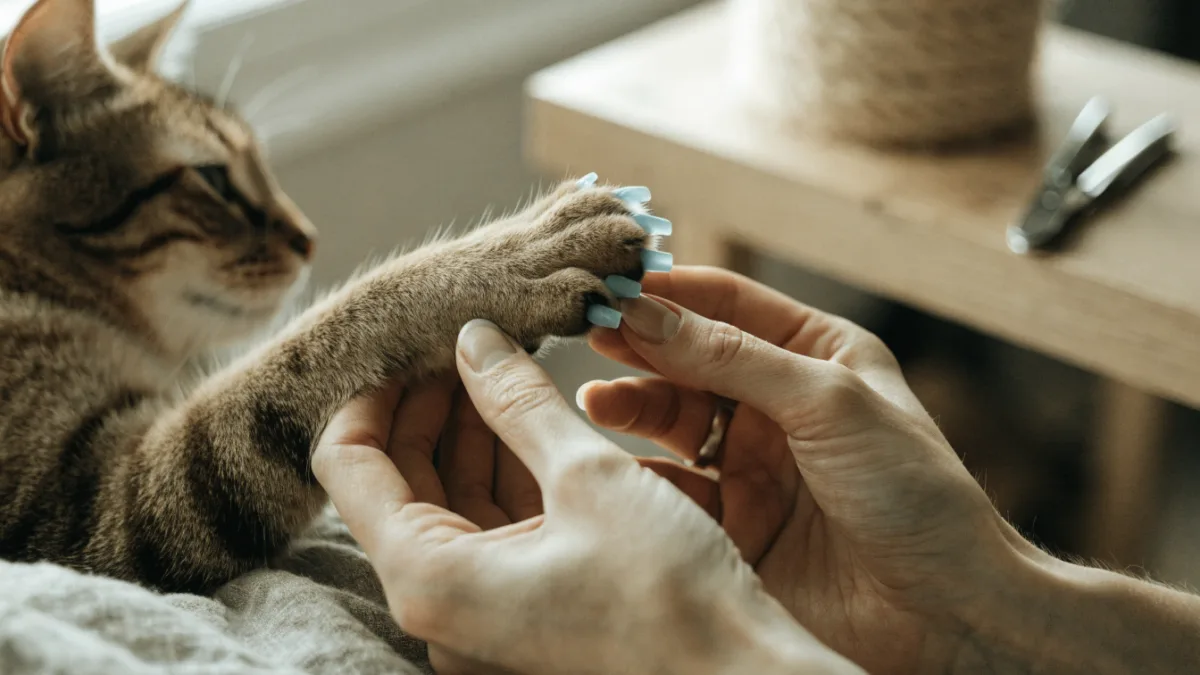
If trimming isn’t enough, soft vinyl nail caps are the middle path — you’ve probably seen them sold under brand names like Soft Paws. They’re little blunt caps glued over each trimmed nail with non-toxic adhesive, sized from kittens to large adults, in colors if you want your cat to have highlighter-pink toenails. They stay on about four to six weeks, then shed naturally as the nail grows out, and you reapply. The cat keeps every scratching behavior — the stretch, the motion, the whole routine — but the tips can’t do damage.
Honest cons, because there are some: application has a learning curve (my first attempt glued a cap to my own thumb, which the internet assures me is a rite of passage), some cats pop caps off within days, and you still have to trim the nails first. The [2] positions caps as the fallback for harder cases, and that matches what I’ve seen — for most cats, training to a scratch post does the job, and caps catch the exceptions. Like Kevin, a foster kitten whose idea of recreation was using my legs as a climbing wall. Caps solved Kevin. My calves remain grateful.
Scratch Surfaces: Location, Location, Location
Scratching isn’t misbehavior — it’s maintenance. Cats scratch to shed dead nail sheaths, to mark territory with scent glands in their paw pads, to stretch their shoulders and back, and to blow off stress. It’s so hardwired that declawed cats keep making the motion on posts for life. You cannot train the instinct out of a cat. You can, however, give it somewhere better to go.
Offer Real Options
Cats have individual preferences — some scratch vertically, some horizontally, some at an angle. Cover your bases: a tall vertical post, a horizontal corrugated cardboard pad, maybe an angled one. Sisal rope, cardboard, carpet, bare wood — different cats want different textures, and cardboard scratchers cost about as much as a fancy coffee. Two non-negotiables: the post must be tall (at least 32 inches, so an adult cat can get a full overhead stretch) and stable. Wobbliness is the single most common reason cats reject a post — would you stretch against a wall that lunged at you?
Placement Is Everything
Banishing the post to the far corner is a classic mistake. Cats scratch where life happens:
- Right next to the furniture they’ve been working on — you’re offering an upgrade, not a commute
- Near favorite sleeping spots, because cats scratch when they wake, the way we stretch
- At room entrances and territory edges, where scent-marking matters most
Rub the post with catnip or silvervine, or use a scratch-attractant spray. On the off-limits furniture, double-sided sticky tape or furniture guards make the target unappealing. Then redirect, every time — lure the cat to the post when they go for the couch, and celebrate when those claws hit sisal.
What Doesn’t Work
Punishment. A spray bottle doesn’t teach a cat that scratching is wrong; it teaches them you’re scary and that scratching is now a covert operation. The behavior goes underground and the trust takes the damage. The behaviorists and the owners in [3] land in the same place: redirect, don’t punish.
When It’s Not About the Couch at All
Scratching spikes with stress — a new pet, a move, a stray cat parading past the window. If your cat’s scratching suddenly escalates, ask what changed. Pheromone diffusers can take the edge off, more vertical territory (cat trees, shelves) reduces squabbles over space, and a couple of hard daily play sessions burn off energy that would otherwise go into your baseboards. One caveat: if the change is sudden or your cat seems off in other ways, check with your vet before assuming it’s purely behavioral.
There’s an argument that surfaces in every one of these debates — better declawed than surrendered. I take it seriously, and I’d never lecture someone standing at the end of their rope. But the evidence says the combination above succeeds in the overwhelming majority of cases: trims, the right surfaces in the right places, and some patience. If you’re stuck, that’s exactly what your vet or a local rescue’s behavior resources are for. One last thought: domestic cats aren’t a wild species with a conservation status, but the songbirds outside your window very much are — and keeping cats indoors, claws intact and with proper outlets, is one of the best things we can do for both. My replacement couch has survived two years and counting. Mochi kept all ten of her front toes. The birds kept their birds.
Sources
- Facebook thread — facebook.com
- Anti-Cruelty Society's alternatives guide — anticruelty.org
- this Reddit thread — reddit.com