

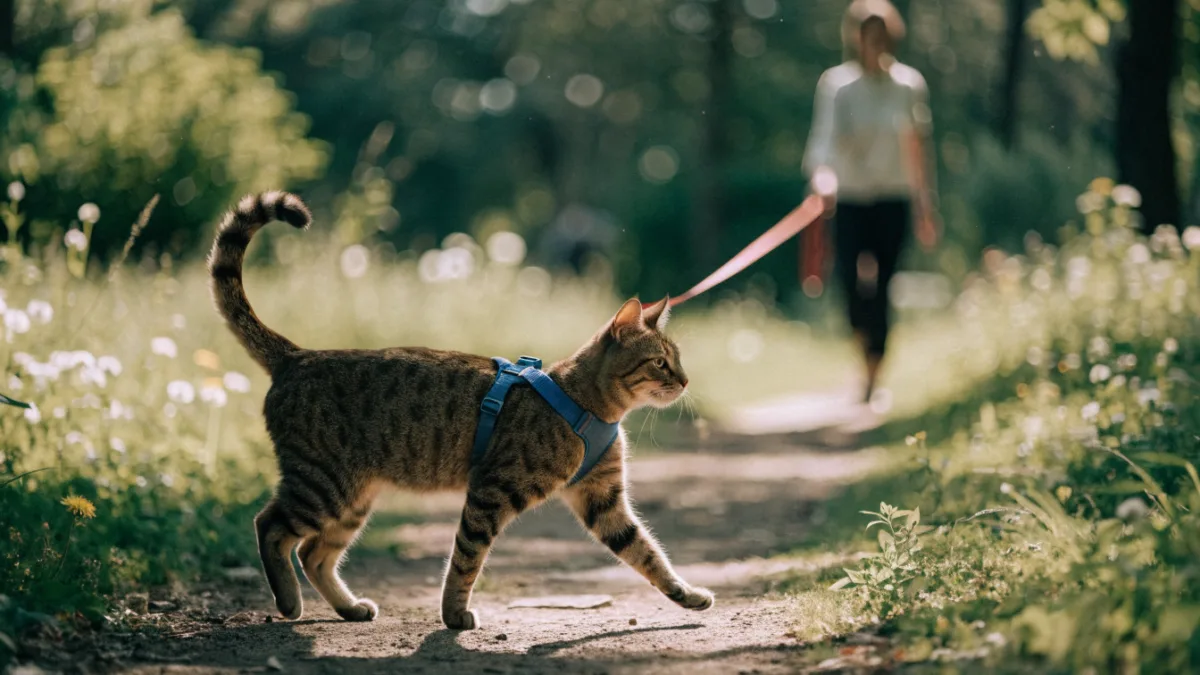
I used to think leash training a cat was just dog training with more complaining. Then a client adopted Olive, a two-year-old shelter cat, and asked me to help turn her into the adventure cat she’d been scrolling past on Instagram. Olive had other ideas. For the first week, her idea was to fall over sideways every time the harness came out. Six weeks later she was sniffing her way down the apartment hallway like she paid rent there. Same cat. Different approach — one where Olive set the pace and I stopped treating her like a small, judgmental dog.
If you’re an apartment dweller wondering whether any of this is possible with your cat, the short answer is yes. The longer answer is that walking a cat looks nothing like walking a dog, and the faster you accept that, the better this goes.
Can You Walk a Cat? Yes — Just Not the Way You Think
Yes, you can walk a cat, and kittens are not a prerequisite. Olive was two when we started, and plenty of adult cats take to a harness just fine. The catch is the word “walk.” When,[1] the framing matters: a leash walk with a cat isn’t a structured outing where the cat strolls beside you. It’s supervised exploration. The cat leads. You follow.
The harness is a last line of defense, not a steering wheel.
That’s the mental shift that changes everything. Dogs learn to yield to leash pressure — a dog feels tension and slows down. A cat feels tension and either ignores it completely or loses her mind. Your cat never fully understands that the leash exists. The harness exists so that if a garbage truck backfires and she bolts, she doesn’t vanish. That’s it. That’s the whole job.
So why bother? Because indoor life is genuinely safer — indoor cats commonly live 10 to 15-plus years, while free-roaming cats average closer to 2 to 5 — but safe can slide into boring, especially in a small apartment. Leash time is a middle path: real smells, sunshine, grass under paw, with you standing between your cat and the road.
Why Some Cats Thrive and Others Prefer the Balcony View
Confidence and early experience predict success better than age does. The socialization window — roughly two to seven weeks of age — is when kittens form their baseline opinion of the world. Kittens gently exposed to harnesses, carriers, and new textures during that window often take to outdoor life like they were born for it. But it’s not destiny. Breed tendencies are real too: Bengals, Abyssinians, and Maine Coons have a well-earned reputation as adventure cats, though I’ve met mellow tabbies who loved walks and one Bengal who wanted absolutely no part of it. Individual cats are individuals.
Another client of mine had a cat named Miso who froze at every open door. After a month of honest effort, they scrapped the leash plan, built a window-box catio, and Miso is now the happiest cat on the block — from behind a screen. Some cats want the world. Some want a better view of it. The,[2] all make the same point: progress follows the cat’s comfort level, never the calendar. If your cat tells you she’s a balcony cat, listen. Window perches, catios, backpacks, and strollers deliver enrichment without a leash.
Get the Gear Right Before Anything Else
Rule one, no exceptions: the leash attaches to a harness, never a collar. Cat necks and tracheas are delicate, and cats back out of collars with embarrassing ease. Every trainer and vet I’ve ever talked to about this agrees.
What to look for in a harness:
- Vest-style: covers more body, harder to wriggle out of, good for beginners and escape artists
- H-style: lighter and more adjustable, better for cats who hate the feeling of coverage
- Jacket-style: maximum coverage and security, warmer for cool-weather outings
Whichever style you pick, look for adjustable straps at both the neck and girth, plus double closures for escape resistance. Then use the two-finger rule: you should be able to slide two fingers under any strap, but not three. And recheck the fit before every single outing — cats gain and lose weight, and a panicking cat can back out of yesterday’s perfect fit.
On leashes: this is a genuine debate. Some trainers love retractable leads because cats explore in bursts and hate being tethered to your pace. Others point to tangles, sudden jerks, and slow recall when a dog rounds the corner. My take — start with a fixed 4-to-6-foot leash, graduate to a retractable in open, low-risk areas once your cat is solid. Carry a backup leash either way.
Cat Harness Training, Step by Step
This is roughly the path Olive and I took. Expect each step to take days to weeks depending on the cat. There is no schedule. There are only thresholds.
Step 1: Make the Harness Boring
Leave it next to the food bowl. Drape it over her favorite sleeping spot. Toss a treat every time she sniffs it. You’re waiting for the day the harness is just furniture.
Step 2: Short Wearing Sessions
Seconds at a time, literally. Buckle it on, scatter treats on the floor, take it off. If she falls over like Olive did, keep the session even shorter and try again tomorrow. The golden rule: remove the harness before she fusses, never after. Build gradually from seconds to minutes to a whole evening.
Step 3: Attach the Leash Indoors
Let it drag behind her under supervision. Then hold it loosely and follow her around the apartment. This is where dog people like me have to unlearn everything — tension means panic, so if she pulls toward the couch, you go to the couch. You are the caboose. Accept it.
Step 4: Door Manners
Before any outdoor plans, teach her to wait at the threshold: door opens, she sits, she gets a treat, she’s released with a cue. A cat who bolts at the sound of the door knob is a genuine safety problem, and this one habit prevents it. Some people also carry their cat outside or use a backpack so the front door never becomes a trigger.
Step 5: The First Outdoor Session
Pick somewhere quiet, enclosed, and low-traffic — a courtyard at 7 a.m., not a busy sidewalk at noon. Expect her to lie down next to the door and sniff for ten minutes. That is the walk. Keep the first few sessions under 15 minutes, always carry an exit plan (a carrier, backpack, or even a towel to wrap her in), and end on a win. There are entire online communities, [3] trading first-outing stories — reading a few will recalibrate your expectations fast.
Safety, Stress Signals, and Knowing When to Call It
Before the first outing, a vet visit. Outdoor cats run into pathogens and parasites that indoor cats don’t, so you want:
- Current vaccinations
- Flea, tick, and parasite prevention
- A microchip with up-to-date registration
- An ID tag on the harness itself
Out there, never tie a cat out unattended — not for a minute. Watch for dogs and pick her up early rather than late. And learn the stress signals: flattened ears, tucked tail, freezing, crouching low to the ground, panting. Any one of those means the session is over. No negotiating, no “she’ll settle in a minute.” She won’t. And if weeks of honest effort still leave your cat miserable, that’s not failure — that’s information. Miso’s family heard it, adjusted, and everyone’s happier for it.
One last reason to do this right: free-roaming cats carry a serious ecological footprint. The landmark study in Nature Communications (Loss et al., 2013) estimated that free-ranging cats in the U.S. alone kill somewhere between 1.3 and 4 billion birds and 6.3 to 22.3 billion small mammals every year. A cat on a harness — or in a catio, or on a window perch — gets her enrichment without adding to that tally. That’s the real prize here. Not an Instagram-worthy adventure cat, but a cat whose world got a little bigger on her terms, at her speed, while the songbirds outside stay exactly where they belong.
Sources
- Jackson Galaxy tackles the question of whether you should leash walk your cat — jacksongalaxy.com
- cat harness training guides worth reading — chewy.com
- like this one — facebook.com